
Quick answer: FSVP supplier verification means choosing, performing and documenting activities that give assurance that the hazards requiring a control in an imported food have been significantly minimized or prevented. Under 21 CFR 1.506, the options include onsite audits, sampling and testing, review of the supplier’s food safety records and other appropriate activities. The importer bases the choice and frequency on its evaluation of food risk and supplier performance.
This guide is for food brand owners and supplier development teams that import food into the United States and want consistent verification without wasting effort.
Why verification gets messy as you grow
Fast-growing importers often inherit a mix of audit reports, certificates, test programs and supplier declarations. Usually, nobody has recorded which evidence is needed for which food. As a result, some suppliers get too much attention and others too little.
The rule asks for something more deliberate. Before importing a food, the importer must determine and document which verification activities are needed and how often. That determination must rest on the evaluation of the food and the supplier. In addition, the activities must address the entity that actually controls the hazard.
One rule needs special attention. When the foreign supplier controls a hazard with a reasonable probability of serious adverse health consequences or death, an onsite audit is the default. It is required before initial import and at least annually afterward. An importer may instead use other activities or less frequent audits only with an adequate written determination that they provide adequate assurance.
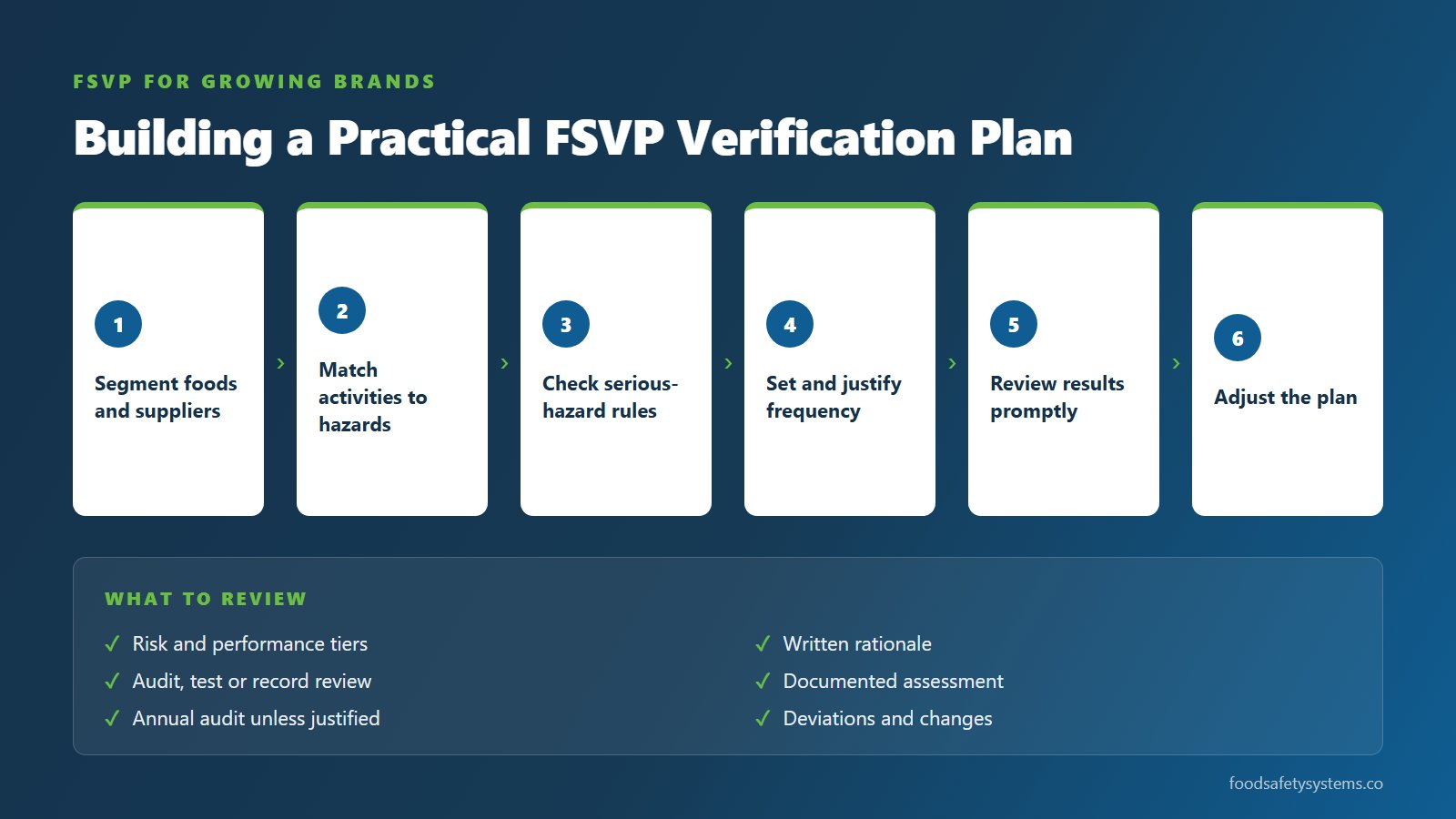
Six steps to practical FSVP supplier verification
1. Segment foods and suppliers by risk and performance
Group supplier-food combinations into tiers. Use the hazards requiring a control, who controls them and the supplier’s track record. This keeps effort proportionate. For the evaluation behind it, see risk-based foreign supplier evaluation.
2. Match activities to the hazards
Choose the activity that best shows the hazard is controlled. For example, an onsite audit can review process controls. Sampling and testing can check for a specific contaminant. A record review can confirm that monitoring happened. Not every certificate is equal evidence, so check what each one actually covers.
3. Apply the serious-hazard rule
Identify any hazard the supplier controls that could cause serious adverse health consequences or death. For those, plan an initial and annual onsite audit, or write an adequate justification for an alternative. Our article on risk-based supplier audit planning covers this in detail.
4. Set and justify frequency
Record how often each activity happens and why. Verification must occur before importing the food and periodically afterward. A realistic schedule that the team can actually keep beats an ambitious one that slips.
5. Review results promptly
The importer must promptly review and assess results and document that review. If results do not provide adequate assurance, take corrective action under 21 CFR 1.508. Unreviewed test reports in an inbox do not count as verification.
6. Adjust the plan when things change
A supplier deviation, a new product or a reevaluation may call for different or additional activities. Track completion, findings and changes so the plan stays current.
Rules that often trip teams up
- You may rely on another entity’s verification activities if you review and assess the results.
- However, the foreign supplier and its employees may not perform verification activities, except sampling and testing.
- Qualified individuals performing verification must not have financial conflicts of interest that influence results.
- Payment must not depend on the results of the activity.
- Written results of certain FDA, other U.S. government or officially recognized foreign authority inspections may substitute for an onsite audit if conducted within one year of the audit due date.
Records to keep
- The written determination of activities and frequency for each supplier and food.
- Onsite audit records: procedures, dates, conclusions, corrective actions and auditor qualifications.
- Test records: food and lot, number of samples, tests and methods, dates, results, laboratory and corrective actions.
- Record review documentation: dates, records reviewed, conclusions and corrective actions.
- Your documented review and assessment of every result.
Records must meet 21 CFR 1.510, including availability to FDA on request.
Example: tiering a supplier portfolio
A frozen-food brand imports from twelve foreign suppliers. After segmentation, three supply ready-to-eat components where the supplier controls a serious pathogen hazard. These receive initial and annual onsite audits by a qualified auditor.
Five suppliers provide ingredients whose main hazard is controlled later by the brand’s own U.S. cook step. For those, the team checks whether 21 CFR 1.507 applies and keeps the documentation that section requires. The remaining four supply lower-risk dry ingredients, where periodic record reviews and testing fit better. Consequently, the brand’s audit budget goes where the risk is highest.
How verification evidence links to FSSC 22000
FSVP is a U.S. importer obligation. FSSC 22000 certification does not satisfy it by itself. Nonetheless, an FSSC 22000 system already monitors purchased materials and externally provided processes, so verification evidence can serve both systems. A supplier’s FSSC 22000 audit report can be one input. However, check whether its scope, date, site and auditor qualifications meet FSVP onsite audit requirements before relying on it. See FSSC 22000 seafood supplier verification and FSSC 22000 supplier control for imported materials.
Some imports are exempt or covered by modified requirements, for example under 21 CFR 1.507 or 1.512. Confirm which provisions apply first.
FSVP supplier verification checklist
- Tier supplier-food combinations by risk and performance.
- Document the chosen activities and frequency before import.
- Apply the annual onsite audit default for serious hazards controlled by the supplier, or justify an alternative in writing.
- Keep complete records for each audit, test and record review.
- Review every result promptly and document the assessment.
- Update the plan after deviations, product changes or reevaluation.
Frequently asked questions
Is a supplier certificate enough for FSVP verification?
Usually not on its own. A certificate shows a scheme audit occurred, but you still need to judge whether the underlying evidence verifies the hazards requiring a control.
Can the supplier test its own product for us?
Yes, sampling and testing is the one activity the foreign supplier may perform. You must still review and assess the results.
Is an annual onsite audit always required?
No. It is the default only for serious hazards controlled by the foreign supplier, unless an adequate written determination supports an alternative.
How Consultare Inc. Group can help
Consultare Inc. Group helps growing brands set up structured verification workflows, organize supplier evidence and define what happens when suppliers or products change. Services are tailored to the agreed scope, and the importer remains responsible for its FSVP obligations.
- Supplier verification support: proportionate plans and evidence reviews.
- Corrective action support: follow-up when results fall short.
- FSVP Services: our sister site dedicated to FSVP programs.
Need help managing your FSVP responsibilities?
Discuss your imported foods, suppliers, records, risks and next steps with our team. Contact us or book a free consultation.
Prefer to organize your compliance activities yourself? Create a free SystemsBuilder account to structure supplier records, verification activities and corrective actions.
Technical sources: 21 CFR Part 1, Subpart L and FDA’s FSVP rule page. This article is educational information, not legal advice, FDA approval or a compliance guarantee. FSVP obligations vary by food, importer and applicable exemptions or modified requirements, so confirm current requirements and have specific conclusions reviewed by an appropriately qualified individual. Food Safety Systems is an independent consultancy and is not affiliated with the FSSC 22000 Foundation or FDA.