
Quick answer: FSSC 22000 seafood supplier verification and FDA import verification are related but separate. FSSC 22000 is a certification scheme, while seafood importers must meet 21 CFR 123.12 under Part 123. Therefore, keep both sets of obligations visible and do not treat one as proof of the other.
For refrigerated tuna and salmon, an effective FSMS ties hazard analysis, prerequisite programs, operational controls and verified records together. Those activities should reflect species-specific risks and the evidence available from the supplier through receiving and distribution.
This guide is for seafood processors, importers and distributors running an FSSC 22000 FSMS, along with their supplier quality and receiving teams. For general supplier control of imported ingredients, see FSSC 22000 supplier control for imported food materials.
Six steps to FSSC 22000 seafood supplier verification
Define the product and hazard context
Start with the species and its intended raw or cooked use. Then evaluate histamine potential, pathogen hazards and allergen declaration within the FSMS scope. As a result, supplier requirements follow the real hazards rather than a generic template. See conduct a hazard analysis.
Establish measurable operational criteria
Set justified acceptance limits for transport and receiving temperature, cooling media and handling. Also define how often each parameter is monitored. Measurable criteria let the receiving team make a clear accept, hold or reject decision. See establishing critical limits.
Maintain supporting prerequisite programs
Traceability, hygienic handling, calibration, label control and supplier approval all support the hazard-control strategy. In particular, label control should confirm the correct species name on every carton, because fish is a major food allergen. See supplier approval and monitoring.
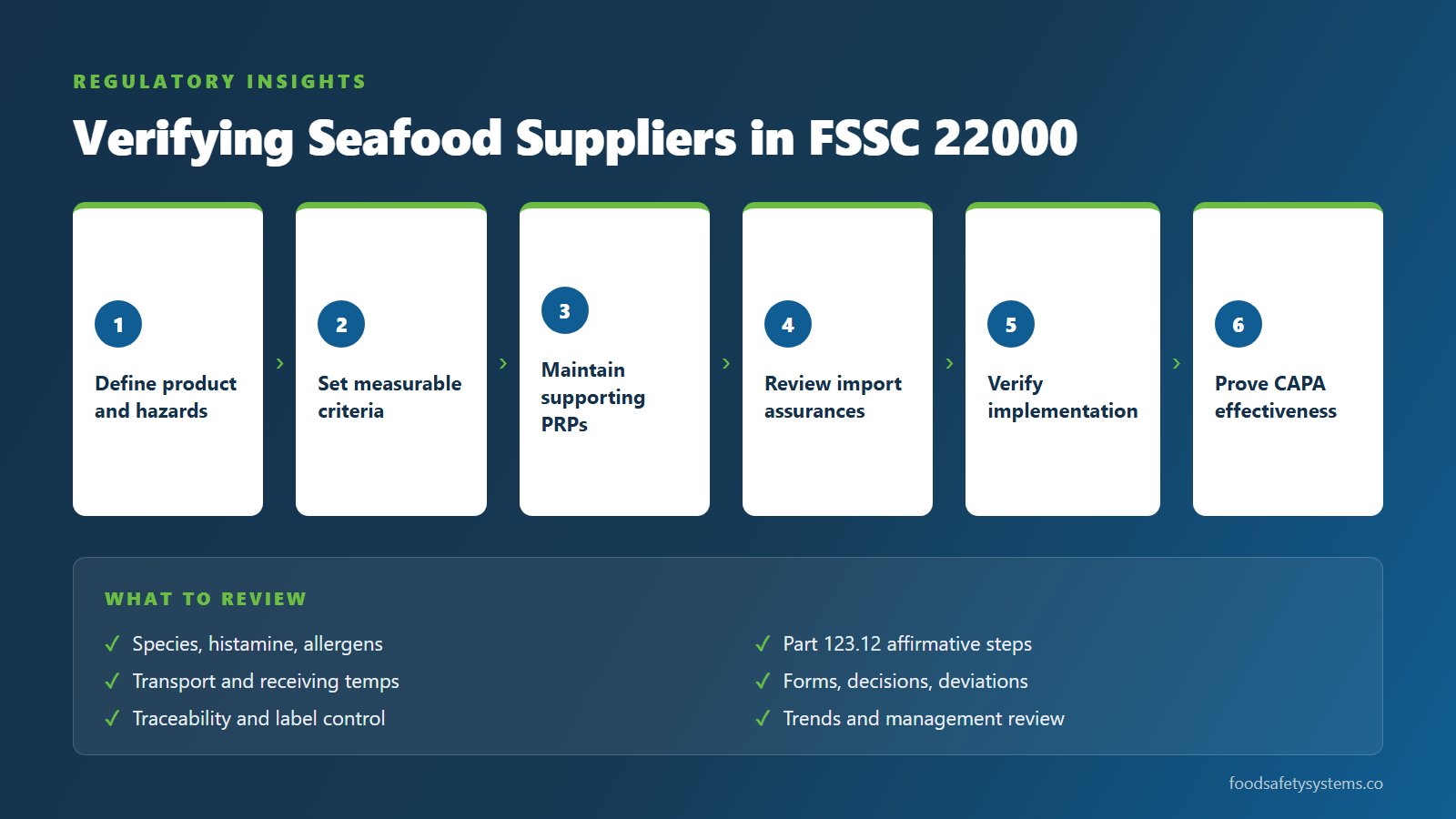
Review imported supplier assurances
For imported seafood, assess the foreign processor’s evidence separately from its FSMS certificate. Under 123.12, importers need written verification procedures with product specifications and affirmative steps. Those steps may include lot records, certificates from a competent authority or third party, facility inspections, or a HACCP plan on file with a written guarantee. The FSVP rule does not apply when the foreign supplier must comply, and does comply, with Part 123. In that case, 123.12 is the import requirement to meet.
Verify system implementation
Next, check whether monitoring forms, acceptance decisions, label checks and deviation records show that controls operate as written. Compare records with what happens on the dock. Gaps between the two are a common audit finding.
Promote corrective action effectiveness
After a significant process or supplier deviation, apply nonconformity control and trend analysis. Then confirm through management review that the fix worked. See management review procedures.
FSSC 22000 seafood supplier verification checklist
- Verify applicable seafood HACCP and importer requirements for each product and activity.
- Confirm that hazard analyses address species-specific pathogen, histamine and allergen risks.
- Check receiving temperatures, transport evidence and monitoring forms against procedures.
- Validate product identification, approved cartons and species-specific labeling.
- Record deviations, product disposition and corrective action effectiveness.
- Keep supplier, import verification and traceability evidence current where applicable.
Frequently asked questions
Does FSSC 22000 remove the need for seafood HACCP?
No. Applicability depends on the food and activity, and certification does not substitute for 21 CFR Part 123 compliance.
Why are critical limits important?
They give measurable criteria for deciding whether a control is working.
What should management review for seafood suppliers?
Record completeness, supplier performance, exceptions, label checks, internal audit results and corrective action effectiveness.
How Consultare Inc. Group can help
Consultare Inc. Group supports FSSC 22000 readiness, FSMS reviews, seafood supplier assurance, import verification procedures, internal audits and continual improvement planning. Services depend on your products, the applicable rules and the agreed scope.
- Supplier verification support: approval files and import verification evidence.
- FSSC 22000 and FDA compliance integration: align your FSMS with Part 123.
- Corrective action support: verification that supplier fixes hold.
Need help managing your FSSC 22000 responsibilities?
Discuss your seafood products, suppliers, records and priorities with our team. Contact us or book a free consultation.
Prefer to organize your compliance activities yourself? Create a free SystemsBuilder account to structure supplier information, verification evidence and corrective actions.
Technical sources: FSSC 22000, 21 CFR Part 123 and 21 CFR 1.501. This article is educational; requirements depend on your products, certification scope and applicable regulations. Food Safety Systems is an independent consultancy and is not affiliated with the FSSC 22000 Foundation or FDA.