
Quick answer: FSSC 22000 seafood Listeria controls rely on hazard analysis, suitable prerequisite programs, environmental monitoring, documented operational controls, verification and management review. Check the applicable scheme version and sector requirements on fssc.com.
Environmental contamination in seafood areas depends on equipment design, sanitation effectiveness, employee traffic, water movement and product exposure. Listeria monocytogenes is a particular concern where ready-to-eat fish, such as smoked or cooked products, is exposed after the last lethal step. An FSSC 22000 FSMS should make sure PRPs and operational controls fit the processes actually used at the site.
This guide is for seafood processors implementing an FSSC 22000 FSMS, including sanitation leads and QA teams. For the general approach outside seafood, see Listeria risk management in FSSC 22000.
Six steps to FSSC 22000 seafood Listeria controls
Identify exposure routes in the hazard analysis
Map handling steps, ready-to-eat product exposure and food-contact surfaces. Also include tool storage, washing operations and packaging flow. As a result, the hazard analysis shows exactly where Listeria could reach product. See conduct a hazard analysis.
Strengthen sanitation prerequisite programs
Specify cleanable equipment and utensil standards and wash-down controls. Then verify cleaning and keep waste handling separate from ready-to-eat areas. Wash-down hoses can spread aerosols, so control when and where they are used. See cleaning and sanitation.
Establish meaningful environmental monitoring
Document Listeria targets, methods, sampling locations, response triggers and trending. In addition, distinguish indicator results, such as Listeria spp., from pathogen findings. Each result type should trigger a defined response. See environmental monitoring.
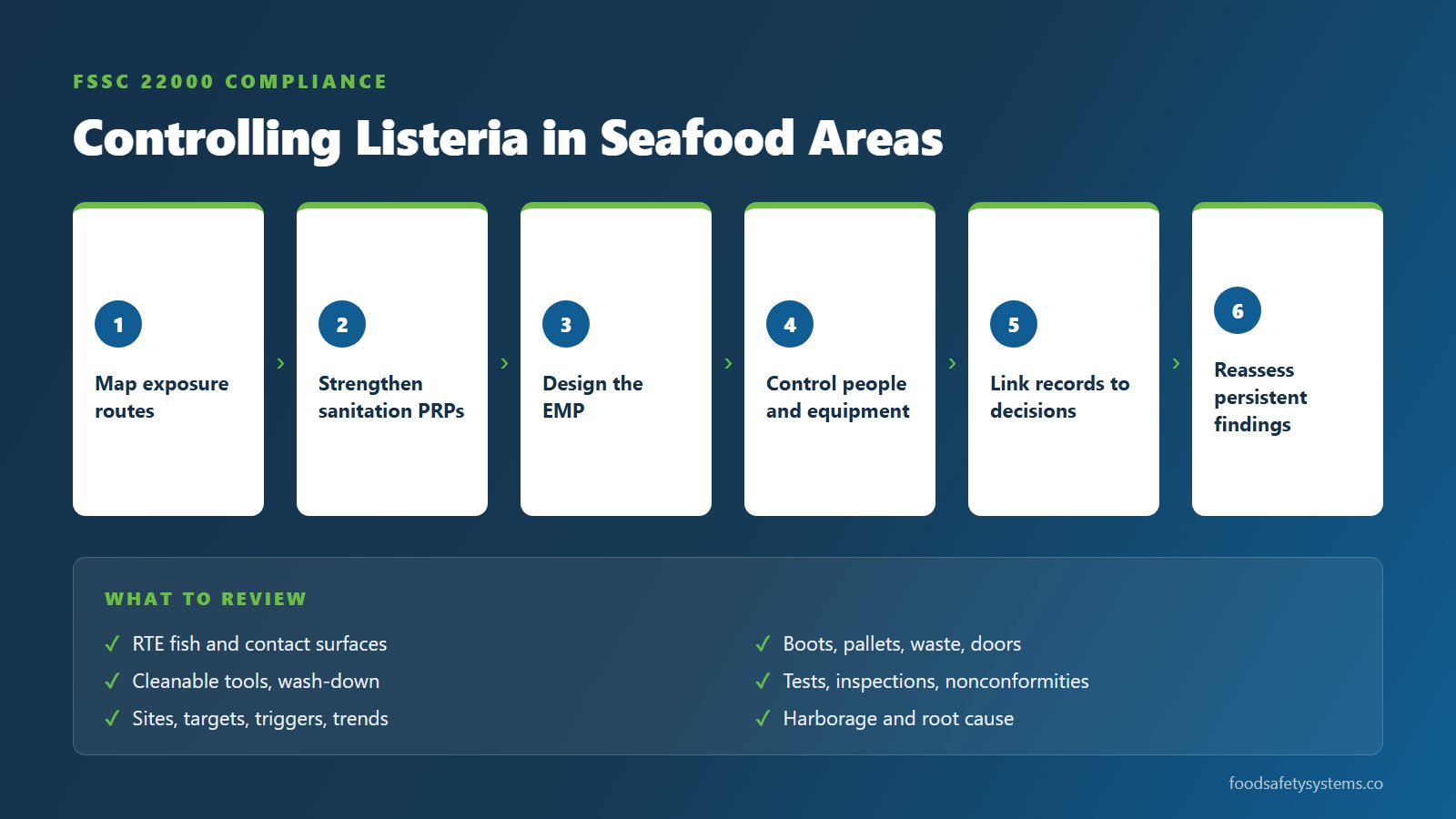
Manage personnel and equipment movement
Reduce transfer from boots, door points, pallets and waste containers to exposed ready-to-eat fish and clean surfaces. For instance, use dedicated footwear or boot washes at zone entries. See staff flow and movement procedures.
Maintain monitoring and verification records
Link inspection results, environmental tests, sanitation assessments and nonconformities. Bring them into management review so decisions rest on evidence. For seafood processors, FDA also requires sanitation monitoring and records under 21 CFR 123.11, including food-contact surfaces and cross-contamination.
Reassess persistent failures
Repeat positives often point to a harborage site. Therefore, investigate equipment condition, root causes and correction effectiveness. Also review the applicable FSSC sector PRPs and use the findings for continual improvement.
FSSC 22000 seafood Listeria controls checklist
- Confirm which regulations and standards apply to the actual products and operations.
- Document product- and process-specific hazards and supplier responsibilities.
- Review sanitation, personnel hygiene, equipment and contact surfaces.
- Verify that written monitoring procedures match records and observed practice.
- Track deviations, root causes, corrective actions and effectiveness evidence.
Frequently asked questions
What role do PRPs play in seafood environmental control?
PRPs create the hygienic conditions that hazard controls depend on. They include cleaning, personnel practices and protection of product-contact areas.
Is environmental Listeria testing the same as finished-product testing?
No. Environmental monitoring evaluates conditions in the production area. Finished-product testing answers different questions and cannot replace hygiene controls.
Does FSSC 22000 automatically satisfy FDA seafood HACCP?
No. Applicable 21 CFR Part 123 obligations must be assessed and implemented separately.
How Consultare Inc. Group can help
Consultare Inc. Group supports FSSC 22000 readiness assessments, FSMS and PRP reviews, environmental monitoring evaluations, process verification, internal audits and continual improvement planning. Services are tailored to the agreed scope.
- FSSC 22000 implementation readiness: Listeria controls checked before your audit.
- FSSC 22000 and FDA compliance integration: align your FSMS with Part 123.
- Corrective action support: root cause and verification after positive findings.
Need help managing your FSSC 22000 responsibilities?
Discuss your products, facilities, suppliers and compliance priorities with our team. Contact us or book a free consultation.
Prefer to organize your compliance activities yourself? Create a free SystemsBuilder account to structure monitoring records, corrective actions and compliance workflows.
Technical sources: FSSC 22000 and 21 CFR Part 123. This article is educational; requirements depend on your products, certification scope and applicable regulations. Food Safety Systems is an independent consultancy and is not affiliated with the FSSC 22000 Foundation or FDA.