
Quick answer: A risk-based foreign supplier evaluation weighs two things together: the risk posed by the imported food and the foreign supplier’s performance. Under 21 CFR 1.505, the importer considers the hazard analysis, who controls each hazard, the supplier’s practices, FDA compliance information and food safety history. The evaluation must be documented. It then supports supplier approval and the choice of verification activities.
This guide is for food brands, distributors and sourcing managers that import food into the United States and are adding suppliers, sites or sourcing countries as they grow.
Why price and availability are not enough
A new product, ingredient, sourcing country or manufacturing site can change the risk profile of an otherwise familiar supplier. Procurement teams naturally focus on price, capacity and lead time. However, those decisions do not resolve the importer’s food safety evaluation responsibilities.
Under the standard FSVP provisions, the evaluation must consider several factors. First, the hazard analysis of the food, including the nature of each hazard requiring a control. Second, the entity that will significantly minimize or prevent those hazards. That may be the foreign supplier, its raw material supplier or another entity in the supply chain.
Third, the foreign supplier’s performance. This includes its food safety procedures and practices and applicable FDA regulations. It also covers compliance information, such as whether the supplier is subject to an FDA warning letter, import alert or other compliance action. Finally, it includes food safety history, such as testing results, audit results and how quickly the supplier corrects problems. Other factors, such as storage and transportation practices, may also matter.
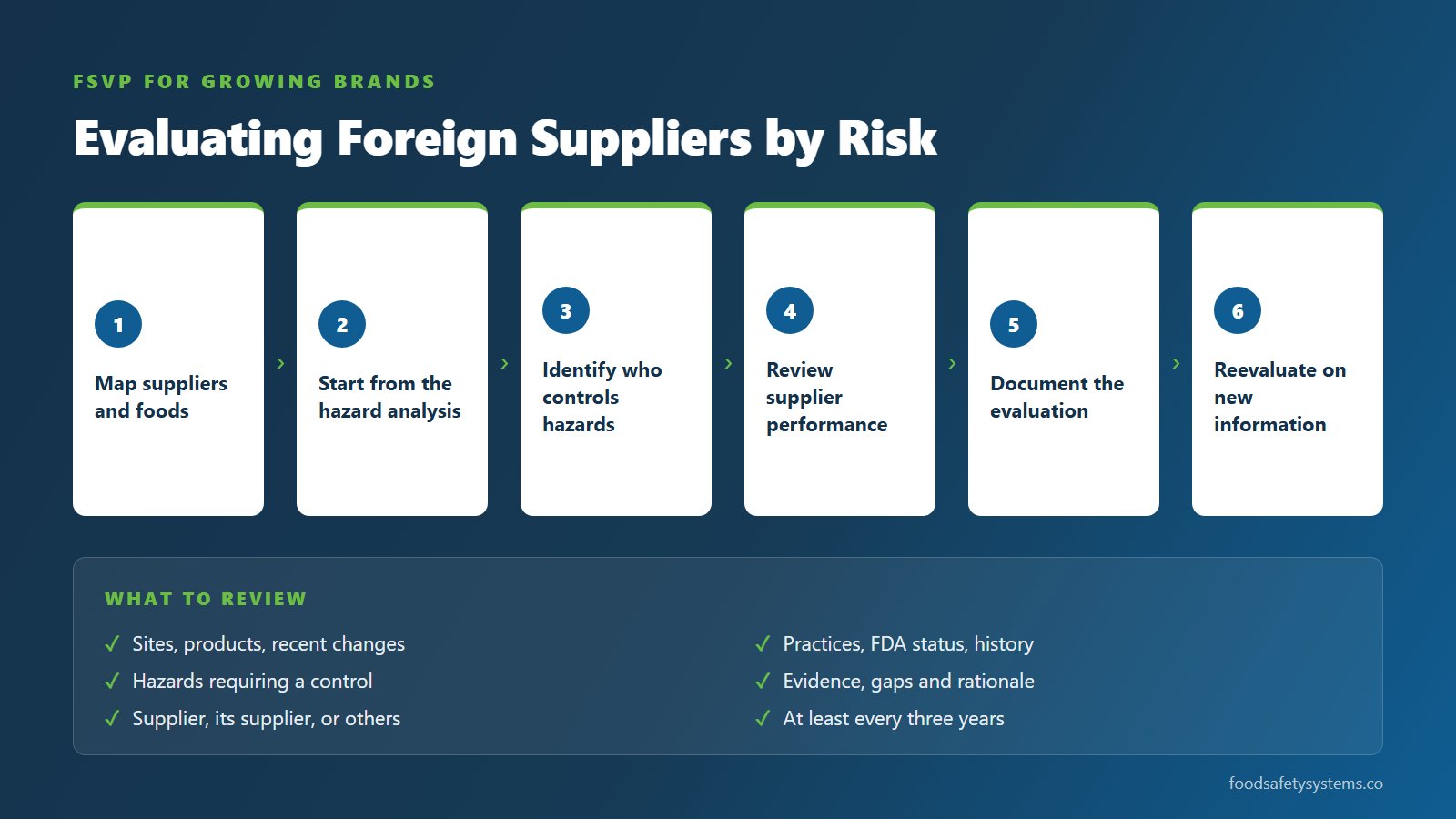
Six steps to a risk-based foreign supplier evaluation
1. Map suppliers, foods and recent changes
List every foreign supplier with the foods and sites it supplies. Then mark recent changes, such as a new product, a new site or a new raw material source. Approved product-and-site combinations should be clearly separated from new arrangements.
2. Start from the hazard analysis
The evaluation builds on the written hazard analysis for each food. If that analysis is missing or out of date, fix it first. Our guide to a risk-based FSVP hazard analysis explains how.
3. Identify who controls each hazard
Record which entity significantly minimizes or prevents each hazard requiring a control. Sometimes the foreign supplier controls it. In other cases, its ingredient supplier or your U.S. customer does. This decision shapes the verification that follows.
4. Review supplier performance with objective evidence
A questionnaire is only a starting point. Look for objective evidence: audit reports, test results, FDA compliance information and the supplier’s record of correcting problems. Check FDA import alerts and warning letters for the supplier as part of this step.
5. Document the evaluation and its rationale
Record what you reviewed, what you concluded and any open questions. Then show how the findings support approval and the choice of verification activities. A defensible file explains the reasoning, not just the outcome.
6. Reevaluate when new information arrives
The rule requires prompt reevaluation when you become aware of new information about these factors. If no reevaluation has occurred within any three-year period, you must reevaluate then. Either way, document the reevaluation and any resulting actions.
Common evaluation gaps in growing brands
- Supplier approval rests on a questionnaire with little supporting evidence.
- Audit, testing or regulatory history is missing or years out of date.
- The file does not say who controls each hazard requiring a control.
- A new site or product was added under an existing supplier evaluation.
- The team cannot explain how performance findings shaped verification decisions.
Records to keep
- The documented evaluation for each foreign supplier and type of food.
- Evidence reviewed: audit reports, test results, compliance checks and correspondence.
- Your documented review if another entity performed the evaluation using a qualified individual.
- Documented reevaluations and the decisions that followed.
Records must be signed and dated, kept legible and made available to FDA on request under 21 CFR 1.510.
Example: one supplier, two very different risks
A growing beverage brand buys fruit purée and dried tea from the same overseas supplier. The purée is pasteurized at the supplier’s plant, so the supplier controls the main pathogen hazard. In contrast, the tea is a lower-risk ingredient with a different hazard profile, mainly pesticide residues.
The evaluation treats these as two decisions, not one. For the purée, the team reviews the supplier’s process controls, recent audit results and any FDA compliance history in detail. For the tea, residue test results and supplier specifications may carry more weight. As a result, the brand approves both foods with verification proportionate to each risk.
Where FSSC 22000 supplier information fits
FSVP is a U.S. importer obligation, and FSSC 22000 certification does not satisfy it by itself. Still, the two systems overlap. An FSSC 22000 system already requires control of purchased materials and externally provided processes. Consequently, many supplier records can serve both purposes. A supplier’s FSSC 22000 certificate and full audit report can be one input to your performance review, provided the scope covers the relevant site and product. See FSSC 22000 supplier control for imported materials and supplier and raw material approval and monitoring.
Some imports are exempt or subject to modified requirements, for example under 21 CFR 1.507 or 1.512. Therefore, assess the requirements for each food and importer.
Risk-based foreign supplier evaluation checklist
- Confirm the food, supplier site and applicable FSVP provisions.
- Link the evaluation to a current written hazard analysis.
- Record who controls each hazard requiring a control.
- Review procedures, FDA compliance status and food safety history.
- Document conclusions, open questions and the approval rationale.
- Reevaluate on new information and at least every three years.
Frequently asked questions
How often must we reevaluate a foreign supplier?
Promptly when new information about the food or supplier arises. If no reevaluation has happened within three years, one is required then.
Is a supplier questionnaire enough?
Rarely on its own. Questionnaires help collect information, but the evaluation should rest on objective evidence such as audits, test results and compliance history.
Can someone else perform the evaluation?
Yes. An entity other than the foreign supplier may perform it using a qualified individual. You must then review, assess and document that evaluation.
How Consultare Inc. Group can help
Consultare Inc. Group helps expanding brands build organized supplier evaluation files, standardize evidence requests and set up follow-up workflows. Services are tailored to the agreed scope, and the importer remains responsible for its FSVP obligations.
- Supplier verification support: evidence-based supplier files.
- FSSC 22000 and FDA compliance integration: one supplier system for both.
- FSVP Services: our sister site dedicated to FSVP programs.
Need help managing your FSVP responsibilities?
Discuss your imported foods, suppliers, records, risks and next steps with our team. Contact us or book a free consultation.
Prefer to organize your compliance activities yourself? Create a free SystemsBuilder account to structure supplier records, verification activities and corrective actions.
Technical sources: 21 CFR Part 1, Subpart L and FDA’s FSVP rule page. This article is educational information, not legal advice, FDA approval or a compliance guarantee. FSVP obligations vary by food, importer and applicable exemptions or modified requirements, so confirm current requirements and have specific conclusions reviewed by an appropriately qualified individual. Food Safety Systems is an independent consultancy and is not affiliated with the FSSC 22000 Foundation or FDA.