
Quick answer: Risk-based FSVP supplier approval means approving each foreign supplier on the basis of a documented evaluation of the food’s risk and the supplier’s performance. Under 21 CFR 1.505(b), the importer must document that approval. Under 21 CFR 1.506(a), it must also follow written procedures so that it imports only from approved suppliers.
This guide is for food brands, distributors and procurement leaders that import food into the United States and need supplier approvals to keep pace with new products, factories and formulations.
Why approvals drift as a brand grows
New supplier, new factory or new formulation: does your existing approval still apply? As brands expand, sourcing changes often happen faster than food safety decisions. A supplier approved for one product or site is not automatically suitable for another. The relevant hazards and performance evidence may differ.
The rule ties approval to evaluation. First, the importer evaluates the food’s risk and the supplier’s performance. Then it approves the supplier on that basis and documents the approval. Next, it must establish and follow written procedures to make sure it imports only from approved suppliers, and it must document use of those procedures.
There is one narrow exception. When necessary and appropriate, a food may come temporarily from an unapproved supplier. In that case, the food must undergo adequate verification activities before it is imported. In practice, this calls for a clear rule, not an informal workaround.
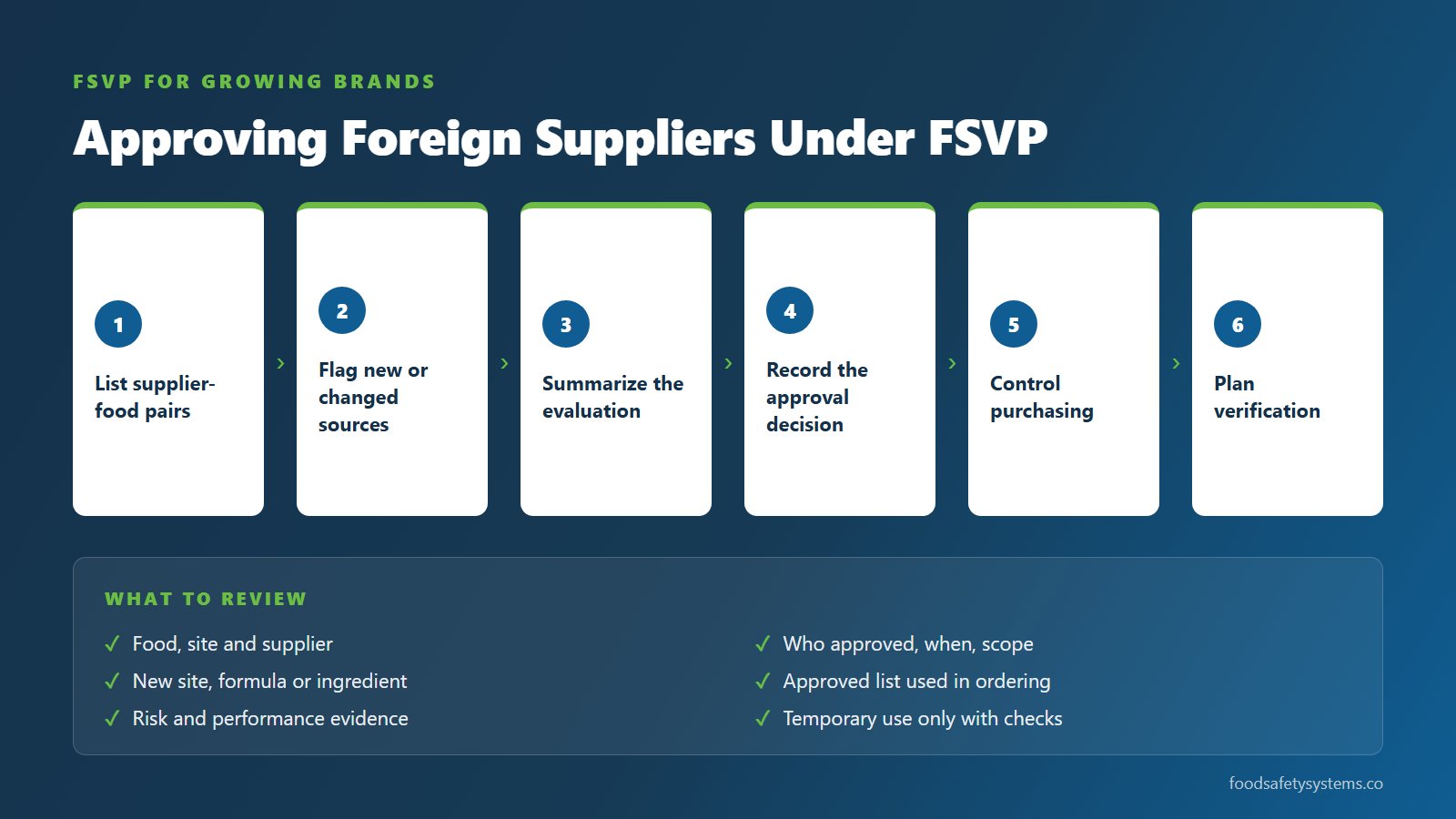
Six steps to risk-based FSVP supplier approval
1. List active supplier and food combinations
Build one list of each foreign supplier, site and food you import. Define approval scope by food and facility where appropriate. This list becomes the backbone of the approved supplier register.
2. Flag new or changed sources
Mark any change in ingredient, formulation, product or production location. Each flagged item needs an evaluation before it is treated as approved. A risk-based foreign supplier evaluation provides that input.
3. Summarize the evaluation for the decision-maker
Prepare a short evidence summary for each decision. It should cover the hazards requiring a control, who controls them, the supplier’s performance and any open questions. A concise summary helps the person approving the supplier see the full picture.
4. Record the approval decision
Document who approved the supplier, when, for which foods and sites, and on what basis. The FSVP importer makes this decision. A consultant can organize evidence and recommendations, but responsibility does not transfer.
5. Connect approval to purchasing
Written procedures should stop purchase orders for foods from unapproved suppliers. Many brands do this with an approved supplier list built into the ordering or ERP system. In addition, define who can authorize temporary use and which verification must happen first.
6. Plan verification and keep status current
Approval leads directly into verification planning. Update supplier status when the evaluation changes. For the next stage, see our guide to FSVP supplier verification.
Common approval gaps
- Purchasing uses suppliers without a documented FSVP approval status.
- The approval file does not show the food-risk and supplier-performance evaluation.
- A supplier changed sites or formulations without an updated decision.
- Temporary sourcing happened without verification records.
- Approval is recorded per supplier, but not per food and site.
Records to keep
- The documented evaluation supporting each approval.
- The documented approval: foods, sites, approver and date.
- Written procedures for using approved suppliers, and evidence they were followed.
- Verification records for any temporary use of an unapproved supplier.
If another entity establishes these procedures or performs the activities, you may rely on it. However, you must review and assess its documentation and record that review. All records must be available to FDA on request under 21 CFR 1.510.
Example: a co-packer moves production
A plant-based snack brand learns that its overseas co-packer will move one product line to a second factory. The original approval covered only the first site. Under the brand’s procedure, the new site is flagged as unapproved in the ordering system until it is evaluated.
The quality lead gathers the new site’s audit report, recent test results and FDA compliance information. Then the approver reviews a one-page summary and approves the site for that product only. Finally, purchasing can release orders, and the verification plan is updated for the new site.
How FSVP approval relates to FSSC 22000 supplier control
FSVP is a U.S. importer obligation. FSSC 22000 certification does not satisfy it by itself. Even so, an FSSC 22000 system already expects controlled supplier approval for purchased materials and externally provided processes. Consequently, one approved supplier register can often serve both, provided it records FSVP-specific evidence and decisions. A supplier’s FSSC 22000 certificate and audit report can be one input to the approval. See FSSC 22000 supplier control for imported materials and supplier approval and monitoring.
Exemptions and modified requirements, such as those in 21 CFR 1.512 for very small importers, may change the specific obligations.
Risk-based FSVP supplier approval checklist
- Define approval scope by supplier, food and site.
- Base each approval on a documented risk and performance evaluation.
- Record the approver, date, scope and rationale.
- Block purchasing from unapproved suppliers through written procedures.
- Allow temporary use only with adequate verification before import.
- Update status and verification plans when evaluations change.
Frequently asked questions
Who makes the FSVP supplier approval decision?
The FSVP importer. Consultants and other entities can support the work, but they do not take over the importer’s responsibility.
Can we import from a supplier we have not approved yet?
Only temporarily, when necessary and appropriate, and only if the food undergoes adequate verification activities before importing.
Does approving a supplier cover all its factories?
Not necessarily. Hazards and performance can differ by site and product, so define approval scope accordingly.
How Consultare Inc. Group can help
Consultare Inc. Group assists growing businesses with risk-based onboarding, supplier approval documentation and coordinated follow-up between procurement and food safety teams. Services are tailored to the agreed scope, and the importer retains authority for every approval decision.
- Supplier verification support: approval files built on evidence.
- FSSC 22000 and FDA compliance integration: one approved supplier register.
- FSVP Services: our sister site dedicated to FSVP programs.
Need help managing your FSVP responsibilities?
Discuss your imported foods, suppliers, records, risks and next steps with our team. Contact us or book a free consultation.
Prefer to organize your compliance activities yourself? Create a free SystemsBuilder account to structure supplier records, verification activities and corrective actions.
Technical sources: 21 CFR Part 1, Subpart L and FDA’s FSVP rule page. This article is educational information, not legal advice, FDA approval or a compliance guarantee. FSVP obligations vary by food, importer and applicable exemptions or modified requirements, so confirm current requirements and have specific conclusions reviewed by an appropriately qualified individual. Food Safety Systems is an independent consultancy and is not affiliated with the FSSC 22000 Foundation or FDA.