
Quick answer: Risk-based supplier audit planning decides which foreign suppliers need an onsite audit, how often, and what the audit must cover. Under 21 CFR 1.506, an onsite audit is one of several FSVP verification activities. It becomes the default, before first import and at least annually, when the supplier controls a hazard that could cause serious adverse health consequences or death. A qualified auditor must perform it.
This guide is for growing food brands and international sourcing teams that import food into the United States and need to decide where audit effort really matters.
Why audit certificates are not an audit plan
How do you decide which foreign suppliers deserve a closer onsite audit? Growing brands often inherit audit certificates from different schemes, sites and dates. It is tempting to treat them all as equal. However, an FSVP verification plan must still consider the specific food and supplier risks.
The importer chooses verification activities and their frequency based on its evaluation of food risk and supplier performance. When an onsite audit is used for FSVP, a qualified auditor must conduct it. If the food is subject to FDA food safety regulations, the audit must consider them. It must also review the supplier’s written food safety plan, if any, and its implementation for the hazard being controlled.
Not every imported food needs an annual audit. For serious hazards controlled by the supplier, the importer may use other activities or less frequent audits instead. That requires an adequate written determination that the alternative provides adequate assurance.
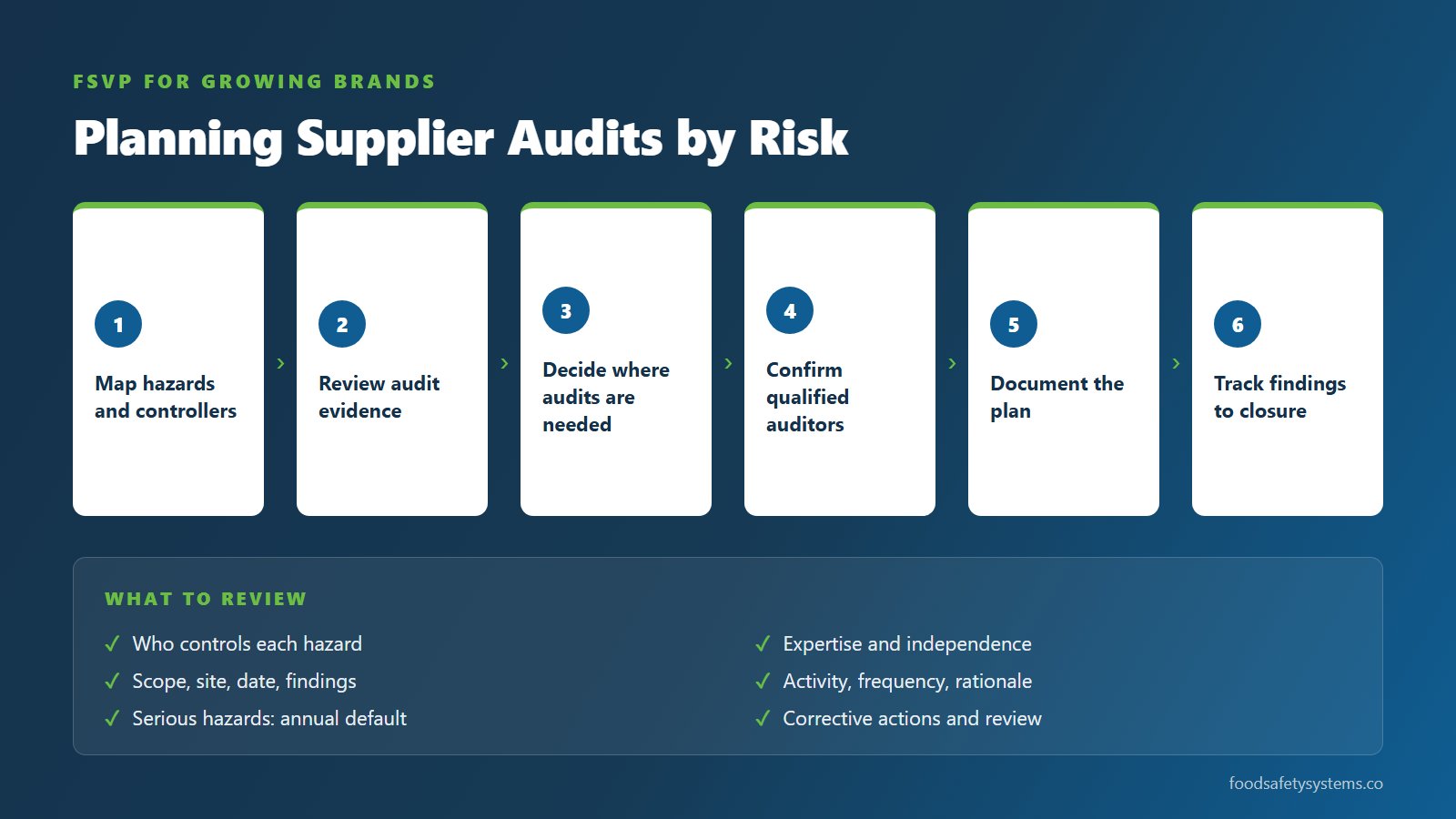
Six steps to risk-based supplier audit planning
1. Map significant hazards and who controls them
Start from the hazard analysis and the supplier evaluation. For each food, note the hazards requiring a control and the entity that controls them. Audits matter most where the foreign supplier controls a serious hazard. Our guide to FSVP supplier verification explains how audits fit with other activities.
2. Review the audit evidence you already have
Collect existing audit reports, not just certificates. Check the scope, date, facility, findings and corrective actions. A certificate alone rarely gives enough detail to assess findings.
3. Decide where onsite audits are needed
Prioritize suppliers that control serious hazards, have weak performance or have open significant findings. For other suppliers, sampling and testing or record review may provide adequate assurance. Record the reasoning either way.
4. Confirm qualified auditors and independence
A qualified auditor needs technical expertise gained through education, training or experience. In addition, there must be no financial conflicts of interest that influence results, and payment must not depend on the outcome. The foreign supplier and its employees cannot perform the audit for you.
5. Document the plan, frequency and rationale
Write down which suppliers will be audited, how often and why. Where a serious hazard is involved and you choose an alternative to annual audits, record the written determination that supports it.
6. Track findings to closure
Review each audit report promptly and document your assessment. Then track significant findings and supplier corrective actions to closure. If results do not give adequate assurance, take corrective action under 21 CFR 1.508.
Common audit planning gaps
- The supplier provides a certificate but not enough detail to assess findings.
- Audit scope, date, facility or auditor qualifications are unclear.
- Significant findings remain open without documented follow-up.
- The plan does not say whether an onsite audit is needed, or why not.
- The audit did not consider applicable FDA regulations or the supplier’s food safety plan.
Records to keep
- The written determination of verification activities and frequency for each supplier.
- For each onsite audit: audit procedures, dates, conclusions and corrective actions taken for significant deficiencies.
- Documentation that a qualified auditor performed the audit.
- Your documented review and assessment of the results.
Where an inspection by FDA, another U.S. government agency or an officially recognized foreign authority replaces an audit, keep the written results. That inspection must have taken place within one year of the date the audit would have been required. All records must meet 21 CFR 1.510.
Example: building a one-year audit plan
A specialty foods brand imports from nine foreign suppliers. Two supply ready-to-eat cheese, where the supplier controls Listeria. These get annual onsite audits by a qualified auditor whose scope covers the relevant FDA requirements and the supplier’s food safety plan.
A third supplier holds a current scheme certificate, but the full report shows an open major finding on sanitation. As a result, the brand requests the corrective action evidence and moves that supplier up the audit schedule. The remaining six supply lower-risk dry goods. For them, the plan documents record reviews and periodic testing instead of audits.
Using FSSC 22000 audit reports in your FSVP plan
FSVP is a U.S. importer obligation. FSSC 22000 certification does not satisfy it by itself. Even so, a supplier’s FSSC 22000 audit report can be one input to your audit planning. Check whether its scope covers the right site and product, whether the auditor meets the qualified auditor standard and whether it addresses the hazard you need verified. Your own FSSC 22000 system also needs controlled oversight of purchased materials, so one audit schedule can often serve both purposes. See FSSC 22000 supplier control for imported materials and supplier approval and monitoring. Supplier audits are different from your own internal audits, although the same discipline applies.
Exemptions and modified requirements, such as those in 21 CFR 1.507 and 1.512, can change what verification is required.
Risk-based supplier audit planning checklist
- Map hazards requiring a control and the entity controlling each.
- Collect full audit reports and check scope, date, site and findings.
- Apply the annual onsite audit default for serious hazards controlled by the supplier, or justify an alternative in writing.
- Confirm auditor qualifications and independence.
- Document the plan, frequency and rationale.
- Review results promptly and track corrective actions to closure.
Frequently asked questions
Does every foreign supplier need an annual audit?
No. Annual onsite audits are the default only when the supplier controls a hazard with a reasonable probability of serious adverse health consequences or death.
Can we use a supplier’s certification audit?
Often, as one input. Check that the report covers the right site and product and that the auditor is qualified. It must also address the hazard you need to verify.
What must an FSVP audit record show?
The audit procedures, dates, conclusions, corrective actions for significant deficiencies and evidence that a qualified auditor conducted it.
How Consultare Inc. Group can help
Consultare Inc. Group assists with risk-based supplier audit planning, review of prior audit reports and tracking of open supplier actions. Services are tailored to the agreed scope, and the importer remains responsible for its FSVP obligations.
- Supplier verification support: audit priorities and report reviews.
- Audit readiness coaching: audit discipline across your own system.
- FSVP Services: our sister site dedicated to FSVP programs.
Need help managing your FSVP responsibilities?
Discuss your imported foods, suppliers, records, risks and next steps with our team. Contact us or book a free consultation.
Prefer to organize your compliance activities yourself? Create a free SystemsBuilder account to structure supplier records, verification activities and corrective actions.
Technical sources: 21 CFR Part 1, Subpart L and FDA’s FSVP rule page. This article is educational information, not legal advice, FDA approval or a compliance guarantee. FSVP obligations vary by food, importer and applicable exemptions or modified requirements, so confirm current requirements and have specific conclusions reviewed by an appropriately qualified individual. Food Safety Systems is an independent consultancy and is not affiliated with the FSSC 22000 Foundation or FDA.