
Quick answer: FSVP importer responsibilities sit with the party FDA defines as the importer: the U.S. owner or consignee of the food at entry. If there is none, it is the U.S. agent or representative designated by the foreign owner or consignee, confirmed by signed consent. That importer must have an FSVP for each food, use qualified individuals and be identified at entry. As a brand expands, document who holds this role for every food and shipment flow.
This guide is for expanding food brands that import ingredients or finished products through co-packers, distributors or overseas partners. It suits brand owners, operations leads and supplier quality decision makers who need clear accountability before the next shipment.
Why importer roles blur as a brand expands
Early on, one company may buy, own and receive every shipment. Growth changes that. A brand may now use a foreign co-packer that ships on its own account, a distributor that takes title at the port, or a marketplace partner. Each arrangement can shift who owns or receives the food at entry.
As a result, the same operating model should not be assumed for every product. A customs broker’s role or a professional credential does not by itself establish FSVP responsibility. Instead, the importer identity is a fact-specific determination for each food and entry flow.
What the FSVP rule says about the importer
Under 21 CFR 1.500, the importer is the U.S. owner or consignee of the food offered for import. If there is no U.S. owner or consignee at entry, the importer is the U.S. agent or representative of the foreign owner or consignee, as confirmed in a signed statement of consent to serve as the importer.
Under 21 CFR 1.509, the importer’s name, email address and an FDA-recognized unique facility identifier (UFI) must be provided electronically for each line entry when entry is filed with U.S. Customs and Border Protection. Where there is no U.S. owner or consignee, the foreign owner or consignee must designate a U.S. agent or representative as the importer before the food is imported.
The importer must also develop, maintain and follow an FSVP for each food it imports. A qualified individual must develop the FSVP and perform its activities, as set out in 21 CFR 1.503. However, some foods are exempt, and some importers, such as very small importers, qualify for modified requirements. Confirm these before applying the standard process. FDA summarizes the rule on its FSVP key requirements page.
Six steps to clarify FSVP importer responsibilities
1. Map foods and suppliers
List every imported food, its foreign supplier and the manufacturing site. Add the commercial route for each: who buys it, who owns it at entry and who receives it. This product-supplier matrix is the foundation for every later decision.
2. Identify the FSVP importer
For each food and route, determine the U.S. owner or consignee at entry. If there is none, confirm that a U.S. agent or representative has been designated and has signed consent. Check contracts and purchase terms, because title and consignee details often decide the answer.
3. Check exemptions and modified requirements
Before building a full program, confirm whether any exemption or modified requirement applies to the food or the importer. Document the basis for that conclusion. Facts change as you grow, so revisit it when volumes, suppliers or products change.
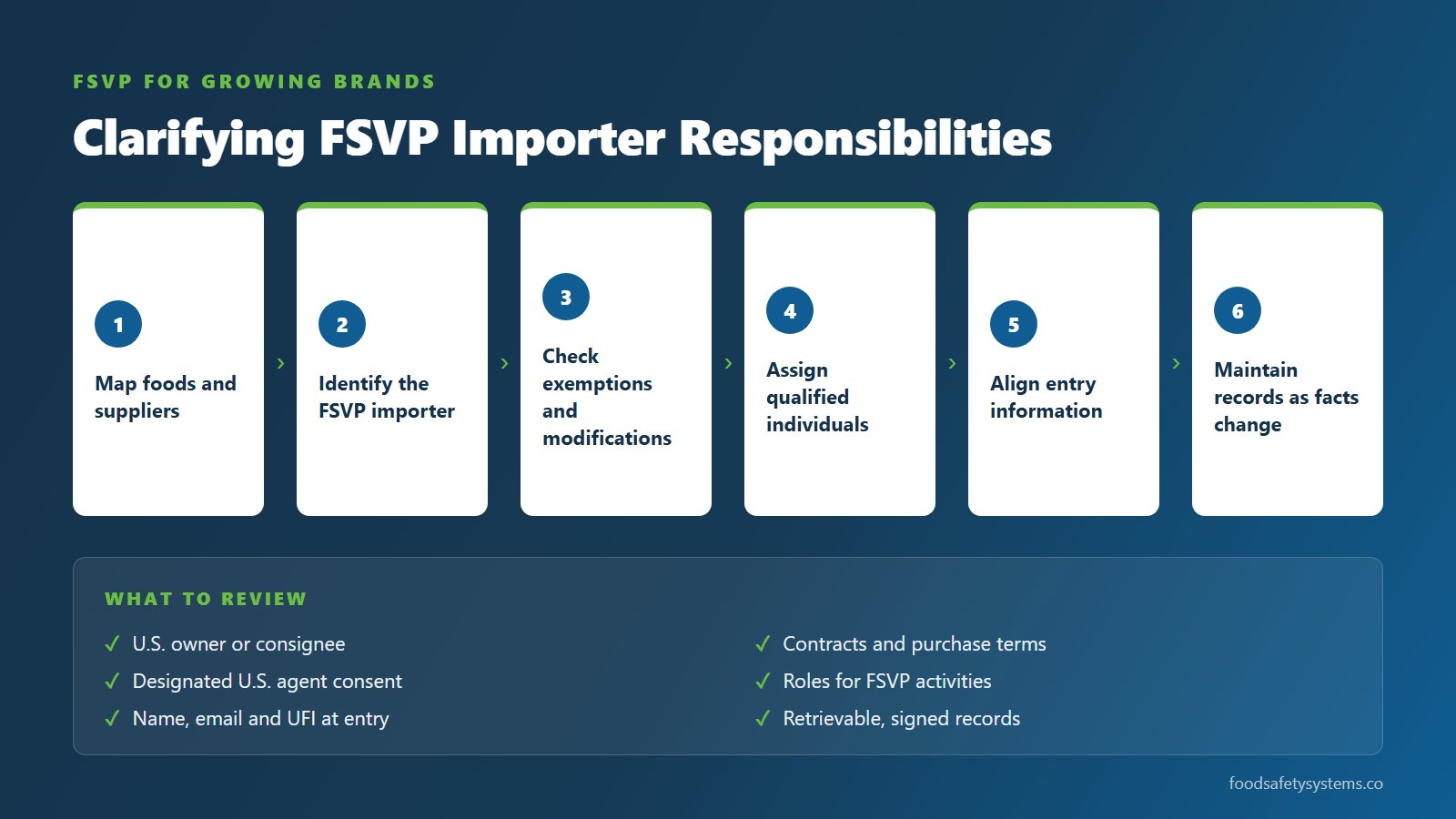
4. Assign qualified individuals
Name who performs each FSVP activity: hazard analysis, supplier evaluation, supplier verification and record review. A qualified individual needs the right education, training or experience and must read the language of the records. They can be an employee or an outside party, but the importer stays responsible.
5. Align entry information
Make sure brokers file the correct importer name, email and UFI for each line entry. Inconsistent filing instructions across partners are a common gap. Give brokers written instructions per product and route, and check sample entries.
6. Maintain records as facts change
Keep FSVP records under 21 CFR 1.510. They must be signed and dated, legible and available promptly to FDA on request. Update the importer matrix when ownership terms, suppliers or routes change. Our page on document control and record-keeping can help structure versions.
Common gaps in expanding brands
- New suppliers launched without a responsibility review.
- Ownership or consignee terms changed without updating the FSVP owner.
- FSVP records scattered between brand, co-packer and distributor.
- Inconsistent importer details in broker filing instructions.
- Assuming a consultant, broker or credential holder is the importer.
How importer responsibilities relate to an FSSC 22000 system
FSVP is a U.S. importer obligation, and FSSC 22000 certification does not satisfy it by itself. Many brands use FSSC 22000-certified co-packers or hold certification themselves. In both cases, the FSSC 22000 system’s supplier control and its management of externally provided processes, products and services can hold the FSVP roles, files and reviews.
A supplier’s FSSC 22000 certificate and audit report can be one input to supplier evaluation. Still, the importer must document its own FSVP decisions. See FSSC 22000 supplier control for imported materials, our guide to reviewing foreign supplier records and FSVP supplier corrective actions.
Example: a brand adds a foreign co-packer and a distributor
A sauce brand has always imported chili paste itself, so it is the U.S. consignee and the FSVP importer. It now adds a foreign co-packer that ships finished sauces directly to a U.S. distributor, which takes ownership at entry.
In the new route, the distributor is the U.S. owner at entry and therefore the FSVP importer for those sauces. The brand documents this, agrees with the distributor how FSVP records will be shared, and updates broker instructions. For the chili paste, nothing changes. A signed matrix now shows the importer, qualified individuals and record location for every food and route.
FSVP importer responsibilities checklist
- Map every imported food, supplier, site and commercial route.
- Identify the U.S. owner or consignee at entry for each route.
- Where none exists, confirm a designated U.S. agent with signed consent.
- Confirm and document any exemption or modified requirement.
- Assign qualified individuals for each FSVP activity.
- Check that each line entry carries the importer’s name, email and UFI.
- Keep signed, dated, retrievable records and update them when facts change.
Frequently asked questions
Is the brand owner always the FSVP importer?
No. The importer is the U.S. owner or consignee at entry. If another company owns or receives the food at that point, it may be the importer instead.
Can a consultant or customs broker be the FSVP importer?
Not simply by offering services. Only the U.S. owner or consignee, or a designated U.S. agent with signed consent where there is no U.S. owner or consignee, is the importer.
What must be provided at entry?
The importer’s name, email address and a unique facility identifier recognized as acceptable by FDA, for each line entry of food.
How Consultare Inc. Group can help
Consultare Inc. Group supports expanding brands with FSVP responsibility mapping, supplier file development, role assignments, onboarding checklists and record structures. Consultare does not act as your FSVP importer by offering consulting. Services are tailored to the agreed scope.
- FSSC 22000 and FDA compliance integration: align FSVP roles with your FSMS.
- Supplier verification support: build and review supplier files.
- FSVP Services: dedicated FSVP program support from our network.
Need help clarifying FSVP importer responsibilities?
Discuss your products, suppliers, commercial arrangements and next steps with our team. Contact us or book a free consultation.
Prefer to organize your compliance activities yourself? Create a free SystemsBuilder account to structure importer roles, supplier information and FSVP records.
Technical sources: 21 CFR 1.500, 21 CFR 1.503, 21 CFR 1.509, 21 CFR 1.510 and FDA’s FSVP key requirements. This article is educational and is not legal advice, FDA endorsement, import authorization or a guarantee of compliance. FSVP obligations vary by food, importer, supplier and any exemption or modified requirement, so have your conclusions reviewed by a qualified individual. Food Safety Systems is an independent consultancy and is not affiliated with the FSSC 22000 Foundation or FDA.