
Choosing a certification scheme for H-E-B suppliers is a business decision, not a guess. The wrong path can cost far more than an audit fee. Some manufacturers start building a food safety standard before they confirm what their operation qualifies for, or what their prospective customer actually asks for. FSSC 22000, SQF and BRCGS share core risk-management principles, but they differ in structure, prerequisites and audit approach.
Quick answer: start with a documented fit assessment. Define your products and certification scope, ask the relevant H-E-B supplier or purchasing contact which schemes and audits apply, and map what your current system already covers. Then compare the three schemes against that evidence. No single scheme is universally required, and no certificate guarantees acceptance as a supplier.
This guide is for food manufacturers, brand owners, importers and quality leaders who are preparing for possible H-E-B supply. For a broader side-by-side comparison written for another retail channel, see our article on FSSC 22000 vs SQF vs BRCGS.
How the three schemes differ
All three schemes have certification programmes recognised by the Global Food Safety Initiative (GFSI) for specified scopes. GFSI lists FSSC 22000, SQF and BRCGS among its recognised certification programme owners. However, recognition does not make their detailed requirements identical. It also does not mean that a retailer accepts every scheme for every product.
FSSC 22000 combines ISO 22000 with sector-specific prerequisite programs (PRPs) and additional scheme requirements. As a result, it suits organizations that already run, or want to run, an ISO-style management system. SQF and BRCGS use their own code structures. If you are leaning toward one of them, our sister sites cover SQF and BRCGS in more depth.
Six steps to choose a certification scheme for H-E-B suppliers
Define products, processes and eligible scopes
List the products, manufacturing operations and food chain categories you want certified. Scheme eligibility and audit scope follow from these facts. Therefore, an unclear product list often leads to the wrong scope, or to a certificate that does not cover what you plan to sell.
Ask the retailer contact what applies
H-E-B publishes supplier information and runs an access-controlled supplier portal for authorized business interactions. Public information alone does not set out a uniform food safety checklist for all suppliers. So ask the relevant H-E-B supplier or purchasing contact which schemes, audits or additional controls apply to your product and channel.
Map your existing management system
Compare what you already have with each scheme. For example, a site with document control, internal audit and management review in an ISO-style format may close FSSC 22000 gaps faster. In contrast, a site built around another code may find that code closer to its current records.
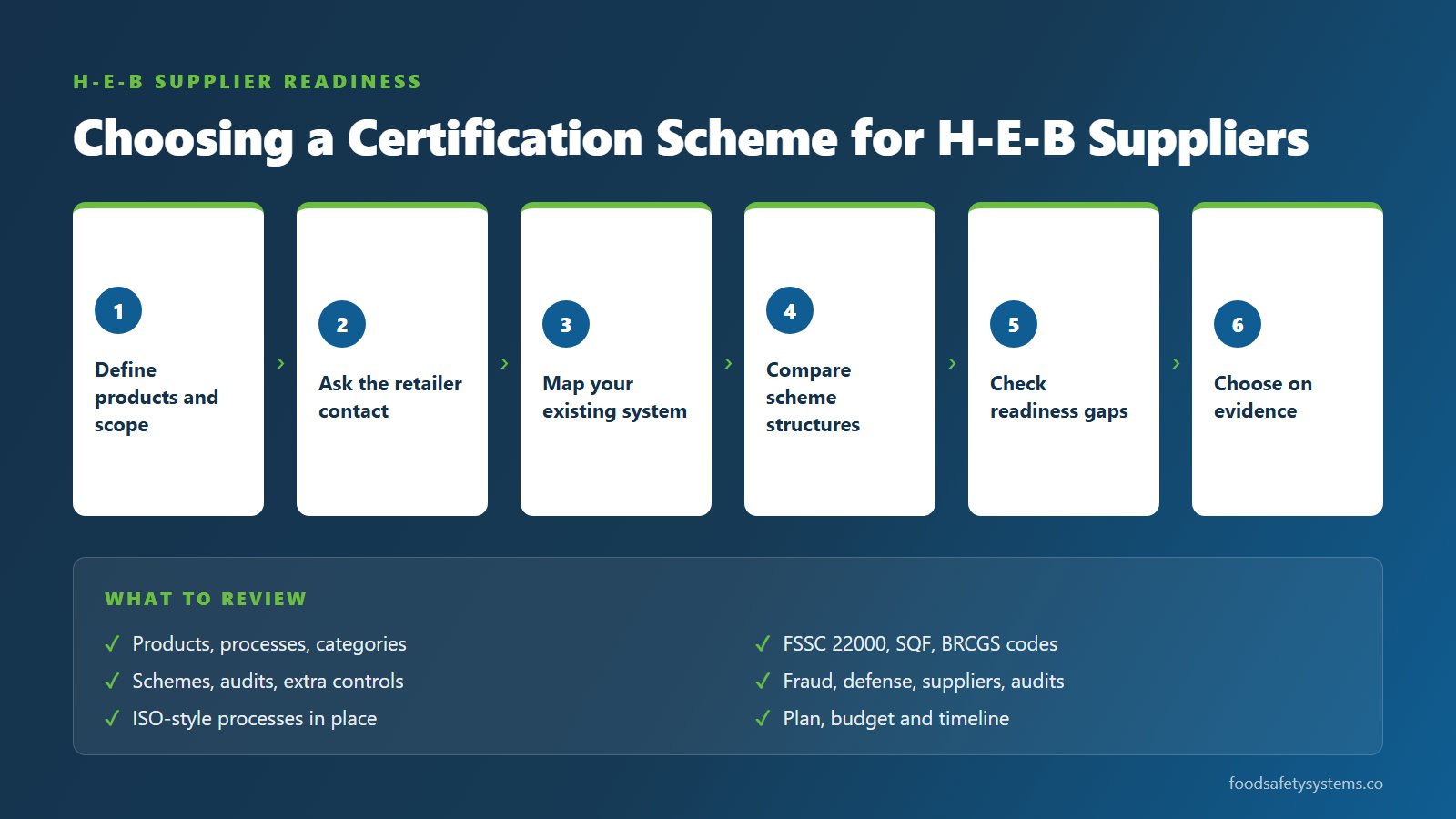
Compare scheme structures, not just names
Read the current scheme documents from each scheme owner. Look at how each one handles PRPs, hazard control, documentation, audit format and certification cycle. Then note which requirements would mean new work and which your system already meets.
Check readiness in high-risk areas
Evaluate food defense, food fraud, supplier approval, internal audit and management review. These areas often reveal the real size of the project. For a structured view of the gaps, a FSSC 22000 gap assessment gives you a documented baseline.
Choose on evidence and plan the work
Select the scheme and scope that your evidence supports. Next, build a realistic plan with owners, resources and an audit timeline. Record why you chose that path, because buyers and auditors may ask.
A practical scenario
A manufacturer already runs an ISO-oriented management system and is considering FSSC 22000. Meanwhile, a second customer asks about BRCGS. A structured comparison shows which certification scope fits the products and avoids writing two overlapping sets of documents.
For a business exploring H-E-B, the useful question is not whether a certificate guarantees acceptance. Instead, ask whether your records and responsibilities can be explained clearly when someone requests them.
Common gaps and what they cost
- Starting implementation before confirming what the customer actually requests.
- Choosing a scope that does not cover all products or processes you plan to supply.
- Rewriting documents that an existing ISO-style system already covers.
- Duplicating training because two schemes run in parallel without a plan.
- Assuming certification replaces applicable FDA requirements.
A mismatched scheme or scope can lead to document rewrites, repeated training and delayed audit scheduling. Moreover, certification does not replace applicable FDA requirements or create an automatic right to supply any retailer.
Records to keep for your scheme decision
- Product, process and category list with the proposed certification scope.
- Notes of what the retailer contact confirmed, with dates and names.
- Gap assessment results against the chosen scheme.
- Implementation plan with owners, resources and target dates.
Certification scheme for H-E-B suppliers: readiness checklist
- Identify product type, manufacturing operation and eligible certification scopes.
- Ask the relevant H-E-B contact which schemes, audits or additional controls apply.
- Compare existing management processes with FSSC 22000, SQF and BRCGS structures.
- Evaluate food defense, food fraud, supplier approval, internal audit and management review readiness.
- Choose a feasible implementation and certification approach based on evidence, not assumptions.
Frequently asked questions
Does H-E-B require FSSC 22000?
Public information does not show a single scheme required for all H-E-B suppliers. Confirm the requirements for your product and channel with the relevant H-E-B supplier or purchasing contact.
Are FSSC 22000, SQF and BRCGS equivalent?
All three have GFSI-recognised programmes for specified scopes. Even so, their structures and detailed requirements differ, so compare them against your own operation.
Can an ISO 22000 system help with FSSC 22000?
Yes. FSSC 22000 builds on ISO 22000, so an existing ISO-style system can shorten the work. You still need the sector PRPs and the additional scheme requirements.
How Consultare Inc. Group can help
Consultare Inc. Group helps compare existing systems with FSSC 22000, SQF and BRCGS needs, evaluate documentation gaps and prioritize implementation work. Support is tailored to the facility, product and supplier pathway.
- FSSC 22000 implementation readiness: gaps found before you commit to a scheme.
- Retail supplier readiness: how an FSSC 22000 system supports retail reviews.
- Retail and wholesale food safety solutions: documentation prepared for buyer reviews.
Unsure which scheme fits your facility?
Share your operation type, processes, existing certifications and customer requests, so we can focus on the right comparison. Contact us or book a free consultation.
Prefer to organize your compliance activities yourself? Create a free SystemsBuilder account to structure certification records, supplier information and corrective actions.
Technical sources: GFSI recognised certification programme owners, the FSSC 22000 scheme and H-E-B supplier information. This article is educational and is not legal advice or a statement of H-E-B supplier policy. Applicability depends on your products, facility and customer arrangements. Food Safety Systems is an independent consultancy and is not affiliated with, sponsored or approved by H-E-B, the FDA or the FSSC 22000 Foundation. H-E-B-specific requirements must be confirmed directly with the relevant H-E-B supplier or purchasing contact.