
Quick answer: Supplier testing evidence works when each test answers a specific hazard question for a specific food and supplier. Under FDA’s Foreign Supplier Verification Program (FSVP) rule, sampling and testing is one verification option chosen by risk, not a test every food needs. When you use it, keep the required details for each test, review the results promptly and act on any detected hazard.
This guide is for growing food brands that import ingredients or finished products and now receive more certificates of analysis (COAs) and lab reports than they can easily review. It fits supplier quality leads, food safety managers and founders who sign off on new suppliers.
Why testing evidence gets messy as you grow
Each new co-manufacturer or ingredient adds test specifications, COAs and lab reports. Formats differ, and so do methods, units and lot codes. Without a framework, teams either accept every COA at face value or pay for tests that add little assurance.
Neither outcome strengthens verification. Instead, a practical framework links tests to hazards, sets a justified frequency and escalates results that do not fit. In short, the aim is fewer, better tests with clear decisions behind them.
What the FSVP rule says about sampling and testing
Under 21 CFR 1.506, the importer must determine and document which verification activities, and how often, give adequate assurance that hazards requiring a control are significantly minimized or prevented. Sampling and testing of the food is one listed option. The others are onsite audits, review of the supplier’s food safety records and other appropriate activities.
When you use sampling and testing, you must keep documentation of each test. The rule lists the food tested (including the lot number, as appropriate), the number of samples, the tests and analytical methods, the test and report dates, the results, any corrective actions for detected hazards, the laboratory’s identity, and evidence that a qualified individual conducted the testing.
Notably, the rule generally bars you from relying on the foreign supplier to perform its own verification activities. Sampling and testing is the one exception, so supplier-run tests can count. Even then, you must promptly review and assess the results and document that review. Some importers and foods also qualify for exemptions or modified requirements.
Six steps to make supplier testing evidence work
1. Decide whether testing fits the risk
Start from your hazard analysis and supplier evaluation. Testing suits some hazards well, such as pathogens in certain ingredients or chemical residues. For others, a process audit or record review gives better assurance. Document why testing is an appropriate verification activity for this food and supplier.
2. Set a justified frequency
Base frequency on the hazard’s severity, the supplier’s history and how much other evidence you hold. A new supplier may start with testing of each lot and move to a reduced frequency after consistent results. Write the rationale down so the next reviewer understands it.
3. Link each hazard to a test
For each hazard, specify the analyte, method, acceptance criteria, sampling plan and how the food and lot are identified. This hazard-to-test map stops tests that answer no real question. It also exposes hazards that no current test covers.
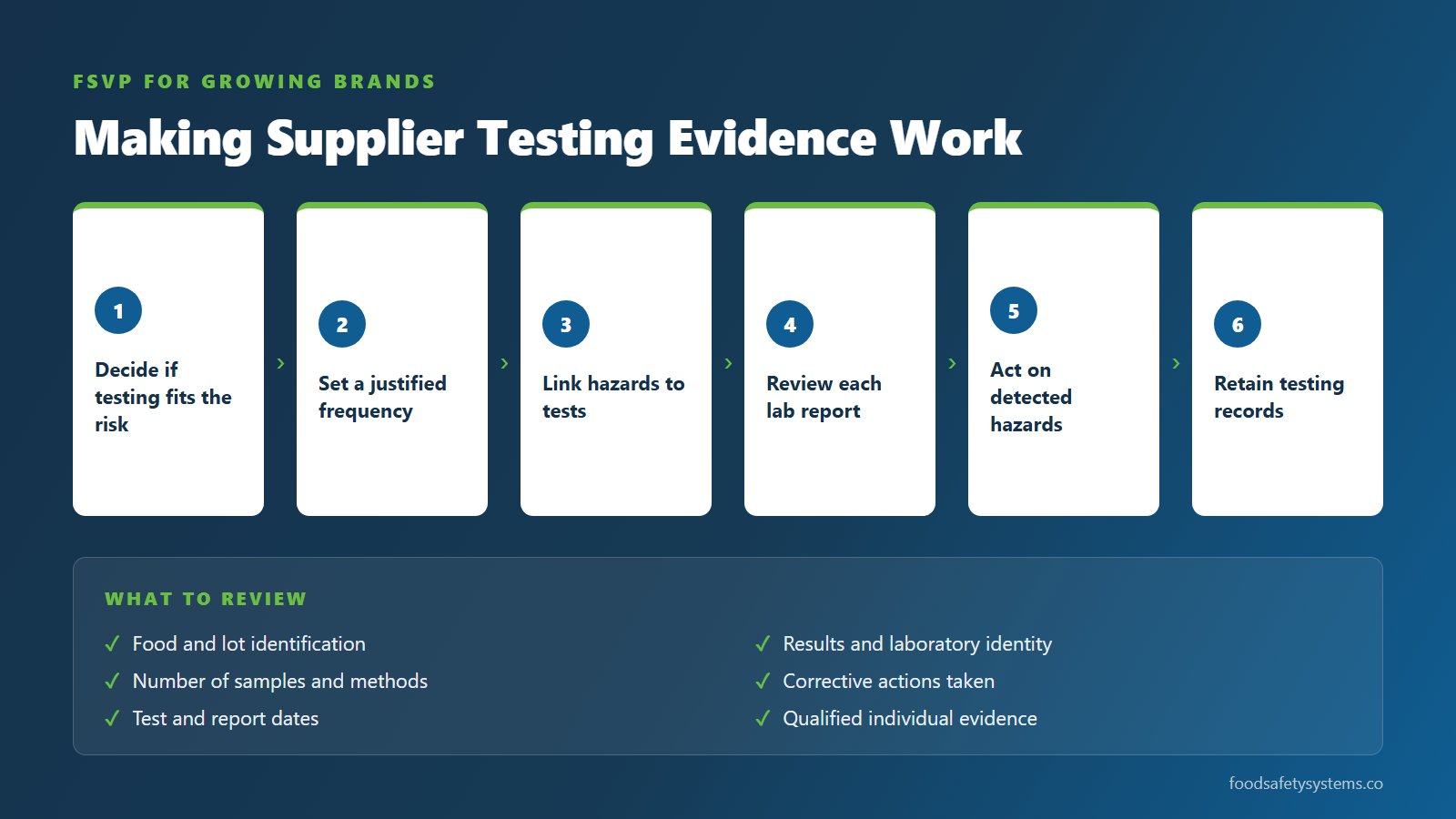
4. Review each lab report
Check that the report names the right food and lot, the sample count, the method, the dates, the results and the laboratory. Then compare results to your criteria and record a conclusion. A COA is useful evidence, but on its own it does not show that every FSVP obligation is met.
5. Act on detected hazards
If a result shows a hazard or does not give adequate assurance, take appropriate corrective action under 21 CFR 1.508. Depending on the facts, that may mean holding product, investigating with the supplier or pausing use of the supplier. Also consider whether your verification activities need to change.
6. Retain testing records
Keep testing documentation under 21 CFR 1.510. Records must be legible, available promptly to FDA on request and generally kept for at least two years. Our page on product testing and inspection covers related controls.
Common gaps in growing brands
- COAs filed without anyone reviewing or concluding on them.
- Identical test panels for every food and supplier, regardless of hazard.
- Missing lot numbers, methods or laboratory details on reports.
- Testing costs rising with no written risk rationale.
- Out-of-specification results handled by email with no corrective action record.
How supplier testing relates to an FSSC 22000 system
FSVP is a U.S. importer obligation, and FSSC 22000 certification does not satisfy it by itself. Still, an FSSC 22000 system already covers control of purchased materials and verification of incoming goods. Your hazard-to-test map and lab report reviews can sit inside that supplier control process.
A supplier’s FSSC 22000 certificate or audit report can be one input when you set testing frequency. However, it does not replace testing where testing is the chosen activity. For examples, see chemical hazard assessment and supplier assurance for fruit ingredients and FSSC 22000 seafood supplier verification.
Example: a beverage brand adds an apple puree supplier
A growing beverage brand imports apple puree from a new overseas processor. The hazard analysis identifies pesticide residues and patulin as hazards requiring a control. The team chooses sampling and testing, plus a review of the processor’s records.
Initially, every lot is tested at an accredited laboratory. Each report is checked for lot, method, dates and results, then signed off by a qualified individual. After a run of conforming lots, the team documents a move to periodic testing. When one lot later exceeds the internal limit, the lot is held, the supplier investigates and the frequency returns to every lot until results stabilize.
Supplier testing evidence checklist
- Document why sampling and testing is appropriate for each food and supplier.
- Record the frequency and its rationale.
- Map each hazard to an analyte, method and acceptance criteria.
- Confirm food and lot identity, sample count, dates, results and laboratory on every report.
- Show that a qualified individual conducted the testing and that results were reviewed promptly.
- Document corrective actions for detected hazards.
- Keep required records apart from customer specifications and voluntary tests.
Frequently asked questions
Is supplier testing required for every imported food?
No. Sampling and testing is one of several verification activities. The importer selects activities and frequency based on its evaluation of the food and supplier.
Can I rely on a supplier’s own COA?
Sampling and testing is the one activity the supplier may perform itself. You still need the required details, a qualified individual, and your own documented review of the results.
What happens if a test detects a hazard?
Take appropriate corrective action and document it. Then decide whether to keep using the supplier and whether verification activities should change.
How Consultare Inc. Group can help
Consultare Inc. Group helps growing brands build evidence inventories, hazard-to-test maps, lab report gap reviews and follow-up tracking. The importer keeps responsibility for choosing verification activities. Services are tailored to the agreed scope.
- Supplier verification support: review of supplier testing evidence.
- FSSC 22000 and FDA compliance integration: connect testing records to supplier control.
- Review foreign supplier records: the companion guide to record review.
Need help managing your FSVP testing evidence?
Discuss your products, suppliers, test data and next steps with our team. Contact us or book a free consultation.
Prefer to organize your compliance activities yourself? Create a free SystemsBuilder account to structure test results, supplier information and corrective actions.
Technical sources: 21 CFR 1.506, 21 CFR 1.508 and 21 CFR 1.510. This article is educational and is not legal advice, FDA endorsement or a guarantee of compliance. FSVP obligations vary by food, importer, supplier and any exemption or modified requirement, so have your conclusions reviewed by a qualified individual. Food Safety Systems is an independent consultancy and is not affiliated with the FSSC 22000 Foundation or FDA.