
Quick answer: Foreign supplier reevaluation keeps an approval tied to the food and supplier you use today. Under FDA’s Foreign Supplier Verification Program (FSVP) rule, you must promptly reevaluate when you learn new information about the food’s risks or the supplier’s performance. If no reevaluation has happened by the end of any three-year period, you must reevaluate then. Each reevaluation, and the decisions that follow, must be documented.
This guide is for growing food brands that import ingredients or finished products and keep adding suppliers, sites and recipes. It suits supplier quality managers, food safety leads and founders who own the approved supplier list.
Why approvals go stale as a brand grows
Fast-growing brands often rely on an original supplier approval long after things have changed. A co-packer moves production to a second plant. An ingredient picks up a new allergen. A supplier lands on an FDA import alert. Yet the approval file still shows the picture from two years ago.
At the same time, not every change is an emergency. A new sales contact or invoice address does not alter food safety risk. Therefore, a scalable process needs to catch meaningful changes without treating every administrative update as an incident.
What the FSVP rule says about reevaluation
Under 21 CFR 1.505, the importer evaluates the food and supplier before approval. The evaluation considers the hazard analysis, who controls each hazard, and the supplier’s performance. Performance includes its food safety procedures and practices, its compliance with applicable FDA food safety regulations (including any warning letter, import alert or other compliance action), and its food safety history.
The reevaluation rule then has two triggers. First, when you become aware of new information about those factors, you must promptly reevaluate and document it. If the concerns have changed, you must promptly decide, and document, whether to keep importing from that supplier and whether verification activities should change. Second, if no reevaluation has occurred by the end of any three-year period, you must reevaluate then.
This three-year backstop is a reevaluation requirement, not a mandatory annual audit. You may also rely on a reevaluation done by another entity, if a qualified individual performed it and you review, assess and document it. Exemptions and modified requirements can change these duties for some importers and foods.
Six steps for foreign supplier reevaluation
1. List every supplier and food pair
Approvals apply to a food from a supplier, not to a supplier in general. So start with a current list of each imported food, its supplier and the manufacturing site. Growth often adds pairs that were never formally evaluated.
2. Retrieve prior evaluations
For each pair, pull the last documented evaluation, the hazard analysis it relied on and the approval decision. Note the date, because it starts the three-year clock. Missing evaluations become your first priority.
3. Watch for change triggers
Define what counts as new information. Typical triggers include a new manufacturing site, a formulation or allergen change, an FDA warning letter or import alert, a recall, audit findings, out-of-specification test results and repeated complaints. Ask suppliers to notify you of such changes and log them when they arrive.
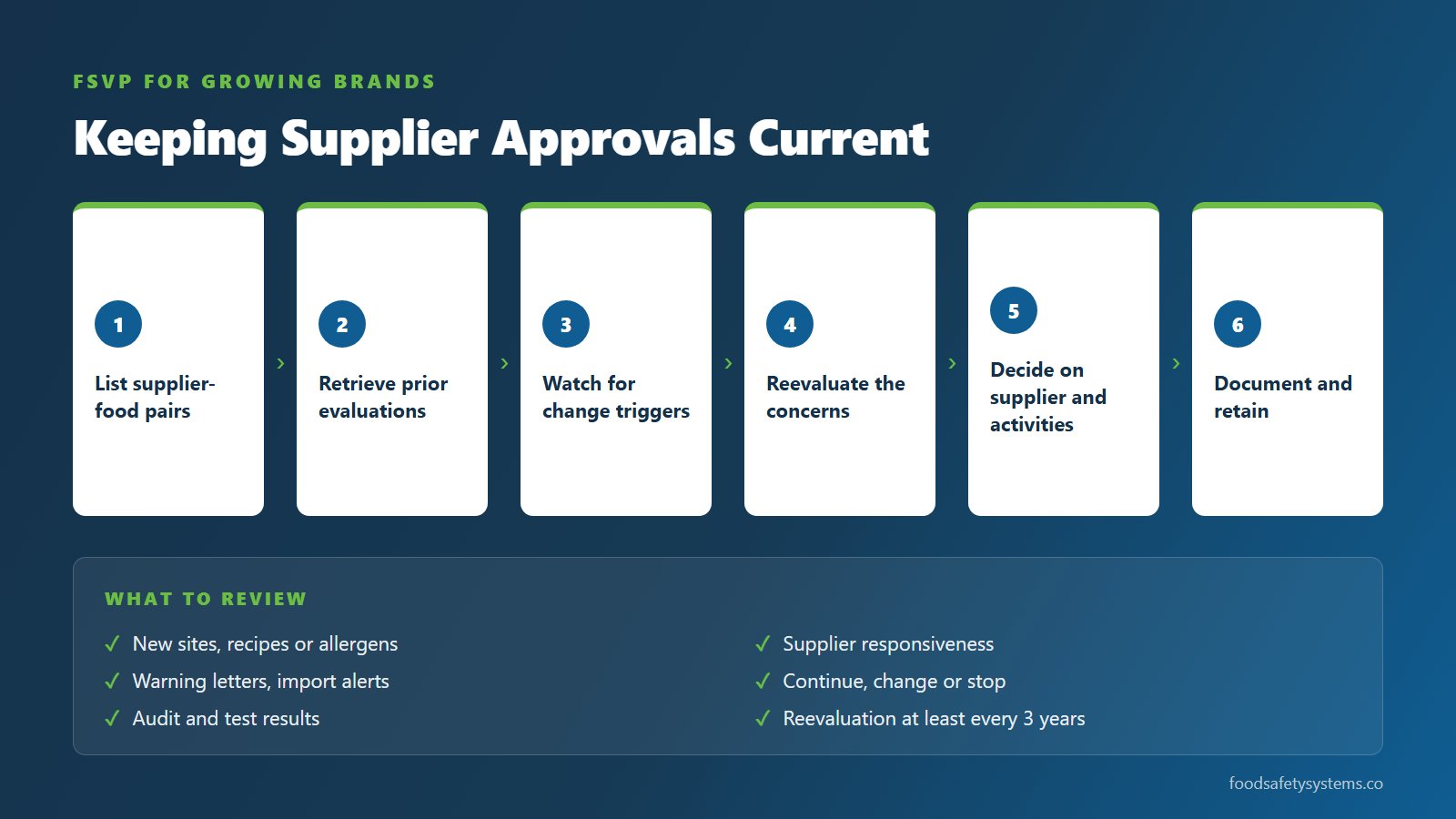
4. Reevaluate the concerns
A qualified individual compares the new information against the prior evaluation. They then judge whether the risk or the supplier’s performance has changed. The conclusion should be specific, such as “allergen profile changed; label and controls need confirmation”.
5. Decide on the supplier and activities
Next, decide whether to continue importing the food from that supplier and whether verification activities need to change. For example, you might add a record review, increase testing or schedule an audit. If the supplier no longer meets the required level of protection, take corrective action under 21 CFR 1.508.
6. Document and retain
Record the reevaluation, the evidence considered, the conclusion, the decisions and any follow-up owners. Keep these records under 21 CFR 1.510. Records tied to evaluations must be kept for at least two years after their use is discontinued, such as after a reevaluation replaces them.
Common gaps in growing brands
- No owner for ongoing FSVP reviews once the launch team moves on.
- Supplier site moves or expansions not reflected in the approval file.
- Import alerts and warning letters not checked after approval.
- Customer review cycles or certification renewals confused with FDA reevaluation duties.
- Reevaluations done but conclusions and decisions never written down.
How reevaluation relates to an FSSC 22000 system
FSVP is a U.S. importer obligation, and FSSC 22000 certification does not satisfy it by itself. Even so, an FSSC 22000 system already expects ongoing monitoring of suppliers and control of purchased materials and externally provided services. It also expects planned management of change. Your reevaluation triggers can feed that same change process.
A supplier’s renewed FSSC 22000 certificate or new audit report is one input to a reevaluation. However, the qualified individual must still judge what changed and what it means for the food. See FSSC 22000 change control, supplier and raw material approval and monitoring and supplier control for imported materials.
Example: a co-packer moves production
A plant-based snack brand learns that its overseas co-packer will move one product line to a sister facility. The current approval covers only the original site. As a result, the quality lead logs the move as new information and starts a reevaluation.
The reviewer requests the new site’s food safety plan, recent audit results and allergen matrix. They also check FDA’s import alert lists and warning letters for the new site. The new site handles sesame, which the old one did not. So the team keeps the supplier approved but adds a record review of allergen controls and a label check. Everything is documented with dates and the reviewer’s name.
Foreign supplier reevaluation checklist
- Keep a current list of every imported food, supplier and site.
- Record the date of each evaluation and track the three-year deadline.
- Define change triggers and ask suppliers to notify you.
- Check FDA compliance information, audit results, test results and complaints.
- Have a qualified individual reevaluate and write a specific conclusion.
- Document decisions on continued use and verification activities.
- Retain reevaluation records and replaced evaluations for the required period.
Frequently asked questions
Does FSVP require an annual supplier reevaluation?
No. The rule requires prompt reevaluation when new information arises, and a reevaluation at least by the end of any three-year period. Some foods and suppliers may still warrant more frequent internal reviews.
What counts as new information?
Anything that affects the evaluation factors, such as a site change, a new hazard, an FDA compliance action, poor test or audit results, or weak responsiveness in correcting problems.
Can someone else do the reevaluation?
Yes. You may review and assess a reevaluation by another entity, if a qualified individual performed it. You must document your review and assessment.
How Consultare Inc. Group can help
Consultare Inc. Group helps growing brands set up supplier change notifications, reevaluation matrices, trigger registers and closure tracking. The importer remains accountable for program decisions, records and corrective actions. Services are tailored to the agreed scope.
- Supplier verification support: structured supplier reevaluation reviews.
- FSSC 22000 and FDA compliance integration: tie reevaluation to change control.
- Make supplier testing evidence work: use test results as reevaluation input.
Need help keeping supplier approvals current?
Discuss your products, suppliers, evaluation dates and next steps with our team. Contact us or book a free consultation.
Prefer to organize your compliance activities yourself? Create a free SystemsBuilder account to structure supplier information, review dates and corrective actions.
Technical sources: 21 CFR 1.505, 21 CFR 1.508 and 21 CFR 1.510. This article is educational and is not legal advice, FDA endorsement, supplier approval or a guarantee of compliance. FSVP obligations vary by food, importer, supplier and any exemption or modified requirement, so have your conclusions reviewed by a qualified individual. Food Safety Systems is an independent consultancy and is not affiliated with the FSSC 22000 Foundation or FDA.