
Quick answer: Hygienic design for utilities means making sure water, compressed air, steam and other utilities cannot contaminate food or food-contact surfaces. The risk comes from unsuitable connections, missing quality controls or poor maintenance. A practical approach maps where each utility touches the process, sets specifications for that use, and then maintains and verifies the system.
This guide is for FSSC 22000 food safety teams, maintenance and engineering managers, and utility owners at food manufacturing sites.
Why utilities are a hidden food safety risk
Utilities are often managed by engineering as background services. However, water, compressed air and steam can affect product safety when they contact food or food-contact surfaces. Problems may come from the supply itself, from the distribution lines or from the point of use.
For example, compressed air may carry oil, moisture or particles if filtration and drainage are not suitable. Similarly, water lines may allow backflow, and steam or cold pipes may produce condensate above open product. These issues are part of your wider FSSC 22000 sanitary design work, and the utilities PRP should address them directly.
What good utility hygiene looks like
- Every point where a utility contacts food, packaging or food-contact surfaces is identified.
- Each use has a defined quality specification based on the actual process and PRP requirements.
- Lines, filters and treatment equipment are designed and installed for the intended use.
- Backflow prevention is in place where waste or non-potable systems could affect potable water.
- Condensate is managed so that it cannot drip onto product or food-contact surfaces.
- Utility equipment is accessible for maintenance, inspection and sampling.
Our page on utilities: water, air and energy sets out the site standard expectations in more detail.
Common utility problems
- Nobody has listed where compressed air or steam contacts product.
- Filters are present but have no change frequency or records.
- Hoses and connections are improvised and left on the floor.
- Condensate drips from pipes or ducts over exposed product areas.
- Water or air quality is assumed rather than monitored where the risk requires it.
Note that room air handling is a related but different topic. Our page on air handling and movement covers ventilation and airflow between zones.
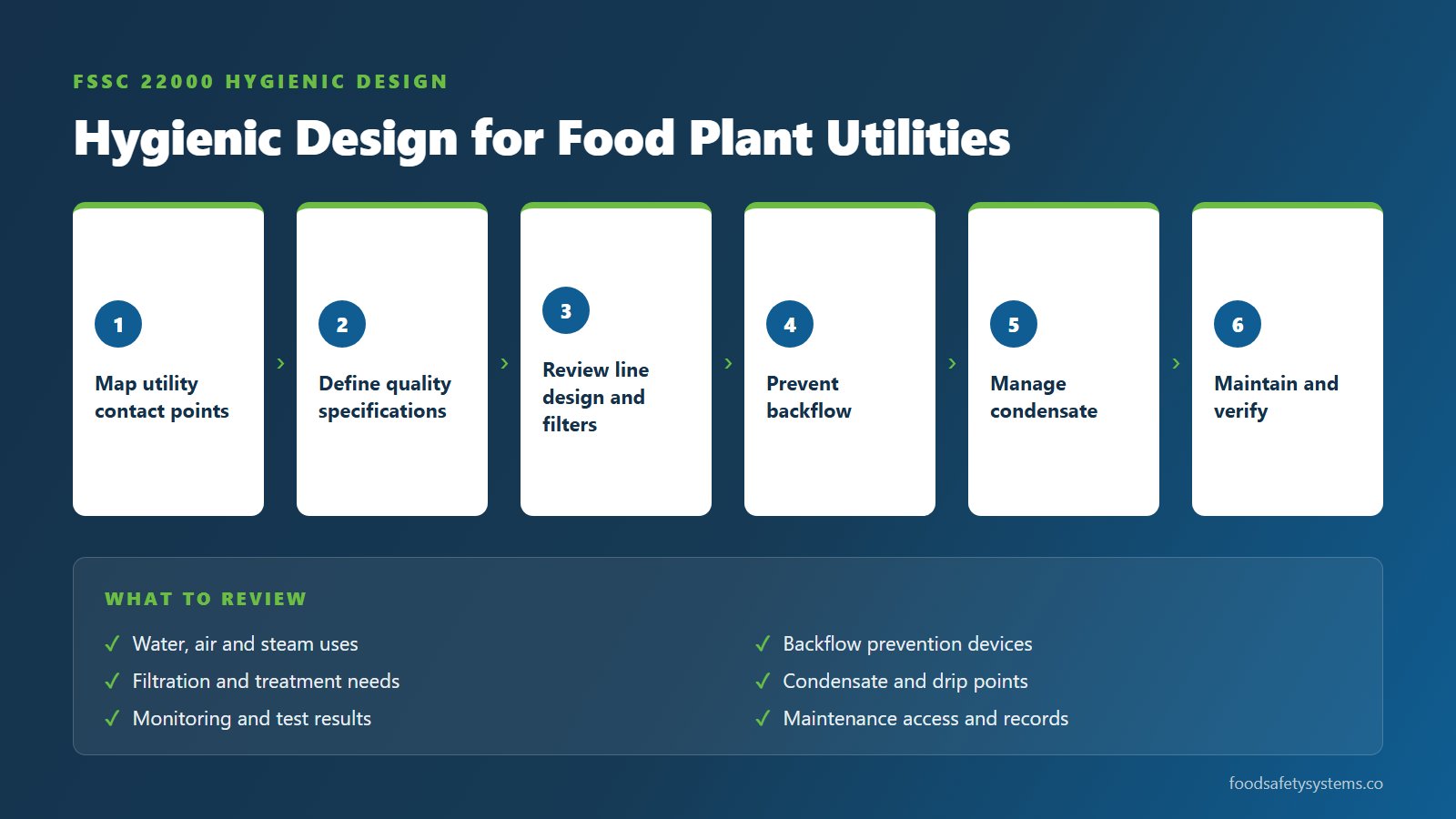
Six steps to apply hygienic design for utilities
1. Map utility contact points
Identify where water, compressed air, steam and other utilities contact food, packaging or food-contact surfaces. Include cleaning uses, such as air used to blow down equipment.
2. Define quality specifications
Determine applicable specifications from the actual process and PRP requirements. The specification for air that contacts product may differ from air used only to drive machinery.
3. Review line design, filtration and treatment
Check line design, materials, filtration and treatment needs for each use. Make sure filters and dryers are located and sized for the point of use.
4. Prevent backflow where relevant
Confirm that backflow prevention is in place where waste or non-potable lines could affect water used for food. Record the devices and how they are checked.
5. Manage condensate
Identify where pipes, ducts and equipment can form condensate. Then make sure drips cannot reach exposed product or food-contact surfaces.
6. Maintain, monitor and verify
Provide maintenance access, filter change frequencies and monitoring where the risk requires it. Our article on FSSC 22000 equipment maintenance explains how to connect this to your maintenance program.
Records and evidence to keep
- A utility map showing contact points and their intended use.
- Quality specifications for each utility use.
- Filter, dryer and treatment maintenance records.
- Monitoring or test results where the risk assessment requires them.
- Backflow device inventory and inspection records.
- Corrective actions for utility failures, with verification of closure.
Example scenario
A confectionery plant uses compressed air to cool and move product on a coating line. During a utility review, the team finds the point-of-use filter has no change record. They also notice water draining from the air line near the coating pan.
As a result, maintenance adds a filter change schedule and installs a drain on the air line. Food safety defines a specification for product-contact air and adds periodic checks. Afterwards, the team adds the line to the utility map and updates the maintenance plan.
U.S. FDA context
For facilities subject to FDA rules, several Current Good Manufacturing Practice requirements in 21 CFR Part 117 apply directly. Under 21 CFR 117.37, water that contacts food, food-contact surfaces or food-packaging materials must be safe and of adequate sanitary quality. Plumbing must also prevent backflow from, or cross-connection with, waste water or sewage piping.
In addition, 21 CFR 117.40 requires that compressed air or other gases introduced into food, or used to clean food-contact surfaces or equipment, are treated so food is not contaminated with unlawful indirect food additives. Finally, 21 CFR 117.20 requires plant construction that prevents drip or condensate from fixtures, ducts and pipes contaminating food. These duties apply independently of FSSC 22000 certification.
Hygienic design for utilities checklist
- Utility contact points with food and food-contact surfaces are mapped.
- Each use has a documented quality specification.
- Filtration, drying and treatment suit the point of use and are maintained.
- Backflow prevention is in place and checked where relevant.
- Condensate risks are identified and controlled.
- Monitoring, maintenance and corrective actions are recorded.
Frequently asked questions
Does all compressed air need testing?
Not necessarily. The need depends on how the air is used and on your hazard assessment. Air that contacts product or food-contact surfaces generally needs closer control than air used only to drive machinery.
Is steam a food safety concern?
It can be, when steam contacts food or food-contact surfaces, or when steam lines create condensate above open product. The same mapping approach applies.
Who owns utility hygiene?
Engineering or maintenance usually own the systems. However, food safety should define specifications and review results, because the impact is on product safety.
How Consultare Inc. Group can help
Consultare Inc. Group can help teams coordinate utility risk reviews, FSSC 22000 prerequisite documentation, change-control records and gap follow-up. Exact deliverables depend on the approved scope. Facility management retains responsibility for approving and implementing changes. We do not promise certification, regulatory approval or an audit outcome.
- FSSC 22000 implementation readiness: utility controls checked before your audit.
- FSSC 22000 and FDA compliance integration: align utility PRPs with Part 117.
- Corrective action support: verification that utility fixes hold.
Need help managing your FSSC 22000 responsibilities?
Discuss your products, process, records, risks and next steps with our team. Contact us or book a free consultation.
Prefer to organize your compliance activities yourself? Create a free SystemsBuilder account to structure utility maps, maintenance records and corrective actions.
Technical sources: FSSC 22000, 21 CFR 117.37, 21 CFR 117.40 and 21 CFR 117.20. This article is educational; requirements depend on your products, certification scope and applicable regulations. Food Safety Systems is an independent consultancy and is not affiliated with the FSSC 22000 Foundation or FDA.