
FSSC 22000 pest exclusion depends on the building as much as on bait stations and monitoring records. Small gaps at doors, utility penetrations, roofs and loading areas can let pests in, even when every trap is checked on time. Physical design is therefore part of an effective exclusion strategy.
Quick answer: map every opening in the building envelope, inspect door seals, screens, wall penetrations, roofs, exterior drainage and waste areas, and record each structural defect with an owner and deadline. Then review pest activity trends with your pest control provider and maintenance team, and verify that repairs hold.
This guide is for FSSC 22000 facility managers, maintenance teams, food safety coordinators and pest management providers.
What good pest exclusion looks like
Good exclusion means pests have no easy way in, nowhere to hide and nothing to attract them. In practice, external doors close tightly and stay closed when not in use. Openings for pipes, cables and ducts are sealed. Roofs, gutters and drains are maintained, and waste areas are kept tidy and away from entrances.
Equally important, the site treats the building envelope as a living control. Defects are found during routine checks, logged and fixed quickly. As a result, pest control reports show exclusion problems before they become infestations. Our page on external and internal site condition explains the wider site standards.
Common weak points at building interfaces
- Dock doors and dock levelers with worn or missing seals and brush strips.
- Personnel doors propped open for ventilation or convenience.
- Damaged or missing screens on windows, vents and air intakes.
- Unsealed holes where new pipes, cables or ducts pass through walls.
- Gaps at roof edges, wall-to-roof joints and around roof plant.
- Exterior drains, standing water and vegetation close to the building.
- Waste compactors and bins near doors, with spillage around them.
These problems often appear after construction work or equipment changes. Therefore, exclusion checks should follow any project that opens walls or roofs.
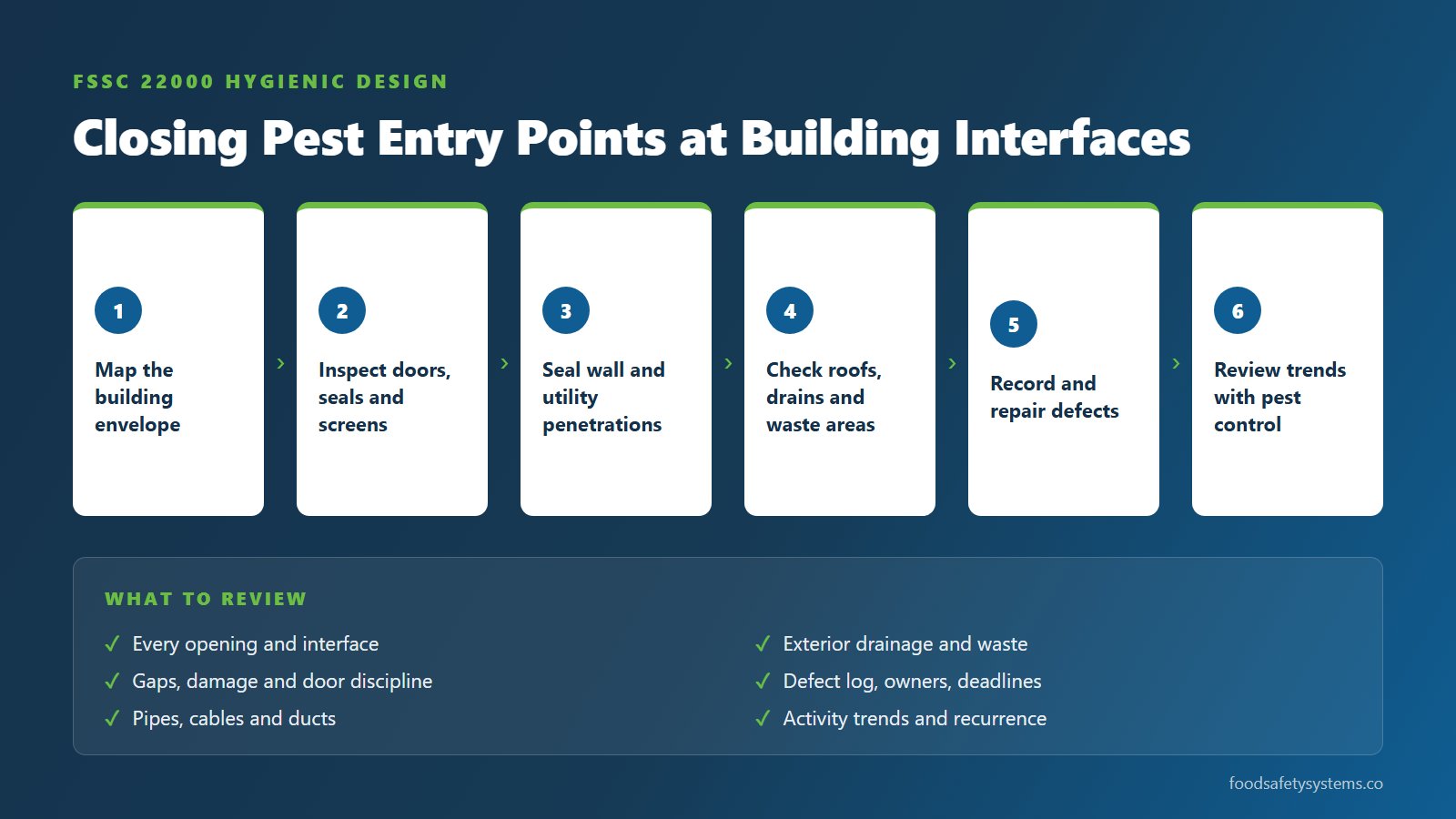
Six steps to strengthen pest exclusion at building interfaces
1. Map the building envelope
Draw or update a site plan showing every external door, window, vent, utility entry, drain and roof access. Mark loading areas and waste points. This map becomes the basis for inspections and trend analysis.
2. Inspect doors, seals and screens
Check that doors close fully and seals are intact along the bottom and sides. Look for daylight around closed doors. In addition, confirm that screens on opening windows, vents and intakes are fitted and undamaged.
3. Seal wall and utility penetrations
Inspect where pipes, cables and ducts pass through walls, floors and ceilings. Seal gaps with suitable materials that suit the area and can be cleaned. Make sure contractors know to seal new openings before they leave. See our page on maintenance and repair for how repairs should be controlled.
4. Check roofs, drains and waste areas
Inspect roof edges, plant areas and gutters for gaps and standing water. Review exterior drainage and vegetation near walls. Keep waste areas clean and covered, and position them away from entrances where possible. Our page on waste management covers waste controls in more detail.
5. Record and repair defects
Log every structural defect with its location, description, potential hazard and photo. Then assign an owner and a deadline based on risk. Track open items until they are closed and verified.
6. Review trends with pest control
Compare pest activity data with the defect log and the site map. Look for clusters near particular doors or penetrations. Then agree follow-up actions with your provider, as described in our pest control program page.
Records and evidence to keep
- A building envelope map showing doors, vents, penetrations, drains and waste areas.
- Inspection records for doors, seals, screens, roofs and exterior areas.
- A defect log with photos, owners, deadlines and closure dates.
- Pest control service reports and activity trends.
- Maintenance and contractor records showing openings sealed after work.
- Corrective actions with root cause and effectiveness checks.
When a defect is found, document it first with the affected area and evidence. Next, assess severity and likelihood, and assign an owner and deadline. Then implement a suitable engineering or procedural fix, coordinated between pest management and maintenance. Finally, verify the repair and keep objective evidence.
Example scenario
A pest control report shows rising rodent activity near the raw material store. The food safety coordinator compares the trend with the site map. As a result, the team finds a new cable entry behind a pallet rack that was left unsealed after an electrical upgrade.
The team logs the defect with photos and rates it as high priority. Maintenance seals the opening, and the contractor procedure is updated to require a sealing check before sign-off. Meanwhile, the pest control provider increases monitoring in that area for four weeks. Activity returns to normal, and the action is closed with the trend data as evidence.
U.S. FDA context
For U.S. facilities, FSSC 22000 certification does not replace FDA current good manufacturing practice under 21 CFR Part 117. Several cGMP provisions apply directly to pest exclusion.
- 21 CFR 117.35 states that pests must not be allowed in any area of a food plant, and effective measures must be taken to exclude pests from manufacturing, processing, packing and holding areas.
- 21 CFR 117.20 requires grounds to be kept free of litter, waste and overgrowth that may attract or harbor pests, and requires adequate screening or other protection against pests where necessary.
- 21 CFR 117.37 requires rubbish to be conveyed, stored and disposed of so it does not become an attractant and harborage for pests.
These legal duties apply separately from your certification scope. Confirm how they apply to your operation.
FSSC 22000 pest exclusion checklist
- The building envelope map is current and covers every opening.
- External doors close fully, and seals are intact.
- Screens on windows, vents and intakes are fitted and undamaged.
- Wall, floor and roof penetrations are sealed after every project.
- Roofs, gutters and exterior drains are inspected and maintained.
- Waste areas are clean, covered and away from entrances.
- Defects have owners, deadlines and verified closure.
- Pest activity trends are reviewed against the defect log.
Frequently asked questions
Is pest monitoring enough without physical exclusion?
No. Monitoring shows where pests are, but it does not stop them getting in. Exclusion and monitoring work together.
Who should own building defects that affect pest control?
Usually maintenance owns the repair, while food safety tracks closure and verifies the result. The pest control provider can help identify and prioritize defects.
How often should the building envelope be inspected?
Set the frequency by risk, season and site history. Many sites combine routine checks with extra inspections after construction work or pest activity spikes.
How Consultare Inc. Group can help
Consultare Inc. Group can help FSSC 22000 teams organize facility condition checks, prerequisite program documentation and root-cause corrective actions. Facility management keeps responsibility for approving and implementing changes, and CIG does not promise certification, regulatory approval or a particular audit outcome.
- FSSC 22000 implementation readiness: pest and facility PRPs checked before your audit.
- FSSC 22000 and FDA compliance integration: align your FSMS with Part 117 cGMPs.
- Corrective action support: verification that exclusion repairs hold.
Need help managing your FSSC 22000 responsibilities?
Discuss your products, process, records, risks and next steps with our team. Contact us or book a free consultation.
Prefer to organize your compliance activities yourself? Create a free SystemsBuilder account to structure inspections, defect logs and corrective actions.
Technical sources: FSSC 22000 and 21 CFR Part 117. This article is educational; requirements depend on your products, certification scope and applicable regulations. Food Safety Systems is an independent consultancy and is not affiliated with the FSSC 22000 Foundation or FDA.