
FSSC 22000 equipment design has to answer a simple question: can your team clean this surface, and can they see that it is clean? If inspectors cannot see or reach a critical surface, routine checks may miss deterioration or residual soil. Cleanability and inspectability therefore need to be evaluated together.
Quick answer: list the surfaces where product, residues or moisture collect, then confirm there is enough clearance, safe access, practical dismantling, good lighting and the right inspection tools to reach each one. Match cleaning methods to those surfaces, and track every recurring “hard-to-reach” finding until the design or method is fixed.
This guide is for FSSC 22000 operations, engineering, sanitation and food safety managers who own equipment-related prerequisite programs (PRPs).
What good equipment design for cleaning and inspection looks like
Well-designed equipment lets a trained person clean and inspect every relevant surface in a reasonable time, without unsafe shortcuts. In practice, frames stand clear of walls and floors, guards come off without special tools where safe, and internal surfaces can be opened or viewed. Lighting is good enough to see residues, and inspectors have torches, mirrors or scopes where needed.
Just as important, the cleaning method fits the design. A sanitation SOP that assumes full dismantling is not realistic if a machine takes four hours to strip. As a result, gaps between design and method often show up as repeat findings in the same places. For background on design in hygienic zones, see our page on equipment and facility design for risk zones.
Common problems with inaccessible equipment surfaces
- Equipment installed tight against walls, floors or other machines, leaving gaps no one can clean.
- Hollow frames, open tubes and unsealed joints where residues and moisture collect.
- Guards and covers that need tools or several people to remove.
- Poor lighting inside and under equipment, so residues are missed.
- Inspection steps that say “check” without saying how or with what.
- The same inaccessible-area finding raised month after month with no design change.
These problems rarely improve through documentation alone. Instead, the team needs to understand the equipment and its surroundings.
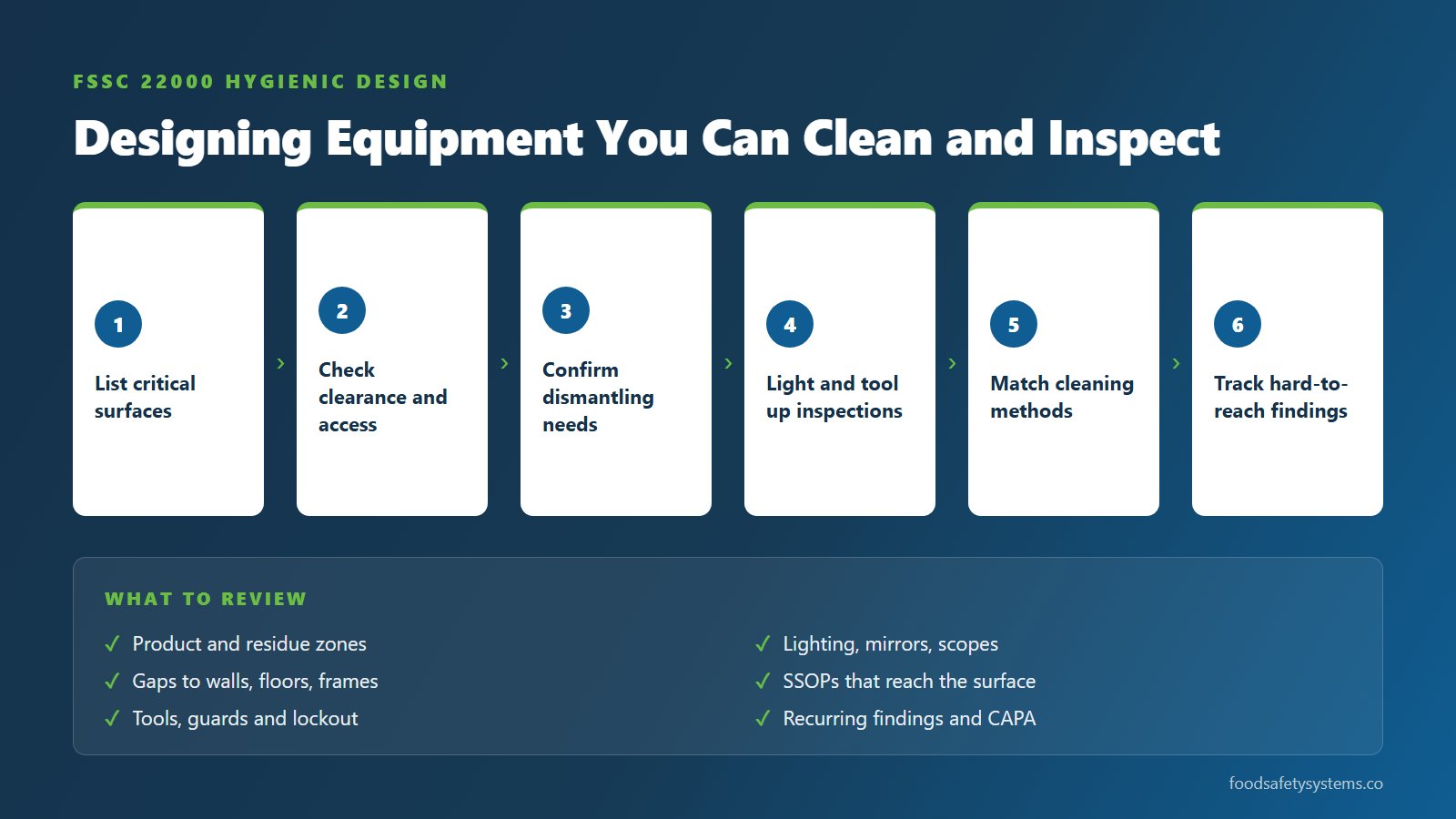
Six steps to design equipment for effective cleaning and inspection
1. List critical surfaces
For each machine, identify where food, residues, moisture or allergens could accumulate. Include product-contact surfaces, splash zones, frames, drip trays and areas under conveyors. This list becomes the basis for cleaning and inspection.
2. Check clearance and access
Review the space around and under equipment. Confirm that cleaners and inspectors can reach each critical surface safely. Where access is poor, consider relocating, raising or modifying the equipment.
3. Confirm dismantling needs
Decide which parts must be removed for cleaning and inspection, and how often. Check whether this can be done safely, with lockout and the right tools. Then build realistic time into the sanitation schedule. Our page on equipment suitability and maintenance covers related site standards.
4. Light and tool up inspections
Make sure lighting is adequate where equipment is cleaned and inspected. Provide torches, mirrors, inspection scopes or swabs where internal surfaces cannot be seen directly. Define in the inspection procedure what to look for and where.
5. Match cleaning methods
Align cleaning methods, chemicals and tools with the equipment design. If a surface cannot be reached with the current method, change the method or the design. Our page on cleaning and sanitation covers the wider program.
6. Track hard-to-reach findings
Record every inaccessible-area finding in one register. Review trends regularly, and escalate repeat findings to engineering or management. Close actions only when the design or method has changed and the result is verified.
Records and evidence to keep
- An equipment assessment register listing critical surfaces, access and dismantling needs.
- Sanitation SOPs that state how each critical surface is cleaned and inspected.
- Pre-operational inspection records, including findings in hard-to-reach areas.
- Equipment repair and modification records.
- Verification results, such as visual checks or swabs where used.
- Corrective actions with the observed condition, potential hazard, owner, deadline and closure evidence.
When a problem is found, document the condition and the evidence first. Next, prioritize it by severity and likelihood, and assign an owner and deadline. Then implement an engineering or procedural change agreed by food safety, sanitation, operations and maintenance. Finally, verify the result and keep objective evidence. Our article on FSSC 22000 hygienic equipment verification explains how to verify equipment controls in more depth.
Example scenario
Pre-op inspections on a slicer line keep recording “residue under conveyor – not reachable.” The finding appears in most weeks. As a result, the food safety manager reviews the equipment with sanitation and engineering.
The team finds that the conveyor frame sits too close to the floor, and the side guards need tools to remove. Engineering raises the frame and fits quick-release guards. Meanwhile, sanitation updates the SOP and adds a torch and mirror to the inspection kit. After four weeks without the finding, the action is closed with photos and inspection records.
U.S. FDA context
For U.S. facilities, FSSC 22000 certification does not replace FDA current good manufacturing practice under 21 CFR Part 117. Several cGMP provisions relate directly to equipment design for cleaning and inspection.
- 21 CFR 117.40 requires equipment and utensils to be designed and made to be adequately cleanable, and equipment to be installed so as to facilitate cleaning and maintenance of the equipment and adjacent spaces.
- The same section requires seams on food-contact surfaces to be smoothly bonded or maintained to minimize accumulation of food particles, dirt and organic matter.
- 21 CFR 117.20 requires adequate working space between equipment and walls, and adequate lighting where equipment or utensils are cleaned.
These legal duties apply separately from your certification scope. Voluntary hygienic design guidance, such as that published by EHEDG, can also help when you specify or modify equipment.
FSSC 22000 equipment design checklist
- Critical surfaces are listed for each piece of equipment.
- Clearance around and under equipment allows safe cleaning and inspection.
- Dismantling needs are defined, practical and built into schedules.
- Lighting and inspection tools reach internal and hidden surfaces.
- Cleaning methods match the equipment design.
- Hard-to-reach findings are tracked in one register.
- Repeat findings lead to design or method changes.
- Closure is verified with objective evidence.
Frequently asked questions
Is cleanability the same as inspectability?
No. A surface may be cleanable but hidden from view, so residues are missed. Good design allows both effective cleaning and a reliable check that cleaning worked.
What should we do about older equipment that is hard to clean?
Start with a risk-based review of critical surfaces. Then decide whether to modify the equipment, change the cleaning method, add inspection tools or plan replacement.
Who should be involved in an equipment design review?
Include food safety, sanitation, operations and maintenance or engineering. Each group sees different problems, and all of them must agree the fix.
How Consultare Inc. Group can help
Consultare Inc. Group supports FSSC 22000 prerequisite program reviews, equipment assessment registers and continuous improvement coordination. Facility management keeps responsibility for approving and implementing changes, and CIG does not promise certification, regulatory approval or a particular audit outcome.
- FSSC 22000 implementation readiness: equipment and sanitation PRPs checked before your audit.
- FSSC 22000 and FDA compliance integration: align your FSMS with Part 117 cGMPs.
- Corrective action support: verification that design fixes hold.
Need help managing your FSSC 22000 responsibilities?
Discuss your products, process, records, risks and next steps with our team. Contact us or book a free consultation.
Prefer to organize your compliance activities yourself? Create a free SystemsBuilder account to structure equipment registers, inspection records and corrective actions.
Technical sources: FSSC 22000, 21 CFR Part 117 and EHEDG. This article is educational; requirements depend on your products, certification scope and applicable regulations. Food Safety Systems is an independent consultancy and is not affiliated with the FSSC 22000 Foundation, FDA or EHEDG.