
FSSC 22000 outsourced maintenance brings skilled people into your plant, but they may not know your hygienic zoning or sanitation release rules. A contractor who drills into a wall above an open line, leaves swarf behind or uses the wrong lubricant can introduce new hazards. Clear contractor controls reduce the chance that maintenance work creates a food safety problem.
Quick answer: induct contractors on site hygiene rules, control their access, tools and clothing, approve repair materials before use, and protect product and zones while work is under way. After the job, clean and inspect the area, then release it for production only when documented evidence shows it is safe.
This guide is for FSSC 22000 food safety, maintenance, engineering and contractor management teams.
What good control of outsourced maintenance looks like
In a well-controlled site, every contractor knows the hygiene rules before they start. Their access is limited to the areas they need, and their tools and materials are checked in and out. Work that affects product areas is planned with food safety, so product can be removed or protected.
Just as important, there is a clear handover at the end. The area is cleaned, inspected and released by a competent site person before production restarts. That release is recorded, so anyone can see who checked what and when. For general rules on people entering the site, see our page on visitor and contractor controls.
Common problems with contractor maintenance
- Contractors entering production without induction, workwear or handwashing.
- Tools, fasteners or offcuts left on or inside equipment after work.
- Non-approved lubricants, sealants or replacement parts used on food equipment.
- Open product or packaging left exposed during drilling, welding or grinding.
- Equipment restarted before cleaning and inspection are complete.
- Work orders closed without any record of hygiene release.
These issues rarely improve through documentation alone. Instead, the contractor process needs clear responsibilities and checks.
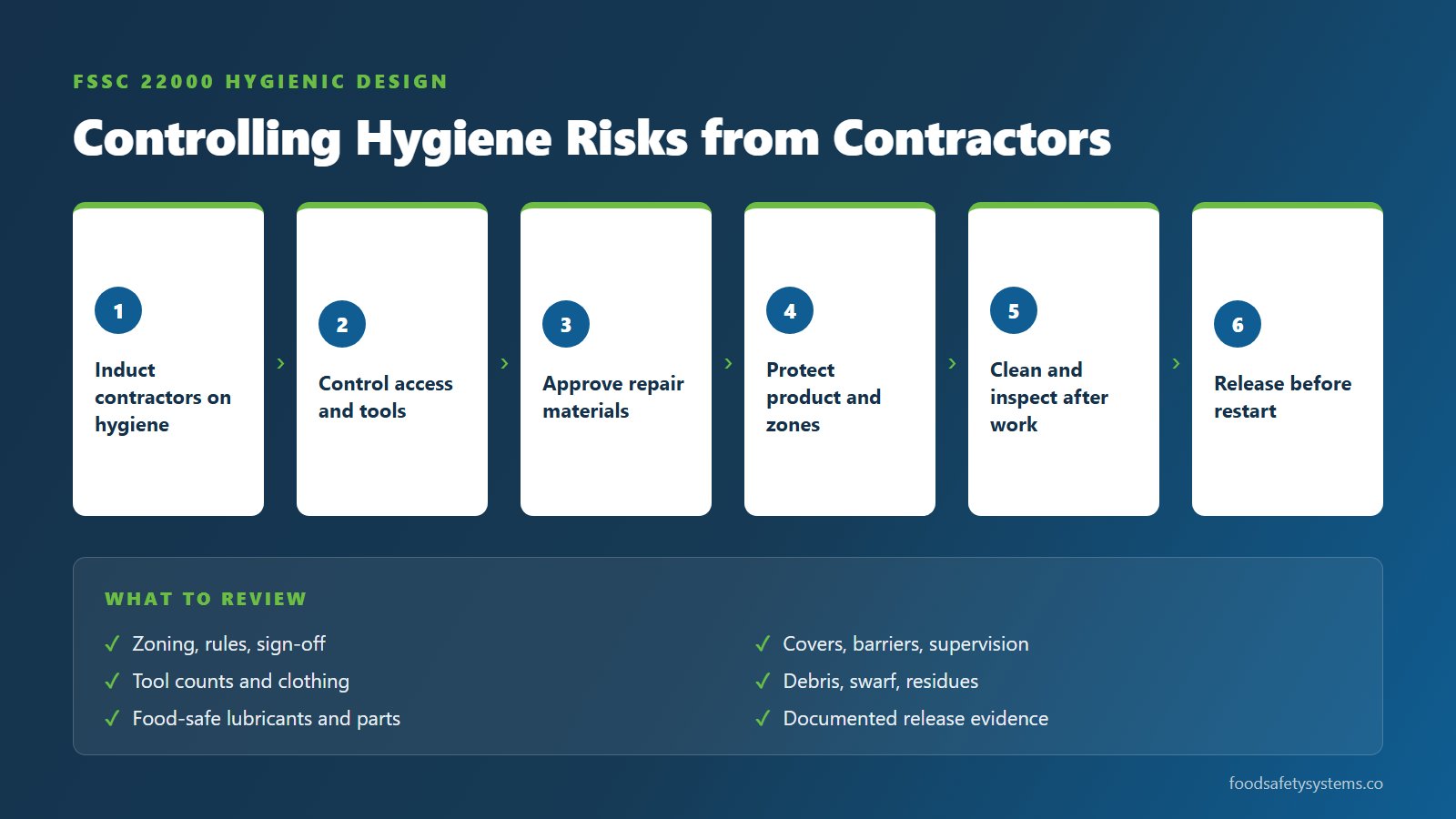
Six steps to control hygiene risks from outsourced maintenance
1. Induct contractors on hygiene
Brief every contractor on hygienic zones, clothing, handwashing, glass and brittle plastics rules, and reporting duties. Keep the induction short and practical. Then record who attended and when.
2. Control access and tools
Limit access to the areas named in the work order. Check tools in and out, especially in open-product areas. In addition, require clean tools and suitable workwear for each hygienic zone.
3. Approve repair materials
Define which lubricants, sealants, gaskets and parts may be used on food equipment and in production areas. Ask contractors to use approved materials only, or to get approval before using anything else. Our article on FSSC 22000 equipment maintenance and food safety risk covers material selection in more detail.
4. Protect product and zones
Plan work with operations and food safety. Remove or cover product, packaging and food-contact surfaces before work starts. Where possible, schedule work during downtime and use barriers to contain dust, debris and noise.
5. Clean and inspect after work
After the job, remove debris, swarf, dust and residues. Then clean and, where needed, sanitize the affected area. Check equipment for missing parts, loose fasteners and left-behind tools.
6. Release before restart
Make a competent site person responsible for hygiene release. Define the evidence needed, such as a signed checklist, tool count and inspection result. Restart production only after release is recorded. Our page on start-up and changeover procedures explains how release links to start-up checks.
Records and evidence to keep
- Contractor approval and induction records.
- Work orders or permits that state the area, hazards and protective measures.
- Tool and material check-in and check-out records.
- A list of approved lubricants, sealants and parts.
- Post-maintenance cleaning, inspection and hygiene release records.
- Corrective actions with the observed condition, potential hazard, owner, deadline and closure evidence.
When a problem is found, document the condition and the evidence first. Next, prioritize it by severity and likelihood, and assign an owner and deadline. Then implement an engineering or procedural fix agreed by food safety, sanitation, operations and maintenance. Finally, verify the result and keep objective evidence. If the work changes equipment or layout, route it through FSSC 22000 change control as well.
Example scenario
An external engineer replaces a bearing on a mixer during a weekend shutdown. On Monday, a pre-op check finds metal shavings in the mixer bowl. The engineer had not been told about the release procedure.
The team holds the line, cleans and inspects the mixer, and checks product made since restart. Food safety records the event and rates it as a physical hazard. As a result, the contractor procedure is updated with a mandatory release checklist and tool count. Meanwhile, all regular contractors complete a short hygiene induction. Over the next quarter, release records are complete and no similar findings occur, so the action is closed.
U.S. context for FDA-regulated facilities
For U.S. facilities, FSSC 22000 certification does not replace FDA current good manufacturing practice. For example, 21 CFR 117.40 requires equipment to be designed, constructed and used to avoid adulteration of food with lubricants, fuel, metal fragments, contaminated water or other contaminants. That duty applies whether maintenance is done by your own staff or by contractors.
FSSC 22000 outsourced maintenance checklist
- Contractors complete a hygiene induction before work starts.
- Access is limited to the areas named in the work order.
- Tools and materials are checked in and out of production areas.
- Only approved lubricants, sealants and parts are used.
- Product, packaging and food-contact surfaces are protected during work.
- The area is cleaned and inspected after work.
- A competent site person records hygiene release before restart.
- Problems are documented, prioritized, fixed and verified.
Frequently asked questions
Who should release equipment after contractor maintenance?
A competent site person, usually from production, sanitation or food safety, rather than the contractor alone. The release should be recorded before production restarts.
Do contractors need the same hygiene training as employees?
They need training suited to the areas and tasks involved. A short, practical induction on zoning, clothing, handwashing and reporting is often enough for most jobs.
How does outsourced maintenance differ from in-house maintenance?
The hazards are similar, but contractors may not know your rules or equipment. As a result, induction, supervision and release checks become more important.
How Consultare Inc. Group can help
Consultare Inc. Group can help FSSC 22000 teams review contractor control procedures, maintenance release records and management system improvement actions. Facility management keeps responsibility for approving and implementing changes, and CIG does not promise certification, regulatory approval or a particular audit outcome.
- FSSC 22000 implementation readiness: contractor and maintenance PRPs checked before your audit.
- Corrective action support: verification that contractor controls hold.
- Food safety training: practical hygiene inductions for contractors and maintenance teams.
Need help managing your FSSC 22000 responsibilities?
Discuss your products, process, records, risks and next steps with our team. Contact us or book a free consultation.
Prefer to organize your compliance activities yourself? Create a free SystemsBuilder account to structure contractor records, release checklists and corrective actions.
Technical sources: FSSC 22000 and 21 CFR 117.40. This article is educational; requirements depend on your products, certification scope and applicable regulations. Food Safety Systems is an independent consultancy and is not affiliated with the FSSC 22000 Foundation or FDA.