
Quick answer: FSSC 22000 sanitary design means treating building and equipment conditions as part of your food safety management system (FSMS), not as a separate engineering topic. Surfaces, equipment, layout and drainage decide how well cleaning, inspection and maintenance can work. When those conditions are weak, even well-written prerequisite programs (PRPs) become hard to follow every day.
This guide is for food safety management teams, sanitation leads, maintenance managers and operations managers at FSSC 22000 certified or certifying sites. It explains what good sanitary design looks like, where it usually fails and how to manage it as a routine part of your PRPs.
Why sanitary design belongs in your PRPs
An effective FSMS considers facility and equipment conditions alongside operational controls. Sanitary design decisions directly influence how practical cleaning, inspection and preventive maintenance are. A surface that cannot be reached cannot be cleaned or inspected reliably, regardless of what the procedure says.
Sector PRP standards such as ISO/TS 22002-1 cover topics like construction and layout, utilities, equipment suitability, cleaning, pest control and maintenance. Sanitary design runs through all of them. For that reason, it works best as a shared responsibility of food safety, sanitation, maintenance and operations. Our page on equipment and facility design for risk zones shows how design expectations change between production areas.
What good sanitary design looks like
Good sanitary design is not about perfect, brand-new facilities. Instead, it means conditions that let your team prevent contamination with reasonable effort. In practice, look for these features:
- Smooth, durable and suitable surfaces that are accessible for cleaning and inspection.
- Equipment installed and maintained to minimize food residue, moisture accumulation and difficult-to-clean areas.
- A facility layout, and personnel and material movement, that limit unnecessary allergen cross-contact and cross-contamination.
- Drainage, condensation controls and maintenance practices that suit the product and process.
Each of these features supports a specific PRP. For example, accessible surfaces support cleaning and sanitation, while sound installation supports equipment suitability and maintenance.
Common sanitary design problems
Many sites know their weak spots but have never recorded them in a structured way. As a result, the same issues return after every audit or sanitation review. Typical examples include:
- Hollow frames, open seams or ledges where product residue and water collect.
- Equipment placed so close to walls or other equipment that cleaning crews cannot reach behind it.
- Condensation forming above exposed product or food-contact surfaces.
- Floors that hold water because drains are poorly placed or damaged.
- Traffic routes that move people or materials from dirty areas into exposed-product areas.
These problems rarely improve through documentation alone. Instead, the underlying site conditions need to be understood, prioritized and addressed.
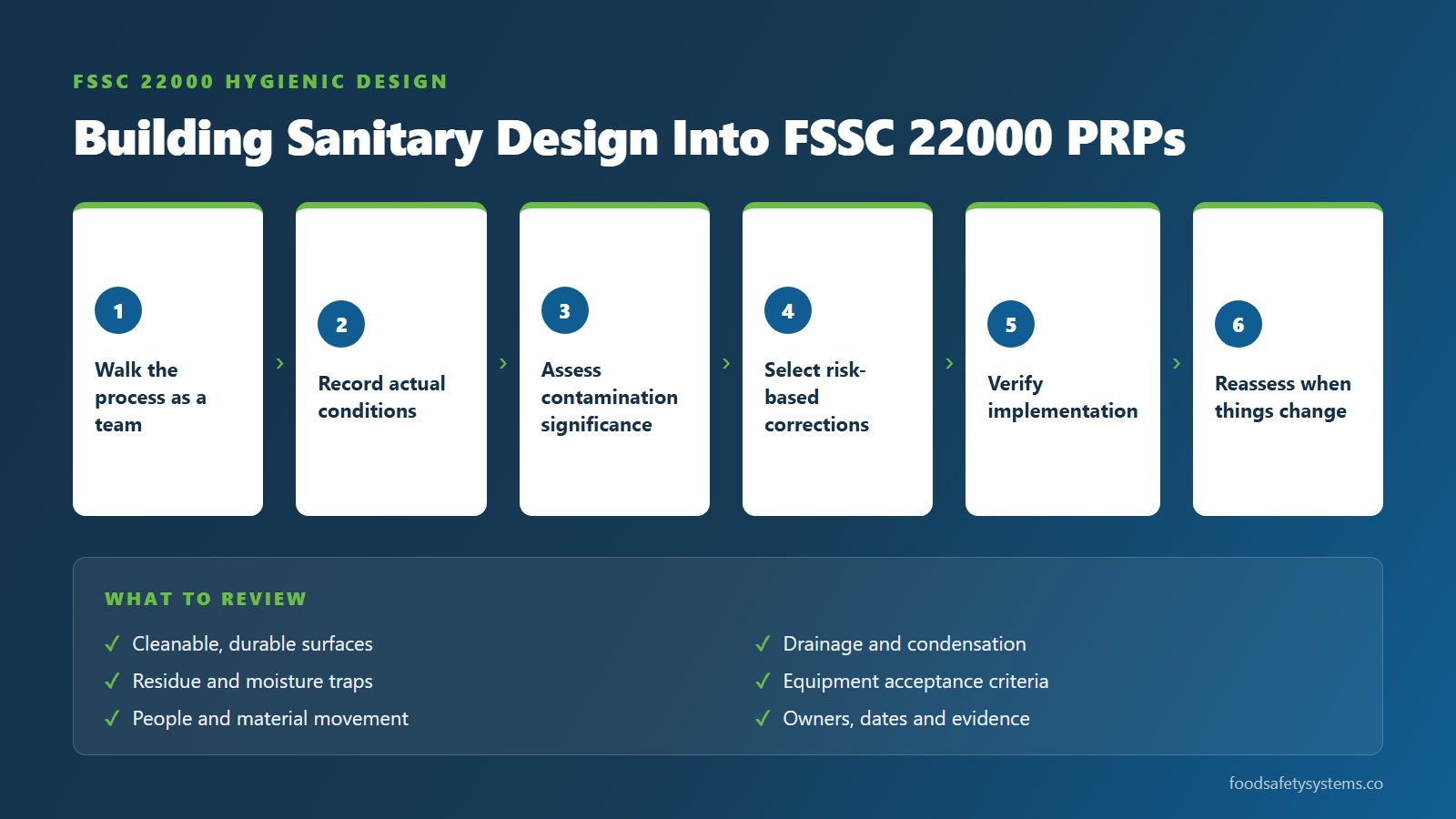
Six steps to manage FSSC 22000 sanitary design
1. Walk the process as a cross-functional team
Walk the process with sanitation, maintenance, operations and food safety personnel. Each group notices different issues. For instance, a sanitation lead knows which areas take longest to clean, while maintenance knows which parts fail repeatedly.
2. Record actual conditions
Record what you actually see, including affected products and processes. Photographs, locations and equipment identifiers make later follow-up much easier.
3. Assess contamination significance
Determine how significant each condition is. Consider product exposure, the cleaning method, product risk and evidence from monitoring and verification. A rough surface above sealed product differs greatly from the same surface above open ready-to-eat food.
4. Select risk-appropriate corrections
Choose repairs, redesigns, procedural controls or further evaluation according to the risk. Then assign responsibility and a target date for each action.
5. Verify implementation
Confirm completion through inspection, records and suitable sanitation verification. Afterwards, monitor whether the condition comes back. Our article on PRP verification explains how to plan these checks.
6. Reassess when processes or equipment change
Define how equipment acceptance, facility changes, sanitation validation or verification where appropriate, and maintenance findings are reviewed. Record responsibilities and reassess contamination risks whenever processes or equipment change.
Records and evidence to keep
Auditors and customers will want to see that sanitary design is managed, not just discussed. Useful evidence includes:
- Walkthrough reports with photos, locations and risk ratings.
- An improvement register with owners, target dates and status.
- Equipment acceptance and change review records.
- Sanitation verification results linked to the corrected areas.
- Maintenance work orders and follow-up checks for recurring conditions.
Example scenario
A snack manufacturer repeatedly finds residue under a conveyor frame during pre-operational inspections. The sanitation team re-cleans the area each time, so the finding never reaches management. During a cross-functional walkthrough, however, maintenance notices that the frame uses open hollow sections. The team rates the condition as significant because the area sits close to exposed product.
As a result, maintenance seals the frame ends, sanitation updates the cleaning instructions and food safety adds the area to verification checks. Over the following weeks, the records show the finding no longer recurs.
FSSC 22000 sanitary design checklist
- Surfaces in product zones are smooth, durable, suitable and accessible.
- Equipment installation allows cleaning and inspection, including behind and under units.
- Moisture, condensation and drainage problems are recorded and prioritized.
- People and material movement limits cross-contact and cross-contamination.
- Changes to equipment or facilities trigger a documented sanitary design review.
- Every corrective action has an owner, a target date and verification evidence.
Frequently asked questions
Is sanitary design separate from PRPs?
In practice, it supports several PRPs at once, such as layout, equipment suitability, cleaning and maintenance. It works best when managed inside those programs rather than as a separate project.
Do we need to replace old equipment to meet FSSC 22000?
Not necessarily. A risk-based review may show that a repair, modification or added procedural control is suitable. The decision should reflect product exposure, cleanability and verification results.
Who should own sanitary design decisions?
Facility management approves and funds changes. However, food safety, sanitation, maintenance and operations should all contribute to the assessment and verification.
How Consultare Inc. Group can help
Consultare Inc. Group supports FSSC 22000 system gap reviews, prerequisite program documentation, improvement tracking and management-system readiness. Services are tailored to your products, existing programs, identified gaps and internal resources. We advise and support implementation, while facility management keeps responsibility for approving changes. We do not promise certification, regulatory approval or an audit outcome.
- FSSC 22000 implementation readiness: sanitary design gaps identified before your audit.
- Corrective action support: verification that design fixes hold.
- Food safety system development: PRPs that reflect real site conditions.
Need help managing your FSSC 22000 responsibilities?
Discuss your products, process, records, risks and next steps with our team. Contact us or book a free consultation.
Prefer to organize your compliance activities yourself? Create a free SystemsBuilder account to structure walkthrough findings, improvement registers and corrective actions.
Technical sources: FSSC 22000 and EHEDG (voluntary hygienic design guidance). This article is educational; requirements depend on your products, certification scope and applicable regulations. Food Safety Systems is an independent consultancy and is not affiliated with the FSSC 22000 Foundation or FDA.