
Quick answer: FSSC 22000 drainage design is about keeping water moving away from product, people and equipment so that moisture does not build up and spread contamination. Drains, floor slopes and floor surfaces affect environmental hygiene every day. Your team therefore needs a defined way to evaluate recurring puddles, backflow concerns and poorly maintained floors, and to verify that fixes work.
This guide is for food safety management teams, sanitation managers, maintenance and engineering staff, and operations leaders at wet-processing sites working to FSSC 22000.
Why drainage matters for environmental hygiene
Drainage design can affect moisture accumulation and environmental contamination potential. Standing water and damaged floors are hard to clean and slow to dry. As a result, they can support microbial harborage and attract pests, which your pest control program then has to manage. In addition, foot and wheel traffic through wet areas can carry contamination into cleaner zones.
Drainage problems are rarely solved by documentation alone. Instead, the site conditions must be understood and addressed. This is why drainage belongs in your FSSC 22000 sanitary design reviews and your prerequisite programs (PRPs) for site condition, cleaning and pest control.
What good drainage looks like
- Drains are located where wet operations and cleaning actually release water.
- Floors slope towards drains, so water does not pool around equipment or walkways.
- Floor surfaces, joints and drain covers are intact, cleanable and in good repair.
- Drains are included in the cleaning schedule, with dedicated tools where appropriate.
- Drain capacity suits normal operations and wash-down, without overflow or backflow.
- Traffic routes avoid crossing wet zones into exposed-product areas where possible.
The condition of floors and building fabric is covered in more detail in our page on external and internal site condition.
Common drainage problems
- Recurring puddles near equipment, doorways or forklift routes.
- Slow drains, odours or signs of backflow after heavy wash-down.
- Cracked floors, failed joints or broken drain covers that hold residues.
- Drain cleaning tools used in other areas or stored in product zones.
- Environmental monitoring results that repeatedly point to the same drain or wet area.
Each of these signs deserves a documented evaluation rather than repeated re-cleaning.
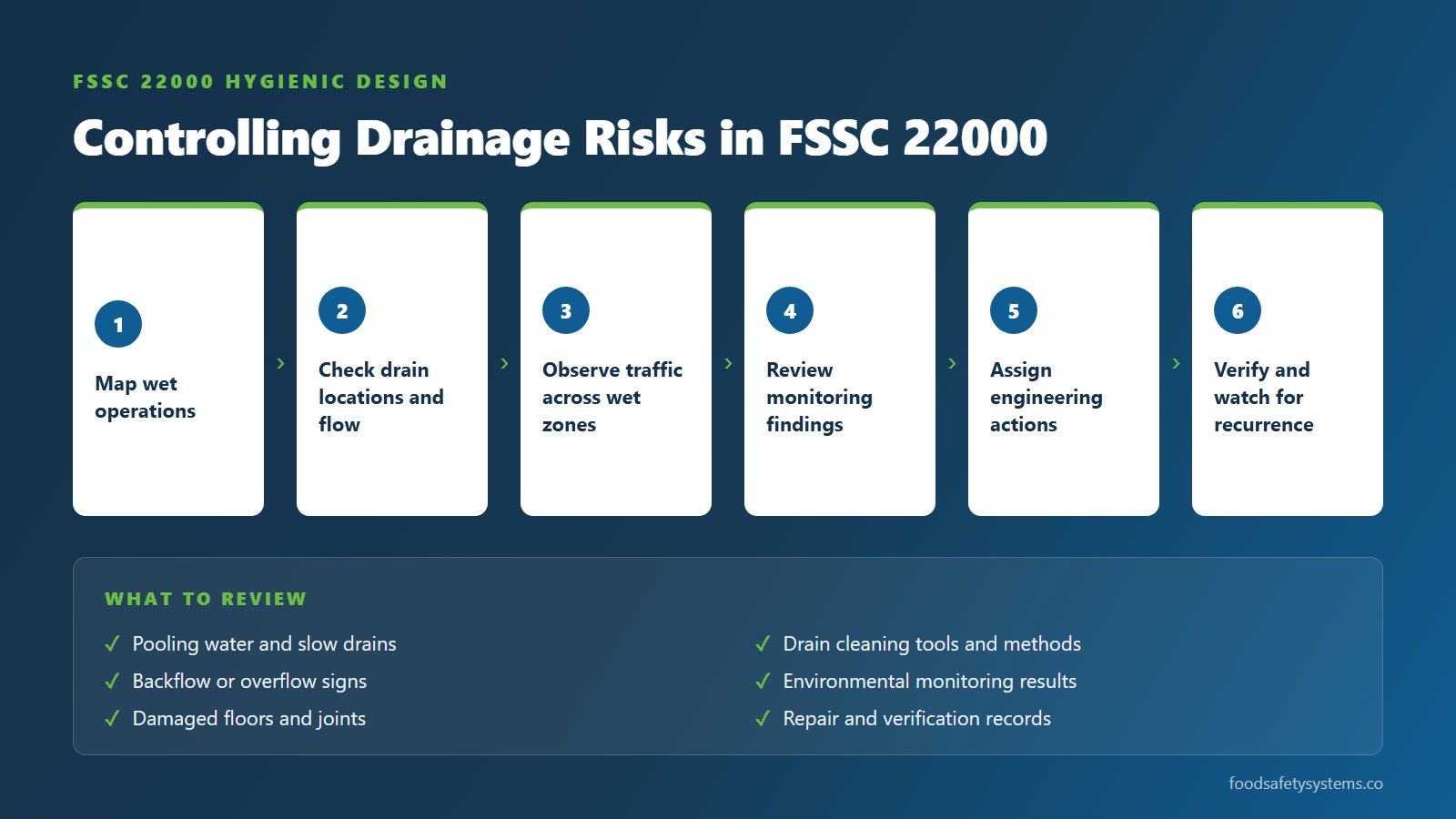
Six steps to control drainage risks
1. Map wet operations
Identify where wet processing and cleaning take place. Mark these areas on a site plan, together with the cleaning methods used.
2. Check drain locations and flow direction
Record drain locations and the direction water flows across floors. Then check whether water flows from dirtier areas towards cleaner ones, or pools before reaching a drain.
3. Observe traffic across wet zones
Watch how people, carts and forklifts move through wet areas. Note where traffic could spread water or residues into exposed-product areas.
4. Review monitoring and inspection findings
Where relevant, review environmental monitoring results and inspection findings for drains and wet floors. Our article on FSSC 22000 environmental monitoring explains how to use these trends.
5. Assign engineering assessment and actions
Establish who is responsible for engineering assessment. Then record the condition, the affected process, the potential hazard and supporting evidence. Assess severity and likelihood in the actual facility context, and assign owners and deadlines.
6. Verify and watch for recurrence
Establish responsibility for corrective action verification. Check the completed work, keep objective evidence and confirm through later inspections that the problem does not return.
Records and evidence to keep
- A wet-area map with drain locations and flow direction.
- Inspection records for drains, floors and drain covers.
- Drain cleaning schedules and verification records.
- Environmental monitoring results and trend reviews for wet areas.
- Maintenance work orders, engineering assessments and closure evidence.
Example scenario
A dairy dessert plant keeps finding standing water beside a filling machine after wash-down. Environmental monitoring also shows repeated indicator results near the same spot. During a drainage review, the team finds that the floor slopes away from the nearest drain. Moreover, forklifts carry water from that area towards the packing room.
As a result, maintenance re-grades the floor section and replaces a damaged drain cover. Operations reroute forklift traffic, while sanitation adds the drain to the verification schedule. Afterwards, follow-up inspections and monitoring results confirm the improvement.
U.S. FDA context
For facilities subject to FDA rules, the Current Good Manufacturing Practice requirements in 21 CFR Part 117 are a separate legal obligation. 21 CFR 117.37(b) requires plumbing that provides adequate floor drainage where floors are subject to flooding-type cleaning or where operations discharge liquid onto the floor. It also requires that there is no backflow from, or cross-connection between, waste water or sewage piping and piping that carries water for food or food manufacturing.
In addition, 21 CFR 117.20 covers draining grounds that may contribute contamination and constructing plants so floors can be adequately cleaned and kept in good repair. FSSC 22000 certification does not replace these duties.
FSSC 22000 drainage design checklist
- Wet operations and cleaning activities are mapped.
- Drain locations, capacity and flow direction are known and reviewed.
- Pooling water, backflow signs and damaged floors are recorded and prioritized.
- Traffic through wet zones is assessed and controlled.
- Drain cleaning and verification are scheduled and recorded.
- Engineering actions have owners, deadlines and verification evidence.
Frequently asked questions
Are drains part of environmental monitoring?
Often they are, because drains can indicate the hygiene status of the surrounding area. However, the sampling plan should be based on your own hazard and risk assessment.
Is re-cleaning a puddle a corrective action?
It is a correction for that moment. A corrective action looks at why water keeps pooling, for example floor slope, drain capacity or blockages.
Who should assess drainage changes?
Engineering or maintenance usually lead the technical assessment. Food safety and sanitation should, however, confirm that the solution supports cleaning and contamination control.
How Consultare Inc. Group can help
Consultare Inc. Group helps food safety management teams organize prerequisite program reviews, maintenance findings and continuous improvement plans. Typical activities include a kickoff discussion, review of procedures and evidence, agreed observations or interviews, a prioritized improvement register and action-tracking support. Exact deliverables depend on the approved scope. We do not promise certification, regulatory approval or an audit outcome.
- FSSC 22000 implementation readiness: drainage and site condition gaps identified before your audit.
- FSSC 22000 and FDA compliance integration: align your PRPs with Part 117 CGMPs.
- Corrective action support: verification that drainage fixes hold.
Need help managing your FSSC 22000 responsibilities?
Discuss your products, process, records, risks and next steps with our team. Contact us or book a free consultation.
Prefer to organize your compliance activities yourself? Create a free SystemsBuilder account to structure inspection records, monitoring trends and corrective actions.
Technical sources: FSSC 22000, 21 CFR 117.37 and 21 CFR 117.20. This article is educational; requirements depend on your products, certification scope and applicable regulations. Food Safety Systems is an independent consultancy and is not affiliated with the FSSC 22000 Foundation or FDA.