
FSSC 22000 cleaning equipment storage is easy to overlook, yet brushes, squeegees, scrapers and buckets touch almost every surface in a plant. When they are wet, damaged or stored in the wrong place, they can spread residues, allergens and microorganisms instead of removing them. Facility design should therefore support orderly segregation, drainage and inspection of the tools used to maintain hygiene.
Quick answer: give every cleaning tool a defined zone and task, a dedicated off-floor storage point where it can drain and dry, and a simple inspection and replacement routine. Then verify that practice on the floor matches the procedure, and keep the evidence.
This guide is for FSSC 22000 sanitation leads, hygiene and food safety managers, and management system teams that own cleaning prerequisite programs (PRPs).
What good cleaning equipment storage looks like
Good storage starts with the hazard, not the hook rail. A risk-based review considers the food, the process, product exposure, cleaning frequency and how the area actually performs. As a result, a high-care ready-to-eat area usually needs tighter separation than a dry warehouse.
In a well-designed site, tools are made of cleanable, durable materials that suit the chemicals and temperatures used. Each tool has a labelled home, off the floor, away from splash zones and open product. Stations drain freely, and air can reach the tools so they dry between uses. Where the site uses color coding, the colors match a documented zone or task map, and staff can explain it.
Equally important, the cleaning tools themselves are cleaned. Worn bristles, cracked handles and frayed mops are removed before they shed foreign matter or harbor soil. For the wider program, see our page on cleaning and sanitation.
Common problems auditors and sanitation teams find
- Tools stored on the floor, in drains or leaning against walls where they collect water and soil.
- Wet tools hung in enclosed cupboards or bins, where they stay damp between shifts.
- Raw-area or allergen-area tools found in high-care or allergen-free areas.
- Floor and drain tools used on, or stored next to, food-contact equipment.
- Damaged or unidentified tools still in use because no one owns replacement.
- Color coding on paper that no longer matches what is on the wall racks.
These issues rarely improve through documentation alone. Instead, the underlying site conditions need to be understood and fixed.
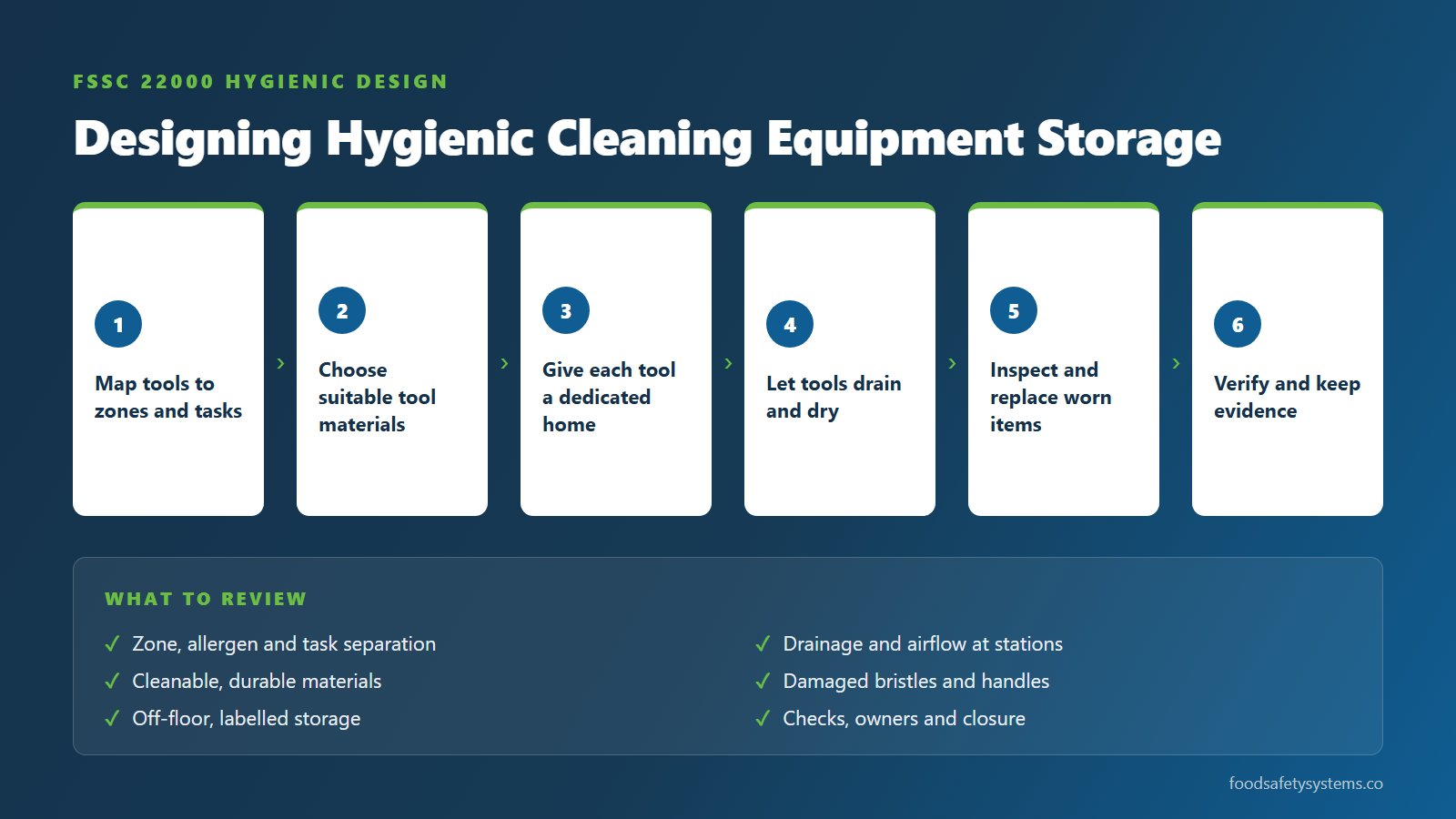
Six steps to design hygienic cleaning equipment storage
1. Map tools to zones and tasks
List every cleaning tool and record where and for what it is used. Separate tools for food-contact surfaces, non-food-contact surfaces, floors and drains. Also consider hygienic zones and allergen areas. Our page on production risk zone hygiene controls explains how zoning shapes these decisions.
2. Choose suitable tool materials
Select tools that withstand your chemicals, water temperature and cleaning methods. Prefer designs without crevices where soil collects. In addition, confirm that bristles and blades are firmly fixed, so they are less likely to become foreign matter.
3. Give each tool a dedicated home
Provide wall-mounted racks or hangers in each zone, close to where tools are used. Keep storage off the floor and away from open product and packaging. Label positions so a missing or misplaced tool is obvious at a glance.
4. Let tools drain and dry
Position racks so water drains away from walls and product areas. Allow airflow around stored tools, and avoid closed boxes for wet items. Where tools are washed centrally, design the wash and drying area so clean tools do not touch dirty ones.
5. Inspect and replace worn items
Add tool condition to routine pre-operational or hygiene inspections. Define what “worn” means, such as splayed bristles, cracks or missing parts. Then make one role responsible for removing and replacing damaged tools.
6. Verify and keep evidence
Check that the storage arrangements work in practice, not only on the layout drawing. Record findings and close them out. Link the results to your wider hygiene PRP records so trends stay visible.
Records and evidence to keep
- A tool register or zone map showing tool types, colors where used, zones and tasks.
- Photos or layout drawings of storage stations in each area.
- Inspection records covering tool condition, location and cleanliness.
- Replacement and purchasing records for cleaning tools.
- Corrective actions with the observed condition, affected process, potential hazard, owner, deadline and closure evidence.
- Training records showing staff understand tool segregation and storage rules.
When a problem is found, follow a simple loop. First, document the condition and the evidence. Next, prioritize it by severity and likelihood in your facility, and assign an owner and deadline. Then implement an engineering or procedural fix agreed by food safety, sanitation, operations and maintenance. Finally, verify the fix and retain objective evidence.
Example scenario
During an internal inspection, a sanitation lead finds a floor squeegee hanging beside the rack for food-contact brushes. The rack sits above a sink, so tools are often wet. In addition, two brushes have splayed bristles.
The team records the finding with photos and rates it as a potential cross-contamination and foreign-matter risk. Maintenance installs a separate floor-tool rack on the opposite wall, with a drip tray that drains to the floor gully. Meanwhile, sanitation replaces the damaged brushes and adds tool condition to the daily pre-op checklist. Two weeks later, the food safety manager checks the area, confirms the change is working and closes the action with photos.
U.S. context for FDA-regulated facilities
For U.S. facilities, FSSC 22000 certification does not replace FDA current good manufacturing practice. For example, 21 CFR 117.35 requires cleaned and sanitized portable equipment and utensils with food-contact surfaces to be stored in a location and manner that protects them from allergen cross-contact and contamination. Apply that duty where it is relevant to your tools and utensils.
FSSC 22000 cleaning equipment storage checklist
- Every cleaning tool has a defined zone, task and storage point.
- Food-contact, non-food-contact, floor and drain tools are kept apart.
- Tools are stored off the floor, away from open product and packaging.
- Storage stations drain freely and allow tools to dry.
- Tool materials suit the chemicals and temperatures used.
- Worn or damaged tools are removed and replaced by a named owner.
- Color coding, where used, matches the current zone map.
- Findings are documented, prioritized, fixed and verified.
Frequently asked questions
Does FSSC 22000 require color-coded cleaning tools?
Color coding is a common way to keep tools separate, but it is a site choice rather than the only option. What matters is that your segregation method is effective, understood by staff and supported by your hazard analysis and PRPs.
How often should cleaning tools be inspected?
Base the frequency on risk and use. Many sites include tool condition in pre-operational or daily hygiene checks, with more frequent checks in high-risk or allergen areas.
Where should cleaning tools for allergen areas be stored?
Keep them within or next to the allergen area, separate from tools used elsewhere. Our article on FSSC 22000 allergen cross-contact prevention covers the wider controls.
How Consultare Inc. Group can help
Consultare Inc. Group can assist with FSSC 22000 prerequisite reviews, sanitation tool-management procedures and corrective action planning. Facility management keeps responsibility for approving and implementing changes, and CIG does not promise certification, regulatory approval or a particular audit outcome.
- FSSC 22000 implementation readiness: sanitation PRPs checked before your audit.
- Corrective action support: verification that storage fixes hold.
- Food safety training: tool segregation and hygiene training for your teams.
Need help managing your FSSC 22000 responsibilities?
Discuss your products, process, records, risks and next steps with our team. Contact us or book a free consultation.
Prefer to organize your compliance activities yourself? Create a free SystemsBuilder account to structure inspection records, tool registers and corrective actions.
Technical sources: FSSC 22000 and 21 CFR 117.35. This article is educational; requirements depend on your products, certification scope and applicable regulations. Food Safety Systems is an independent consultancy and is not affiliated with the FSSC 22000 Foundation or FDA.