
FSSC 22000 personnel entry facilities are physical controls that make hygienic behavior possible. Handwashing stations, changing rooms, toilets and entrances shape what people actually do on their way to work. If a sink is in the wrong place or a hand dryer is broken, even well-trained staff will struggle to follow the rules.
Quick answer: map every route people use to enter production, put handwashing and clothing changes at the point of entry, keep street and work clothing apart, and maintain toilets and changing rooms in good condition. Then check that visitors and contractors follow the same route, and keep records of checks and repairs.
This guide is for FSSC 22000 site leaders, hygiene managers and food safety teams responsible for personnel hygiene prerequisite programs (PRPs).
What good personnel entry facilities look like
Good design makes the hygienic route the easiest route. In practice, people should not be able to reach open product without passing handwashing and the correct clothing change. Facilities should be sized for shift changeovers, so queues do not tempt staff to skip steps.
A well-designed entry usually includes a clear sequence. Staff remove street clothing and store personal items, put on work clothing, wash and dry their hands, and then enter production. Hand-washing points have running water at a suitable temperature, soap, hygienic drying and waste bins. Toilets do not open directly onto production areas, and changing rooms are cleanable and well lit.
The level of control should match product risk. A site with open ready-to-eat product needs stricter entry controls than a warehouse of sealed packs. For wider hygiene rules, see our page on personal hygiene policies.
Common problems at personnel entry points
- Side doors or loading docks that let staff bypass handwashing.
- Hand-washing stations placed after the production entrance, or out of the natural walking route.
- Empty soap or towel dispensers and broken hand dryers.
- Street clothing and work clothing stored in the same lockers.
- Toilets that open straight onto production corridors.
- Visitors and contractors walking in through the office without changing or washing.
- Repairs to sinks, doors and lockers left open for weeks.
These conditions undermine the rules employees are expected to follow. Therefore, the fix is usually physical as well as procedural.
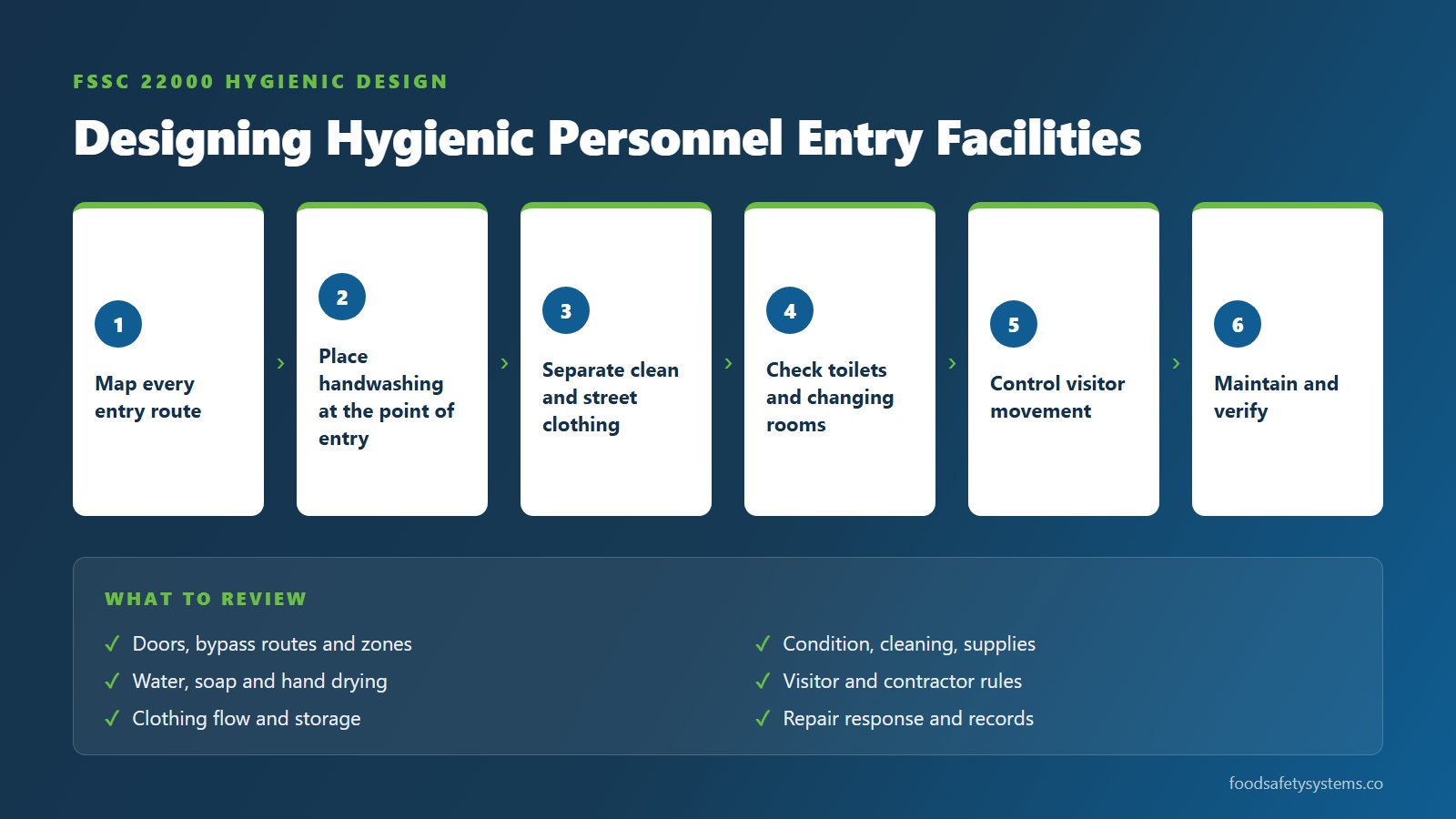
Six steps to design hygienic personnel entry facilities
1. Map every entry route
Walk the site and mark every door people use to reach production, including emergency exits and dock doors. Note which routes bypass hygiene facilities. Our page on staff flow and movement procedures explains how to control movement between zones.
2. Place handwashing at the point of entry
Put hand-washing stations where people cannot avoid them, ideally immediately before entry to production. Provide enough basins for peak shift changes. In addition, consider hands-free taps and hygienic hand drying.
3. Separate clean and street clothing
Design changing areas so street clothing and personal items stay on one side, and clean work clothing on the other. Provide storage for clean and used workwear. For clothing rules, see protective clothing and PPE.
4. Check toilets and changing rooms
Toilets and changing rooms should be clean, well lit, ventilated and in good repair. They should not open directly onto food handling areas. Include them in cleaning schedules and hygiene inspections.
5. Control visitor movement
Make sure visitors, drivers and contractors use the same hygienic entry route as employees. Provide clothing and clear instructions. Our page on visitor and contractor controls covers the wider program.
6. Maintain and verify
Set a response time for repairs to sinks, dryers, doors and lockers. Then verify that facilities are stocked and working, and that people use them as intended. Observations at shift change are especially useful.
Records and evidence to keep
- A site plan showing entry routes, hygiene stations and changing areas.
- Hygiene inspection records covering stock levels, condition and cleanliness.
- Observation records of handwashing and clothing changes at entry.
- Maintenance requests and completion records for entry facilities.
- Visitor and contractor sign-in records showing hygiene briefings.
- Corrective actions with the observed condition, potential hazard, owner, deadline and closure evidence.
When a gap is found, document the condition and evidence first. Next, assess severity and likelihood in your facility, and assign an owner and deadline. Then implement an engineering or procedural fix agreed by food safety, sanitation, operations and maintenance. Finally, verify the result and keep objective evidence. Linking these records to personnel hygiene training helps show why behavior changed.
Example scenario
A hygiene manager notices that night-shift staff often enter the packing hall through a dock door. As a result, they skip the main hand-washing station. Two of the four basins at the main entrance also have low water temperature.
The team records the finding and rates it as a contamination risk for open product. Maintenance repairs the water supply, and operations restricts the dock door to goods only, with an alarm. Meanwhile, a new hand-washing station is added inside the dock entrance for staff who must use it. Two weeks of shift-change observations confirm the new route works, and the action is closed with photos and records.
U.S. FDA context
For U.S. facilities, FSSC 22000 certification does not replace FDA current good manufacturing practice under 21 CFR Part 117. Several cGMP provisions relate directly to personnel entry facilities.
- 21 CFR 117.37 requires adequate, readily accessible toilet facilities, and hand-washing facilities that are adequate, convenient and furnish running water at a suitable temperature.
- 21 CFR 117.10 requires hand washing in an adequate hand-washing facility before starting work, after each absence from the work station and whenever hands may have become soiled or contaminated.
- 21 CFR 117.20 requires adequate lighting in hand-washing areas, dressing and locker rooms, and toilet rooms.
These legal duties apply separately from your certification scope. Confirm how they apply to your own operation.
FSSC 22000 personnel entry facilities checklist
- All entry routes to production are mapped, including bypass doors.
- Hand-washing stations sit at the point of entry and suit peak demand.
- Soap, hygienic drying and suitable water temperature are always available.
- Street clothing and work clothing are stored separately.
- Toilets and changing rooms are clean, lit and do not open onto production.
- Visitors and contractors follow the same hygienic route.
- Repairs have owners and response times.
- Observations and inspections confirm facilities are used as intended.
Frequently asked questions
Where should hand-washing stations be placed?
Place them where people cannot avoid them, usually immediately before entry to production. Additional stations may be needed at other points where hands can become contaminated.
Do visitors need to follow the same entry rules as staff?
Yes, where they enter the same areas. Visitors, drivers and contractors can introduce the same hazards, so they should follow a controlled hygienic route.
Is a procedure enough if the facilities are poorly placed?
Usually not. If the layout makes the rule hard to follow, people will find shortcuts. Physical changes often deliver more reliable results than extra training alone.
How Consultare Inc. Group can help
Consultare Inc. Group can support prerequisite program gap reviews, personnel hygiene procedure updates and improvement-plan coordination. Facility management keeps responsibility for approving and implementing changes, and CIG does not promise certification, regulatory approval or a particular audit outcome.
- FSSC 22000 implementation readiness: hygiene PRPs checked before your audit.
- FSSC 22000 and FDA compliance integration: align your FSMS with Part 117 cGMPs.
- Corrective action support: verification that entry fixes hold.
Need help managing your FSSC 22000 responsibilities?
Discuss your products, process, records, risks and next steps with our team. Contact us or book a free consultation.
Prefer to organize your compliance activities yourself? Create a free SystemsBuilder account to structure hygiene inspections, maintenance requests and corrective actions.
Technical sources: FSSC 22000 and 21 CFR Part 117. This article is educational; requirements depend on your products, certification scope and applicable regulations. Food Safety Systems is an independent consultancy and is not affiliated with the FSSC 22000 Foundation or FDA.