
FSSC 22000 baked goods sanitation PRPs protect product after the oven. Baking is a kill step, but cooled, sliced, filled or iced products are exposed again before packing, so sanitation, zoning, personnel hygiene, allergen and pest controls carry most of the risk. FSSC 22000 combines ISO 22000-based food safety management with sector prerequisite programs (PRPs) and additional scheme requirements, and an effective system connects each contamination hazard to practical controls and measured results.
Six ways to strengthen FSSC 22000 baked goods sanitation PRPs
Align hazard analysis and PRPs
Identify where baked products stay exposed after processing and decide the sanitation, zoning, personnel hygiene and operational controls each point needs. See production risk zones and segregation.
Verify sanitation program implementation
Review cleaning tools, chemical concentrations, contact times, schedules, methods, employee training and supervisory confirmation. A sanitizer mixed too weak gives a clean-looking surface that is not sanitized. See cleaning and sanitation.
Assess allergen cross-contact risks
Document allergen sources, shared equipment, storage, material flow, clean-up, changeovers and verification criteria. Our companion article on FSSC 22000 bakery allergen management covers labels and control classification.
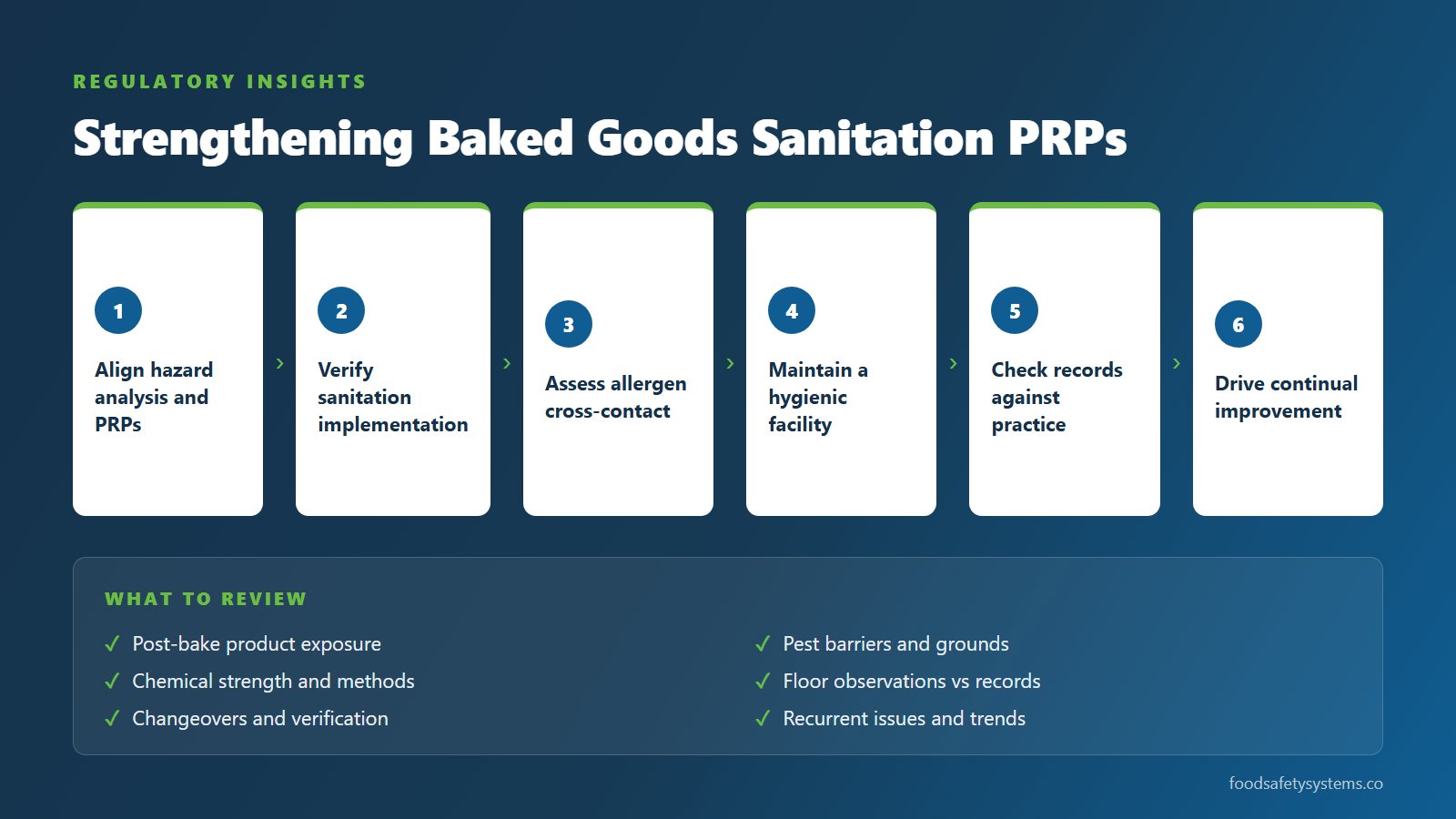
Maintain a hygienic facility
Bakeries attract stored-product insects, rodents and birds. Evaluate pest exclusion barriers, exterior grounds, building condition, damaged equipment such as frayed belts, and maintenance priorities. See pest control program and maintenance and repair.
Check records against practice
Compare approved procedures with floor observations, test results, deviations and maintenance history, and treat inconsistencies as system-level evidence rather than one-off errors. See internal audits.
Drive continual improvement
Track recurring issues and show corrective action effectiveness through audits, trend analysis and management review. See corrective and preventive actions.
Baked goods sanitation PRP checklist
- Confirm the regulatory and certification scope for the facility and products.
- Compare written procedures with direct observation and records.
- Document responsible persons, monitoring frequencies and escalation thresholds.
- Review deviations, corrective actions and objective evidence of effectiveness.
Frequently asked questions
Does a written PRP alone demonstrate control?
No. PRPs must be implemented, monitored and verified.
Do all bakeries need the same sanitation and allergen controls?
No. Controls depend on the hazards, process, ingredients, facility and applicable regulatory or certification requirements.
What records help demonstrate improvement?
Monitoring logs, training records, maintenance tickets, corrective actions, verification results and management review.
How Consultare Inc. Group can help
Consultare Inc. Group supports FSSC 22000 readiness and gap assessments, PRP and sanitation reviews, allergen and pest program evaluation, internal audits and CAPA support. Services depend on the agreed scope.
- FSSC 22000 readiness services: sanitation and site PRP reviews.
- Environmental monitoring add-on: post-bake zone sampling and trends.
- Corrective action support: close findings with evidence.
Need help managing your FSSC 22000 responsibilities?
Discuss your products, processes, documentation and improvement priorities with our team. Contact us or book a free consultation.
Prefer to organize your compliance activities yourself? Create a free SystemsBuilder account to structure monitoring records, work orders and corrective actions.
Technical sources: FSSC 22000 and 21 CFR Part 117. This article is educational; requirements depend on your products, certification scope and applicable regulations. Food Safety Systems is an independent consultancy and is not affiliated with the FSSC 22000 Foundation or FDA.