
The FSSC 22000 seafood cold chain is only as reliable as its receiving checks, storage data and records. Refrigerated seafood safety depends on reliable receiving and storage controls, hygienic conditions, trained people and complete records, and FDA seafood HACCP enforcement keeps showing how a written plan falls short when critical limits, monitoring or corrective actions are not carried out. An FSSC 22000 food safety management system (FSMS) connects seafood hazard analysis, prerequisite programs (PRPs), operational monitoring, competence and corrective action, while applicable FDA seafood HACCP duties under 21 CFR Part 123 remain independent legal obligations.
This guide is for seafood facilities using an ISO 22000-based FSMS, FSMS coordinators, PRP owners and operations managers. For the broader HACCP side, see our article on FSSC 22000 for seafood operations.
Six steps to verify the FSSC 22000 seafood cold chain
Assess seafood hazards within the FSMS
Evaluate receiving, storage and handling as part of the process flow, including pathogen growth, histamine formation in scombroid species and Clostridium botulinum in reduced-oxygen packaged fish. Decide which measures operate as PRPs, operational PRPs or CCPs. See conduct a hazard analysis.
Establish justified incoming-goods criteria
Document how product condition is checked for each delivery method, including refrigerated transport records and ice coverage where ice is used, and define responsibilities, acceptance criteria and records. See supplier approval and monitoring.
Verify the cold chain with objective data
Keep suitable, calibrated monitoring instruments, records and review practices, and evaluate potentially affected product whenever there are data gaps or temperature excursions. A cooler set point is not product temperature. See temperature control measures and calibration of measuring equipment.
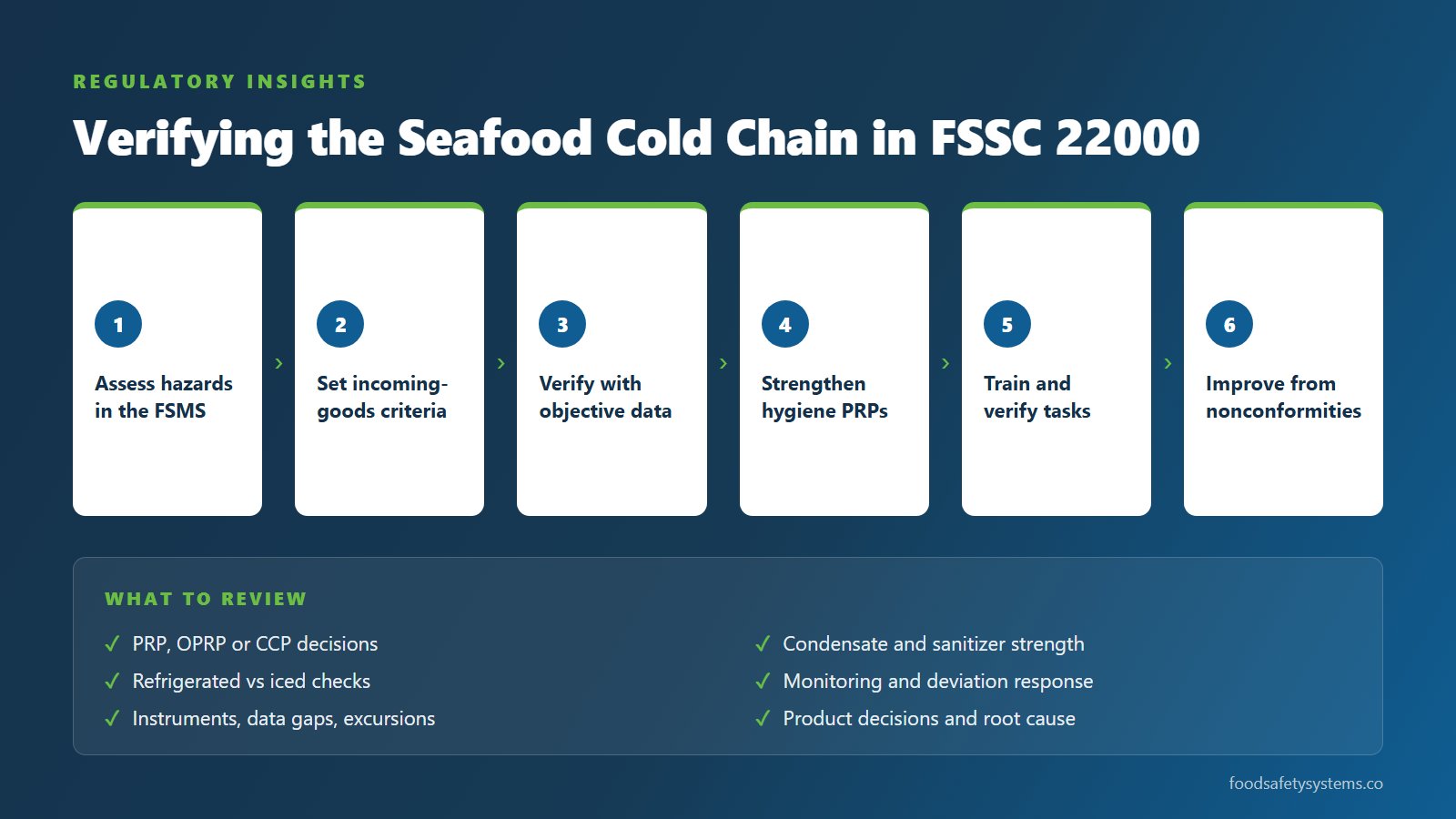
Strengthen facility hygiene PRPs
Address protected storage, condensate management, cleaning effectiveness, sanitizer concentration checks and housekeeping in chilled areas. See warehousing hygiene and maintenance.
Provide task-specific training and verification
Show that personnel understand monitoring methods, record completion and deviation response, and verify that activities happen as planned. See training and competence.
Use nonconformities to drive system improvement
Review repeated failures and make sure corrective actions include product decisions, root causes, owners and effectiveness follow-up. See corrective and preventive actions.
Seafood cold chain checklist
- Confirm the product, facility activity and applicable FDA or certification framework.
- Verify that procedures match actual receiving, storage and handling conditions.
- Assign monitoring responsibilities, acceptance criteria and record review.
- Escalate missing records, deviations and potentially affected product for documented evaluation.
- Track corrective action owners, deadlines, completion evidence and effectiveness.
Frequently asked questions
Does FSSC 22000 certification replace FDA seafood HACCP?
No. Seafood HACCP requirements under 21 CFR Part 123 must be met separately where they apply.
Can PRPs control cold chain hazards?
Some can. Whether a measure is a PRP, operational PRP or CCP depends on the hazard analysis and the ISO 22000 methodology.
What evidence matters for chilled seafood receiving?
Shipment condition checks, temperature data or ice coverage, the accept or reject decision and the response to any deviation.
How Consultare Inc. Group can help
Consultare Inc. Group supports FSSC 22000 readiness assessments, seafood hazard analysis reviews, receiving and cold storage control mapping, hygiene PRP evaluations, internal audits and corrective action support. Services are tailored to the agreed scope.
- FSSC 22000 implementation readiness: cold chain controls checked before your audit.
- FSSC 22000 and FDA compliance integration: align your FSMS with Part 123.
- Corrective action support: verification that cold chain fixes hold.
Need help managing your FSSC 22000 responsibilities?
Discuss your products, process, records, risks and next steps with our team. Contact us or book a free consultation.
Prefer to organize your compliance activities yourself? Create a free SystemsBuilder account to structure monitoring records, supplier information and corrective actions.
Technical sources: FSSC 22000 and 21 CFR Part 123. This article is educational; requirements depend on your products, certification scope and applicable regulations. Food Safety Systems is an independent consultancy and is not affiliated with the FSSC 22000 Foundation or FDA.