
FSSC 22000 bakery allergen management works only when documented processes match what operators actually do. Shared mixers and lines, flour dust, exposed ready-to-eat products and frequent packaging changes create many points where allergen controls can fail, and undeclared allergens remain one of the most common reasons for food recalls. Sesame is a current example: it became the ninth major food allergen in the U.S. on January 1, 2023. An FSSC 22000 food safety management system (FSMS) organizes bakery allergen risk through hazard analysis, prerequisite programs, operational controls, document control, verification and continual improvement, while regulatory duties such as FDA preventive controls (21 CFR Part 117) remain separate.
Six areas to review for FSSC 22000 bakery allergen management
Include allergens and foreign material in the hazard analysis
Evaluate sesame, milk, egg, wheat, tree nuts and other relevant allergens alongside environmental pathogen and physical hazards, considering shared equipment and exposed product zones. See allergen management and conduct a hazard analysis.
Make prerequisite programs operational
Align sanitation, personal hygiene, maintenance, training, supplier approval and storage controls with site practice and documented responsibilities. For sanitation, pest control and equipment in bakeries, see our companion guide to FSSC 22000 baked goods sanitation PRPs.
Decide how controls are classified
Use the ISO 22000 methodology to decide whether each allergen control measure is managed as a PRP, an operational PRP or a CCP, with action criteria or critical limits, monitoring and corrections defined accordingly. Changeover cleaning between allergen profiles is often an operational PRP. See process monitoring and control.
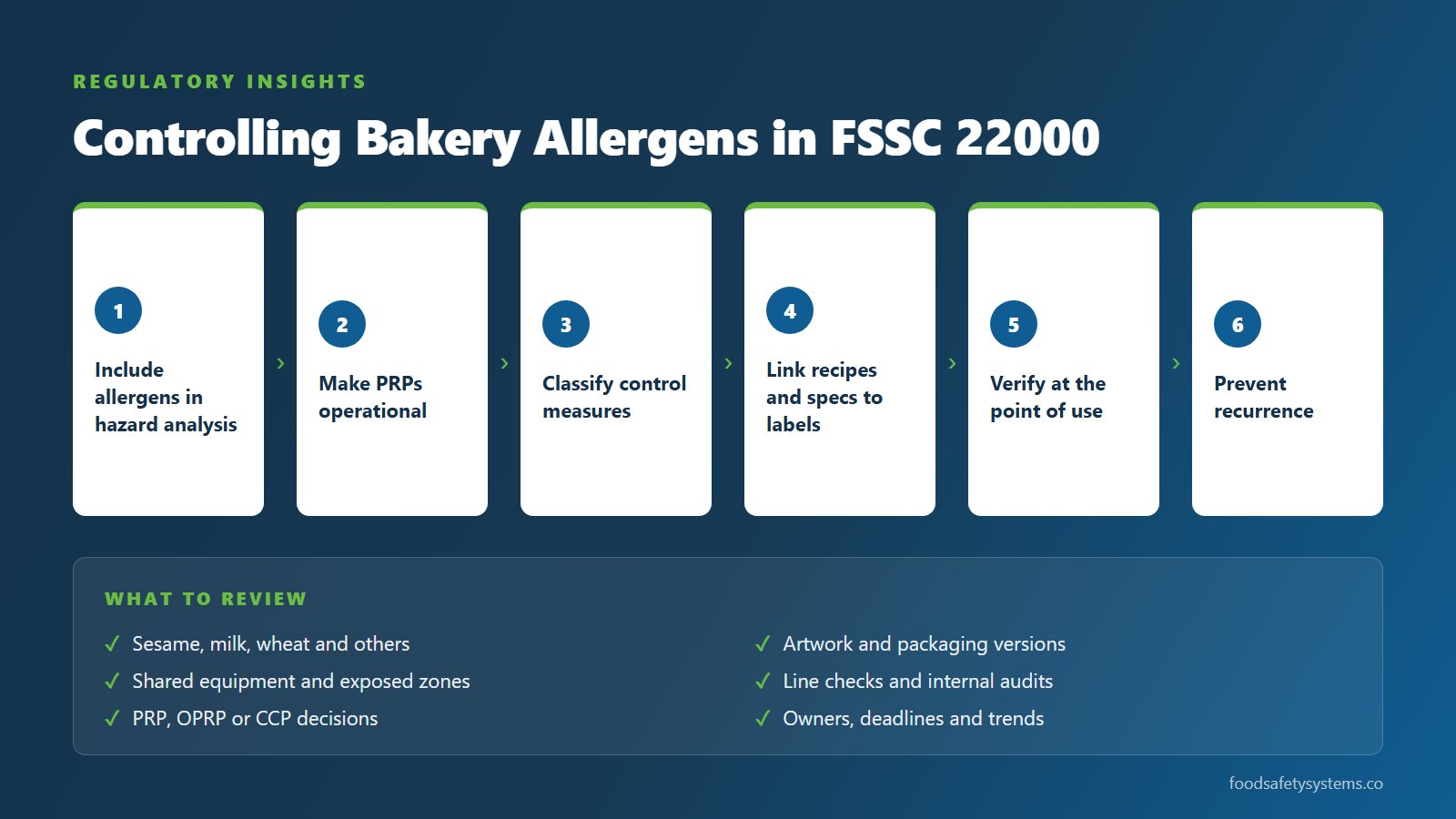
Connect recipes and specifications to labels
Manage approved formulas, raw material changes, label artwork, packaging versions and release approval through controlled information, and remove obsolete packaging when a recipe changes. See product labeling.
Verify implementation at the point of use
Use records, line observations, cleaning checks, label verification at start-up, internal audits and trending to confirm procedures work in practice. See internal audits.
Use management review to prevent recurrence
Assign owners for recurring deficiencies, track actions and deadlines, verify effectiveness and review system performance. See management review procedures.
Bakery allergen management checklist
- Is every allergen, including sesame, in the hazard analysis by product and line?
- Are control measures classified and monitored appropriately?
- Do label and packaging versions match approved recipes?
- Are cleaning checks, audits and corrective actions documented and trended?
Frequently asked questions
Does FSSC 22000 address allergen management?
Yes. FSSC 22000 includes additional requirements for allergen management on top of ISO 22000 and the sector PRPs.
Does FSSC 22000 certification replace FDA preventive controls?
No. Regulatory obligations such as 21 CFR Part 117 must be assessed and met separately.
Why include label control in allergen management?
Because a correctly made product with the wrong label still exposes consumers to an undeclared allergen.
How Consultare Inc. Group can help
Consultare Inc. Group supports FSSC 22000 gap assessments, allergen risk assessments, hazard analysis and control classification reviews, label control workflows, internal audits and CAPA. Scope and deliverables are confirmed for each client.
- FSSC 22000 implementation readiness: allergen program reviews before audit.
- FSSC 22000 and FDA compliance integration: align allergen controls with Part 117 and U.S. labeling.
- Corrective action support: root cause and effectiveness after allergen incidents.
Need help managing your FSSC 22000 responsibilities?
Discuss your products, processes, documentation and improvement priorities with our team. Contact us or book a free consultation.
Prefer to organize your compliance activities yourself? Create a free SystemsBuilder account to structure procedures, monitoring records and corrective actions.
Technical sources: FSSC 22000, 21 CFR Part 117 and FDA: Food Allergies. This article is educational; requirements depend on your products, certification scope and applicable regulations. Food Safety Systems is an independent consultancy and is not affiliated with the FSSC 22000 Foundation or FDA.