
Allergen changeover verification is what turns a completed cleaning checklist into evidence. A signed sheet does not prove that the line is ready for the next allergen profile. Manufacturers that run several products on shared equipment must manage sanitation, sequencing and allergen cross-contact together. Cleaning is routine, but its adequacy needs support from validated methods, ongoing verification and corrective action.
Quick answer: map allergens against shared equipment and changeover sequences, and validate the cleaning methods that matter most. Define routine checks with clear acceptance criteria, control labels and rework, and release the line through a trained person. Finally, investigate every failed check and trend the results. Buyers, including a potential H-E-B purchasing team, may reasonably expect this level of control.
This guide is for food manufacturers, co-packers, brand owners and quality teams preparing for possible H-E-B supply. For the wider system view, see our article on FSSC 22000 allergen cross-contact prevention.
Validation, verification and corrective action are different
FSSC 22000 combines ISO 22000, sector-specific prerequisite programs (PRPs) and additional scheme requirements. Allergen management and sanitation controls must fit the operation and its hazards. However, three activities are often blurred. Validation shows that a cleaning method can work. Verification shows that it worked this time. Corrective action deals with the times it did not.
Where the FDA Preventive Controls for Human Food rule applies, 21 CFR 117.135 lists food allergen controls and sanitation controls among the preventive controls a facility may need. Exact obligations depend on the scheme version, site category and applicable law, so confirm what applies to you.
Six steps for allergen changeover verification
Map allergens and shared equipment
Build an allergen matrix for every product, and link it to lines, fillers, utensils and contact surfaces. Mark the changeover sequences that move from an allergen-containing product to one without it. These are your highest-risk changeovers. Our allergen management page explains the wider program.
Validate the cleaning methods that matter
Document a technically suitable cleaning approach for each high-risk changeover. Where needed, collect validation evidence, for example under worst-case soil and product conditions. Keep the method, the conditions tested and the results together, so the evidence stays usable.
Define routine verification and acceptance criteria
Decide what is checked at each changeover, such as visual inspection, swabs or allergen-specific tests. Set clear acceptance criteria and state who performs each check. Also include hard-to-clean points like valves, gaskets and filler heads. See cleaning and sanitation for related controls.
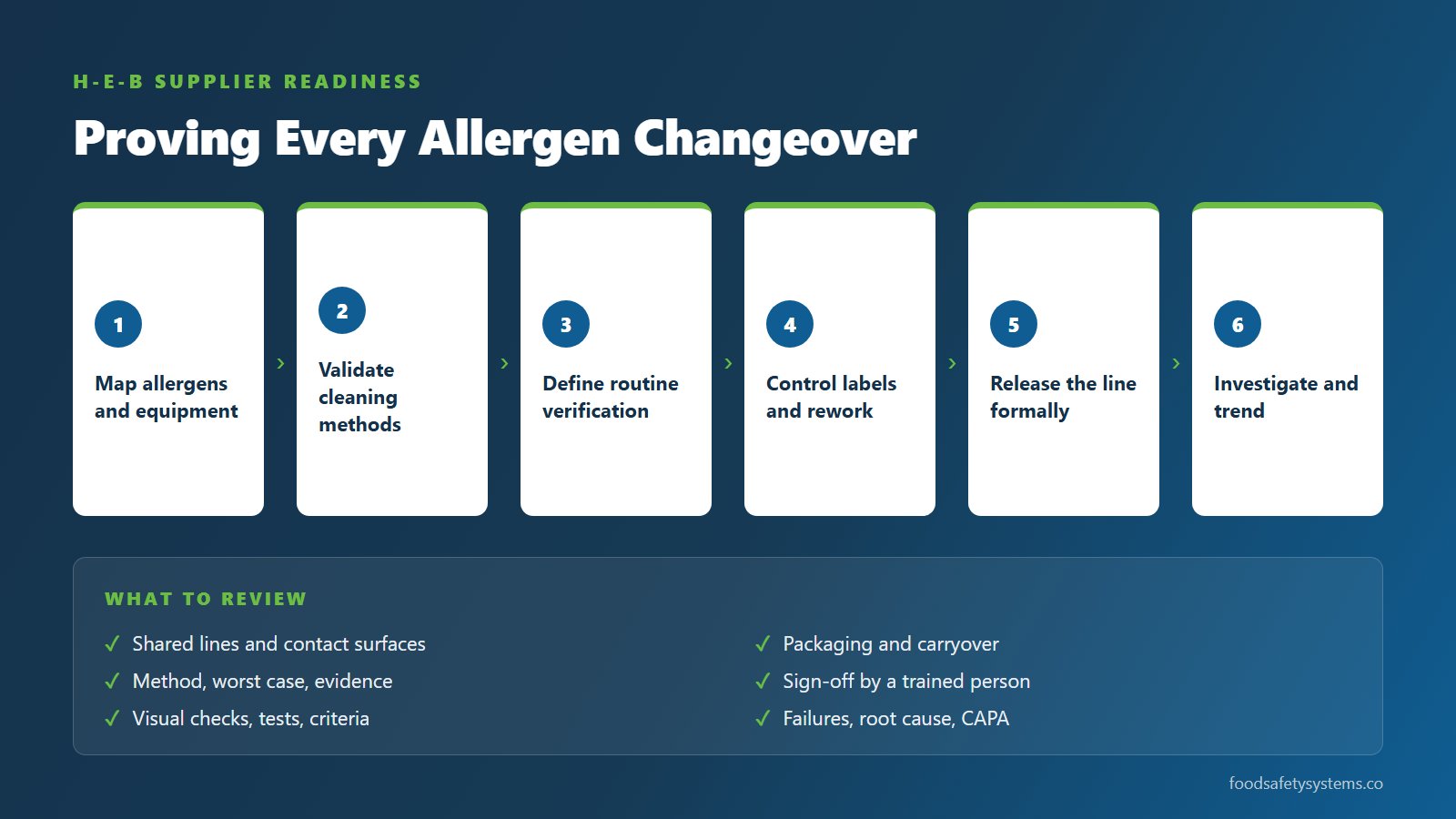
Control labels, packaging and rework
A clean line can still produce a mislabeled product. Therefore, remove the previous run’s labels and packaging before start-up, and check the new ones against the product. Control rework so that allergen-containing material only goes back into compatible products.
Release the line formally
Make line release a defined step, not an assumption. A trained person confirms that cleaning, inspection, verification and packaging checks are complete, and then signs off. Our page on product changeover controls covers the release process in more detail.
Investigate failures and trend results
Treat a failed check as a signal, not just a reclean. Hold affected product, find the root cause and confirm that the fix works. In addition, trend results by line, product and shift to find recurring weak points.
A practical H-E-B supplier scenario
A plant producing a Texas-oriented specialty salsa for potential H-E-B supply uses the same filler for products with different allergen profiles. A signed line-clearance sheet exists. However, the supporting cleaning validation, equipment inspection points and escalation instructions are incomplete.
A system review connects that paperwork to demonstrable control. As a result, the plant can show not only that the line was cleaned, but that the method works and that failures are handled.
Common gaps
- Line-clearance sheets signed without defined inspection points.
- Validation evidence that does not match the current method or equipment.
- Acceptance criteria that are missing or vague.
- Label and packaging changeovers handled separately from cleaning.
- Failed checks recleaned without investigation or trending.
Weak changeover control can cause undeclared allergen risk, label discrepancies, lost production time and customer complaints. A certificate alone does not show that each changeover is properly managed.
Records to keep
- Allergen matrix, shared-equipment list and changeover sequences.
- Cleaning SOPs with validation evidence for high-risk changeovers.
- Verification results with acceptance criteria and the person responsible.
- Line release, label and packaging check records.
- Deviation, investigation and corrective action records, with trends.
Allergen changeover verification readiness checklist
- Map allergens, shared equipment, changeover sequences and high-risk contact surfaces.
- Document technically suitable cleaning approaches and validation evidence where needed.
- Define routine verification tests, visual checks and acceptance criteria.
- Control label changeovers, rework and unintended ingredient carryover.
- Investigate failed verification and trend recurring changeover issues.
Frequently asked questions
Is a visual inspection enough to verify an allergen changeover?
Sometimes it is part of the answer, but not always enough. The right mix of visual checks and tests depends on the allergen, product, equipment and your validation evidence.
How often should allergen cleaning be revalidated?
Revalidate when the method, equipment, product or allergen profile changes, and when verification trends suggest a problem. Your scheme documents and customers may set further expectations.
Does FSSC 22000 certification prove changeovers are controlled?
No. Certification shows the system was audited. Day-to-day control is shown by changeover records, verification results and how failures are handled.
How Consultare Inc. Group can help
Consultare Inc. Group supports FSSC 22000 readiness, PRP documentation, allergen changeover procedures, verification records and internal audits, coordinated with applicable HACCP and PCQI activities.
- FSSC 22000 implementation readiness: changeover controls checked before your audit.
- FSSC 22000 and FDA compliance integration: align allergen controls with Part 117.
- Corrective action support: verification that changeover fixes hold.
Need help verifying your allergen changeovers?
Share your allergen matrix, shared-equipment list, cleaning SOP and sample verification records, so we can focus on your highest-risk lines. Contact us or book a free consultation.
Prefer to organize your compliance activities yourself? Create a free SystemsBuilder account to structure changeover records, verification results and corrective actions.
Technical sources: the FSSC 22000 scheme, 21 CFR 117.135 and H-E-B supplier information. This article is educational and is not legal advice or a statement of H-E-B supplier policy. Applicability depends on your products, facility and customer arrangements. Food Safety Systems is an independent consultancy and is not affiliated with, sponsored or approved by H-E-B, the FDA or the FSSC 22000 Foundation. H-E-B-specific requirements must be confirmed directly with the relevant H-E-B supplier or purchasing contact.