
Food safety culture in management review is where commitments either become evidence or stay on paper. A signed food safety policy does not show how teams behave on a busy shift. Culture becomes visible in how employees escalate defects, how supervisors respond to near misses and whether management funds corrective actions. A growing supplier may have polished policies but little objective evidence that they guide daily decisions.
Quick answer: set practical culture objectives linked to your real risks, and gather staff feedback through interviews, observations and reporting channels. Track leading indicators such as timely escalation, training effectiveness and action closure. Then bring the results into management review, test decisions on staffing and resources, and record what you will change. Confirm any customer-specific expectations with the relevant H-E-B supplier or purchasing contact.
This guide is for site leaders, quality managers and FSMS teams at food manufacturers preparing for possible H-E-B supply. For a broader view of culture on the floor, see our article on food safety culture in manufacturing.
Where culture fits in FSSC 22000
The FSSC 22000 scheme includes additional requirements that cover food safety and quality culture. In practice, the organization defines objectives, communicates expectations, obtains staff feedback and evaluates performance. That evaluation sits naturally in the ISO 22000-based management review. Check the exact wording against the current scheme documents on fssc.com and your certification scope.
Management review is the right place because it is where resources, priorities and accountability are decided. Our guide to FSSC 22000 management review explains the wider inputs and outputs.
Six steps to build food safety culture into management review
Set risk-based culture objectives
Link each objective to the site’s actual risk profile. For example, a site with frequent allergen changeovers might target the speed of escalation when a check fails. Keep objectives few, specific and measurable.
Gather staff feedback
Use interviews, floor observations, short surveys and reporting channels. Ask what makes it hard to stop a line or report a problem. In addition, make sure feedback reaches people with the authority to act on it.
Track leading indicators
Lagging measures such as complaints show problems after the fact. Leading indicators show the habits that prevent them. Examples include near-miss reports, time to escalate, training effectiveness checks and on-time action closure. See our page on food safety culture assessment for ways to measure.
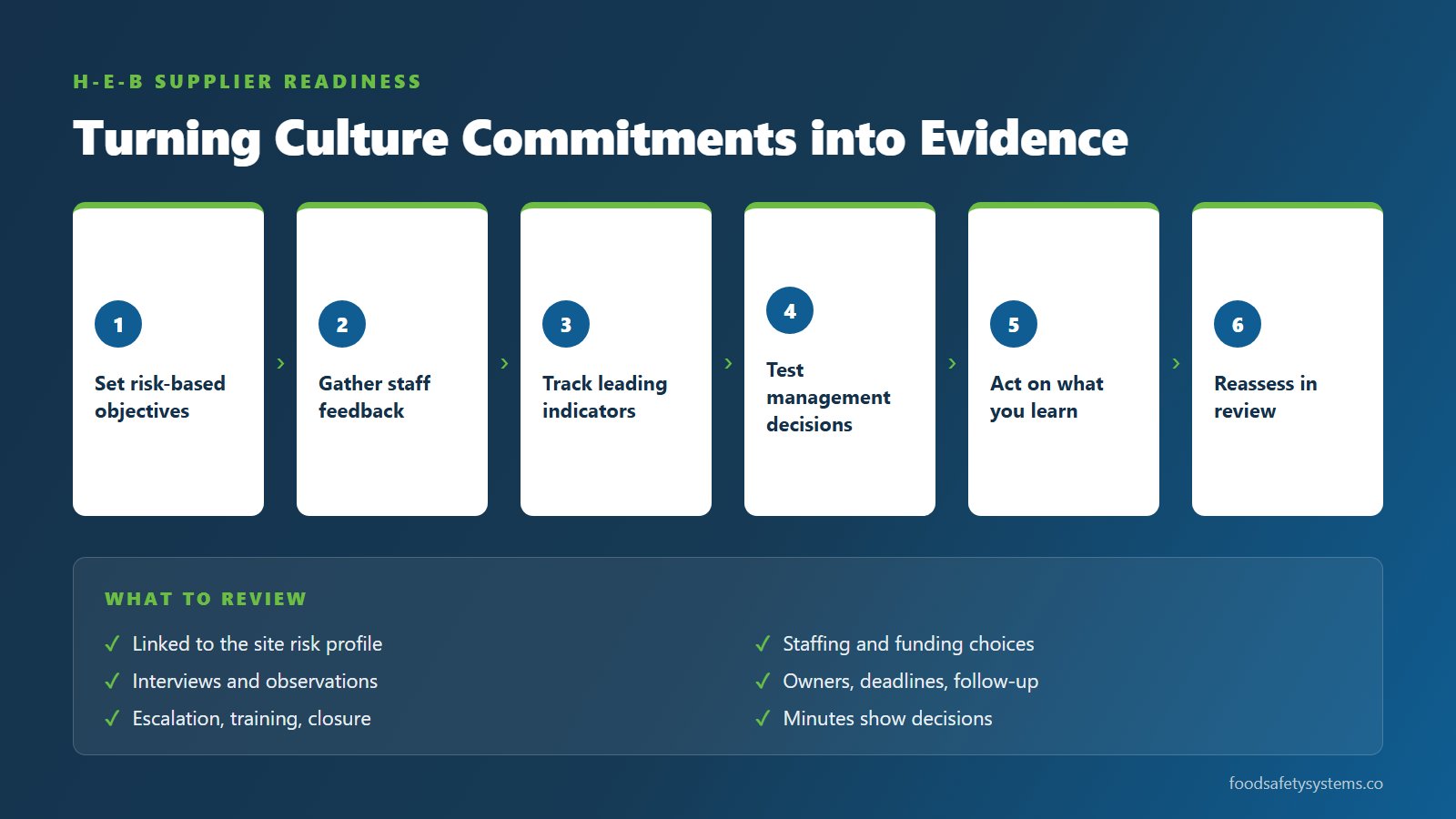
Test management decisions against the evidence
Review staffing, budgets and production pressure against recurring food safety issues. If the same problem returns, ask whether a resource decision is part of the cause. As a result, the review examines leadership choices, not just front-line performance.
Act on what you learn
Turn findings into actions with owners, deadlines and follow-up. Communicate the actions back to staff, so they see that feedback leads somewhere. That visible response is itself part of the culture.
Reassess during management review
Bring results, actions and updated objectives to each review. Record decisions in the minutes, including what will change and who is accountable. Our page on building a food safety culture covers long-term maintenance.
A practical H-E-B supplier scenario
A manufacturer producing a Texas-oriented specialty salsa for potential H-E-B supply reports zero near misses for a year. Yet employees say that equipment problems are seldom written down. Management may be rewarding silence without meaning to, instead of making safe reporting routine.
A culture review in management review would question the zero, not celebrate it. The team could then simplify reporting, recognize good catches and track near misses as a positive indicator.
Common gaps
- Culture objectives copied from a template and not linked to site risks.
- Staff feedback collected but never reviewed by management.
- Only lagging indicators, such as complaints and audit findings.
- Management review minutes that record data but no decisions.
- Zero near-miss reports treated as good news without checking why.
Culture statements without operational evidence can hide weak escalation habits. They can also slow the response to emerging problems.
Records to keep
- The food safety policy and culture objectives, with owners.
- Staff feedback results and observation notes.
- Indicator trends, such as near misses, escalation times and action closure.
- Management review minutes showing culture inputs, decisions and resources.
- Improvement actions with evidence of completion and effectiveness.
Food safety culture in management review: readiness checklist
- Define practical culture objectives linked to the site’s actual risk profile.
- Gather staff feedback through interviews, observations and appropriate reporting channels.
- Track leading indicators such as timely escalation, training effectiveness and action closure.
- Review management decisions, staffing and resources against recurring food safety issues.
- Document improvement actions and reassess culture objectives during management review.
Frequently asked questions
Is a signed food safety policy enough evidence of culture?
No. A policy states intent. Evidence comes from feedback, indicators, decisions and follow-up actions that show the policy guides daily work.
Is zero near misses a good result?
Not necessarily. It may mean that people do not report problems. Check reporting habits before treating a zero as success.
Does H-E-B set food safety culture requirements for suppliers?
Public information does not set out a uniform, detailed food safety checklist for all H-E-B suppliers. Confirm current expectations with the appropriate H-E-B supplier or purchasing team.
How Consultare Inc. Group can help
Consultare Inc. Group supports FSSC 22000 readiness, management system documentation, culture action planning, internal audits and corrective action tracking. Support is tailored to the facility, product and supplier pathway.
- FSSC 22000 implementation readiness: culture and review evidence checked before your audit.
- Management review procedures: inputs, outputs and records that show decisions.
- Corrective action support: actions closed with effectiveness evidence.
Want culture evidence that stands up to review?
Share your food safety policy, culture plan if available, recent management review minutes and a sample near-miss report, so we can focus on meaningful evidence. Contact us or book a free consultation.
Prefer to organize your compliance activities yourself? Create a free SystemsBuilder account to structure objectives, review records and corrective actions.
Technical sources: the FSSC 22000 scheme, ISO 22000 and H-E-B supplier information. This article is educational and is not legal advice or a statement of H-E-B supplier policy. Applicability depends on your products, facility and customer arrangements. Food Safety Systems is an independent consultancy and is not affiliated with, sponsored or approved by H-E-B, the FDA or the FSSC 22000 Foundation. H-E-B-specific requirements must be confirmed directly with the relevant H-E-B supplier or purchasing contact.