
Recall test effectiveness is the difference between a polished recall procedure and records that actually work. Many teams have a well-written procedure. Yet a mock recall can still fail to reconcile incoming ingredient quantities with the finished lots shipped to customers. An FSSC 22000 food safety management system (FSMS) expects traceability and withdrawal or recall processes to operate in practice, so testing them properly is how you prove it.
Quick answer: confirm your certified scope and lot-code handoffs, then trace a real raw material lot through processing, rework, packaging and dispatch. Reconcile quantities with a mass balance and explain any differences. Next, test escalation and customer notification roles, close the gaps with corrective actions and report the results to management. Confirm any H-E-B-specific expectations directly with your H-E-B contact, because certification does not guarantee supplier acceptance.
This guide is for food manufacturers and brands preparing for possible H-E-B supply, as well as quality managers, warehouse leads and food safety teams. For system design basics, see our page on food traceability systems.
What the scheme and the regulations expect
FSSC 22000 builds on ISO 22000, the applicable prerequisite program (PRP) standard for your sector and the scheme’s additional requirements. Traceability, emergency response and withdrawal or recall processes must work as part of the FSMS. Check the scheme documents that currently apply to your site on fssc.com.
U.S. rules apply separately. Where a food has a hazard requiring a preventive control, 21 CFR 117.139 requires a written recall plan. The plan must assign responsibility for notifying direct consignees, notifying the public when appropriate, conducting effectiveness checks and disposing of recalled food. In addition, foods on FDA’s Food Traceability List fall under the Food Traceability Rule. FDA currently states that, following a Congressional directive, it will not enforce that rule before July 20, 2028, so check fda.gov for the latest status.
Retail expectations are a third layer. H-E-B publishes general supplier information and uses an access-controlled supplier portal for authorized business interactions. Public information does not set one detailed food safety checklist for every supplier, so verify current expectations with the relevant H-E-B supplier or purchasing team.
Six steps to improve recall test effectiveness
Confirm scope and lot-code handoffs
Start with the certified scope, the traceability units you use and the points where lot codes change hands. Typical handoffs include receiving, batching, rework, packaging and warehouse dispatch. Each one is a place where the trail can break.
Trace one raw material lot
Pick a real raw material lot, ideally one used across several products or pack sizes. Trace it forward through processing, rework, packaging and dispatch to the customers who received it. Then trace one finished lot backward to its ingredients and packaging.
Reconcile with a mass balance
Compare the quantity received with the quantities used, held in stock, scrapped and shipped. Document any unexplained difference and investigate it. A trace that finds the lots but cannot account for the quantities is only half a result.
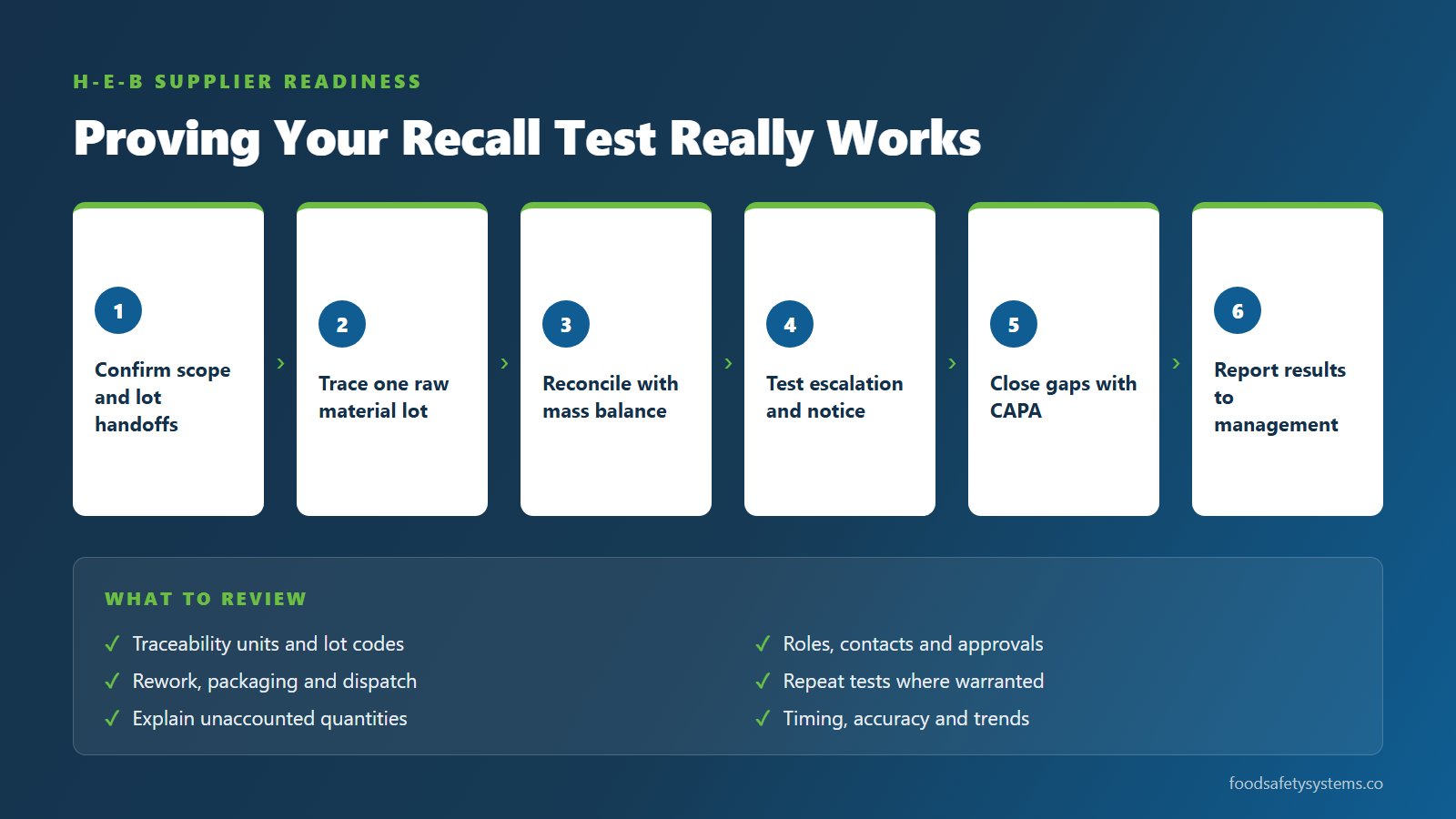
Test escalation and notification
A mock recall should test people as well as records. Check who is called, who decides, who approves customer notification and how quickly contact details are found. See withdrawal and recall procedures.
Close gaps with corrective actions
Record every gap the test revealed, find the root cause and assign an owner and a deadline. Where the fix is significant, repeat the test to show that it works. As a result, the next exercise starts from a stronger position.
Report results to management
Report the time taken, the accuracy of the trace, the reconciliation result and the status of corrective actions. Trends across tests show whether the system is improving. Management review is the right place to decide on resources.
Common gaps in mock recalls
- Testing an easy, single-ingredient product every time.
- Rework that breaks the link between batches.
- Batch sheets, warehouse movements and shipment records that do not agree.
- No mass balance, or differences recorded without explanation.
- Notification roles that exist only on paper and were never tested.
Records to keep
- Traceability and recall procedures, with roles and contact lists.
- Receiving, batch, rework, packaging and dispatch records for the traced lots.
- The mock recall report, including timing and mass-balance results.
- Corrective actions, repeat tests and their outcomes.
- Management review records that cover traceability performance.
Example: one ingredient lot, many packs
A processor uses one ingredient lot across several retail pack sizes and customer channels. A mock recall exposes gaps between batch sheets, warehouse movements and customer shipment records.
Imagine the affected product is proposed for H-E-B, and the commercial team is asked for quick assurance that the issue is closed. A confident answer needs more than a signed form. It requires a traceable risk decision, current objective evidence, an accountable approver and a plan to prevent recurrence. For a related view of disruptions, see food safety continuity for H-E-B suppliers.
Recall test effectiveness checklist
- Confirm the certified scope, traceability units and critical lot-code handoffs.
- Trace a selected raw material lot through processing, rework, packaging and dispatch.
- Perform a mass-balance reconciliation and document unexplained differences.
- Test escalation, customer notification roles and decision approval during a mock event.
- Capture corrective actions, repeat tests where warranted and report outcomes to management.
- Confirm current H-E-B expectations for your product and facility with the relevant H-E-B contact.
Frequently asked questions
What makes a mock recall effective?
It traces real lots forward and backward, reconciles quantities, tests the people and decisions involved and ends with corrective actions. Speed matters, but accuracy matters more.
Does an FSSC 22000 certificate replace the FDA recall plan?
No. Certification and regulatory compliance are separate. Where 21 CFR 117.139 applies, the written recall plan is a legal requirement in its own right. For more context, see FDA food recalls and FSSC 22000.
Does FSSC 22000 certification guarantee acceptance as an H-E-B supplier?
No. Certification can support supplier readiness, but acceptance depends on H-E-B’s own current requirements and commercial decisions. Confirm them with your H-E-B contact.
How Consultare Inc. Group can help
Consultare Inc. Group supports traceability control assessments, mock recall exercises, gap closure documentation and readiness ahead of certification or customer review. For traded products, see also traded product recall readiness.
- FSSC 22000 implementation readiness: traceability gaps found before your audit.
- FSSC 22000 and FDA compliance integration: align your FSMS with the recall plan rule.
- Corrective action support: mock recall findings closed with effectiveness evidence.
Can your records stand up to a real recall?
Share your traceability procedure, sample batch records and last mock recall result, so we can focus on the most important gaps. Contact us or book a free consultation.
Prefer to organize your compliance activities yourself? Create a free SystemsBuilder account to structure traceability records, mock recall results and corrective actions.
Technical sources: the FSSC 22000 scheme, 21 CFR 117.139, FDA’s Food Traceability Rule page and H-E-B’s public supplier information. This article is educational and is not legal advice or a statement of H-E-B supplier policy; applicability depends on your product, facility and customer arrangements. Food Safety Systems is an independent consultancy and is not affiliated with, sponsored or approved by H-E-B, the FDA or the FSSC 22000 Foundation. H-E-B-specific supplier requirements must be confirmed directly with the relevant H-E-B supplier or purchasing contact.