
Food safety continuity for H-E-B suppliers starts with a simple question: when operations are disrupted, who decides whether the affected food is still safe? A power failure can interrupt cold storage and production in minutes. Yet many emergency plans do not say who checks product temperatures, who authorizes disposition or which records must be preserved. An FSSC 22000 food safety management system (FSMS) gives you a framework to answer those questions before an incident happens.
Quick answer: list the credible events that could affect your site, and define escalation authority, product isolation and objective disposition criteria. Next, decide which process, temperature, sanitation and traceability records must continue during a disruption. Then exercise a realistic scenario and feed the lessons into your plan and corrective actions. Confirm any H-E-B-specific expectations directly with your H-E-B contact, because certification does not guarantee supplier acceptance.
This guide is for food manufacturers and brands preparing for possible H-E-B supply, as well as quality managers, plant managers and food safety teams. For the general scheme view, see our article on FSSC 22000 emergency preparedness.
Why business continuity is not enough
A business continuity plan usually focuses on restoring production and deliveries. That matters, but it may leave one question open: is the food that was affected safe to release? Food safety emergency preparedness closes that gap, because it ties the response to hazards, product decisions and evidence.
FSSC 22000 builds on ISO 22000, the applicable prerequisite program (PRP) standard for your sector and the scheme’s additional requirements. Emergency preparedness and response are part of that system. Align your plan with the scheme documents that currently apply to your site, as published on fssc.com, and let your product and site hazards drive the detail.
For a business considering H-E-B, speed to market matters. However, a buyer conversation and a documented, compliant supply operation are different milestones. H-E-B publishes general supplier information and uses an access-controlled supplier portal for authorized business interactions. Public information does not set one detailed food safety checklist for every supplier, so check current expectations with the relevant H-E-B supplier or purchasing team.
Six steps to build food safety continuity for H-E-B suppliers
Identify credible events
List the events that could realistically affect your site and products. Typical examples include power loss, water interruption, flooding, severe weather, contamination events and the loss of a key supplier. For each event, note which products, areas and controls could be affected.
Assign escalation authority
Name who leads the response on each shift and who has authority to stop production, hold product and approve release. Keep contact lists current, including deputies, utilities, key suppliers and service providers. As a result, nobody has to guess who decides at two in the morning.
Isolate affected product
Define how potentially affected product is identified, segregated and placed on hold. Set objective disposition criteria in advance, such as time and temperature limits for chilled goods. Then record each release, rework or disposal decision with the approver’s name. See nonconforming product control.
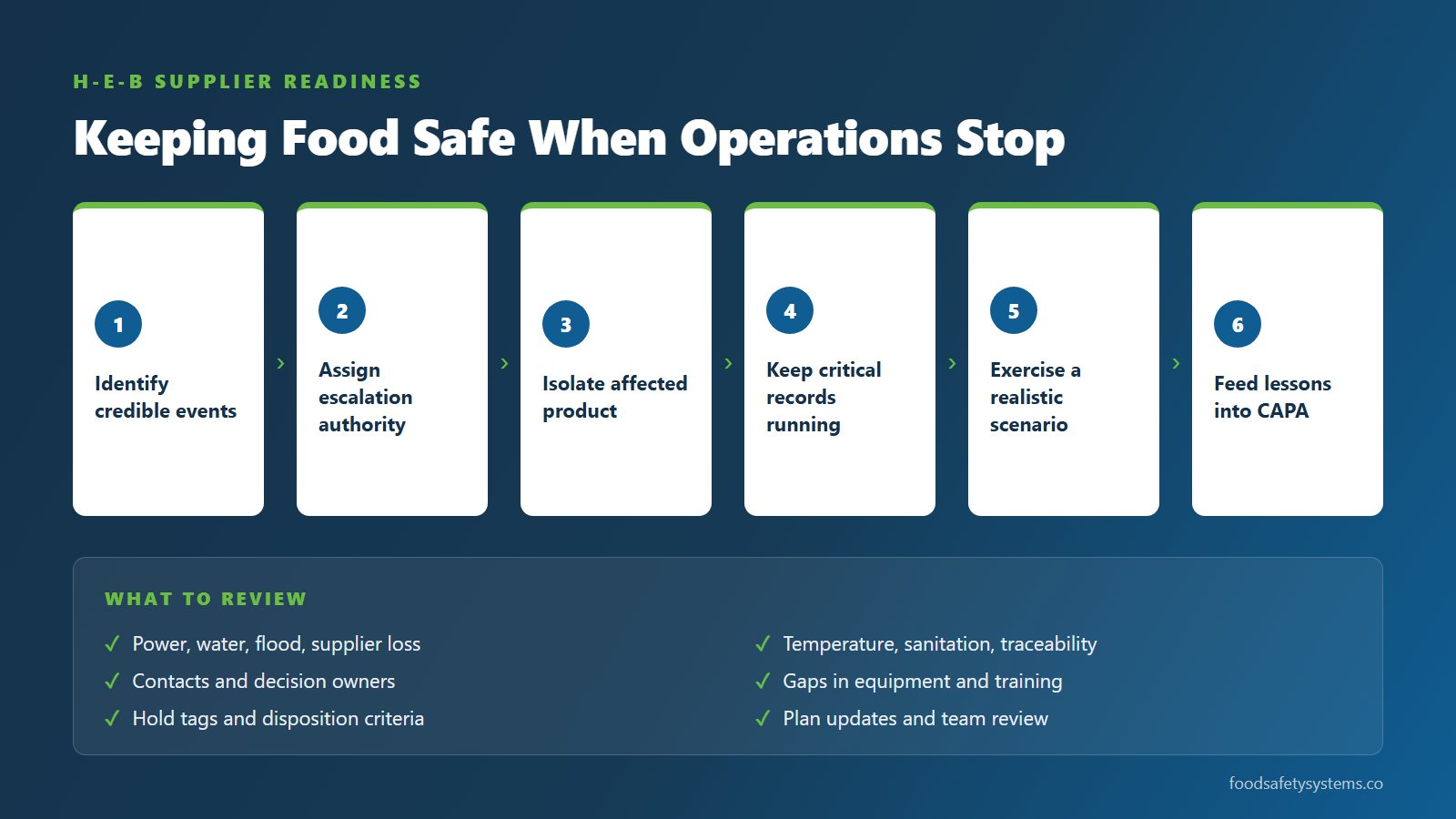
Keep critical records running
Decide which process, temperature, sanitation and traceability records must continue during a disruption. Plan a fallback, such as paper forms or manual temperature checks, when electronic systems fail. See temperature control measures.
Exercise a realistic scenario
Test at least one realistic scenario, for example a refrigeration failure during a storm. Watch for missing equipment, unclear communication and training gaps. Restarts deserve attention too, because equipment that stopped unexpectedly may need cleaning, inspection or maintenance first. See preventive maintenance and food safety risk.
Feed lessons into CAPA
Record what the exercise or real event revealed, then assign corrective actions with owners and deadlines. Update the controlled emergency plan and review it with the food safety team. In this way, each event makes the system stronger.
Common gaps in emergency plans
- The plan restores production but never asks whether affected food is safe to release.
- No named person has authority to approve product disposition.
- Disposition criteria are decided under pressure instead of in advance.
- Temperature and traceability records stop when power or IT systems fail.
- The plan has never been tested, so contact lists and equipment are out of date.
Records to keep
- The controlled emergency plan, with its list of credible events.
- Escalation roles and current contact lists.
- Hold records, product evaluations and disposition decisions.
- Temperature, sanitation and traceability records kept during the event.
- Exercise reports, lessons learned and corrective actions.
Example: refrigeration loss during a storm
A food manufacturer supplying regional distribution loses refrigeration during a storm. Operations resume quickly. However, staff have not evaluated product exposure or documented food safety release decisions.
Imagine the affected product is proposed for H-E-B, and the commercial team is asked for quick assurance that the issue is closed. A confident answer needs more than a signed form. It requires a traceable risk decision, current objective evidence, an accountable approver and a plan to prevent recurrence. For wider incident handling, see food incident and recall management.
Food safety continuity for H-E-B suppliers: checklist
- Identify credible events such as power loss, water interruption, flooding, contamination events and supplier disruption.
- Define escalation authority, contact lists, product isolation methods and objective disposition criteria.
- Determine which process, temperature, sanitation and traceability records must continue during disruptions.
- Exercise at least one realistic scenario and identify missing equipment, communication or training.
- Integrate lessons into controlled emergency plans, food safety team reviews and CAPA records.
- Confirm current H-E-B expectations for your product and facility with the relevant H-E-B contact.
Frequently asked questions
Is a business continuity plan the same as food safety emergency preparedness?
Not quite. Business continuity restores operations, while food safety emergency preparedness also decides whether affected product is safe and documents that decision. The two plans should work together.
How often should we test the emergency plan?
Follow the frequency set in your FSMS and the current scheme documents. Also test after significant changes, such as a new cold store, new products or a real incident.
Does FSSC 22000 certification guarantee acceptance as an H-E-B supplier?
No. Certification can support supplier readiness, but acceptance depends on H-E-B’s own current requirements and commercial decisions. Confirm them with your H-E-B contact.
How Consultare Inc. Group can help
Consultare Inc. Group supports FSSC 22000 readiness assessments, emergency response workflows, simulation evidence, CAPA improvement and record integration. Certification remains subject to an independent audit.
- FSSC 22000 implementation readiness: emergency preparedness gaps found before your audit.
- Crisis and regulatory support: structured help when an incident happens.
- Corrective action support: exercise findings closed with effectiveness evidence.
Is your emergency plan ready for a real disruption?
Share your current emergency plan, last test results and certification scope, so we can focus on the most important gaps. Contact us or book a free consultation.
Prefer to organize your compliance activities yourself? Create a free SystemsBuilder account to structure emergency plans, exercise records and corrective actions.
Technical sources: the FSSC 22000 scheme, ISO 22000 and H-E-B’s public supplier information. This article is educational and is not legal advice or a statement of H-E-B supplier policy; applicability depends on your product, facility and customer arrangements. Food Safety Systems is an independent consultancy and is not affiliated with, sponsored or approved by H-E-B, the FDA or the FSSC 22000 Foundation. H-E-B-specific supplier requirements must be confirmed directly with the relevant H-E-B supplier or purchasing contact.