
Quick answer: A hygienic design review before commissioning checks new or modified equipment against agreed food safety criteria before it enters routine production. Once equipment is installed, correcting inaccessible cleaning points or poor drainage is disruptive and expensive. Involving food safety personnel before start-up therefore reduces avoidable rework and gives you clear release evidence.
This guide is for FSSC 22000 food safety teams, engineering and project managers, sanitation leads and maintenance teams who install, move or modify equipment.
Why review hygienic design before start-up
Equipment purchases are often driven by capacity, cost and delivery dates. Food safety is sometimes considered only when the first cleaning fails. By then, fixing a dead end, a hollow frame or an unsuitable material may require a shutdown and a second installation project.
A pre-startup review moves those questions earlier. It also connects the purchase with your change management process. Our article on sanitary design for facility changes covers the wider change review, while this guide focuses on the final gate before production.
What good pre-startup criteria cover
Good criteria are written down before the equipment arrives and agreed by food safety, sanitation, maintenance and operations. They typically cover:
- Equipment materials suitable for the product, cleaning chemicals and temperatures.
- Accessibility of product-contact and surrounding surfaces for cleaning and inspection.
- The intended cleaning method, whether manual, clean-out-of-place or clean-in-place.
- Drainage of the equipment itself and of the surrounding floor.
- Utility connections such as water, air and steam.
- Lubrication, including where lubricants could contact product.
- Operator and sanitation training, and the release approval step.
Many of these points link to your equipment suitability PRP. Our page on equipment suitability, maintenance and calibration explains that program in more detail.
Common commissioning problems
- Equipment specifications are agreed without food safety or sanitation input.
- Installation leaves too little space to clean around or under the unit.
- Utility connections and drains are added on site without a hygiene check.
- Operators start production before cleaning instructions and training are ready.
- Open issues from installation are not recorded, so nobody follows them up.
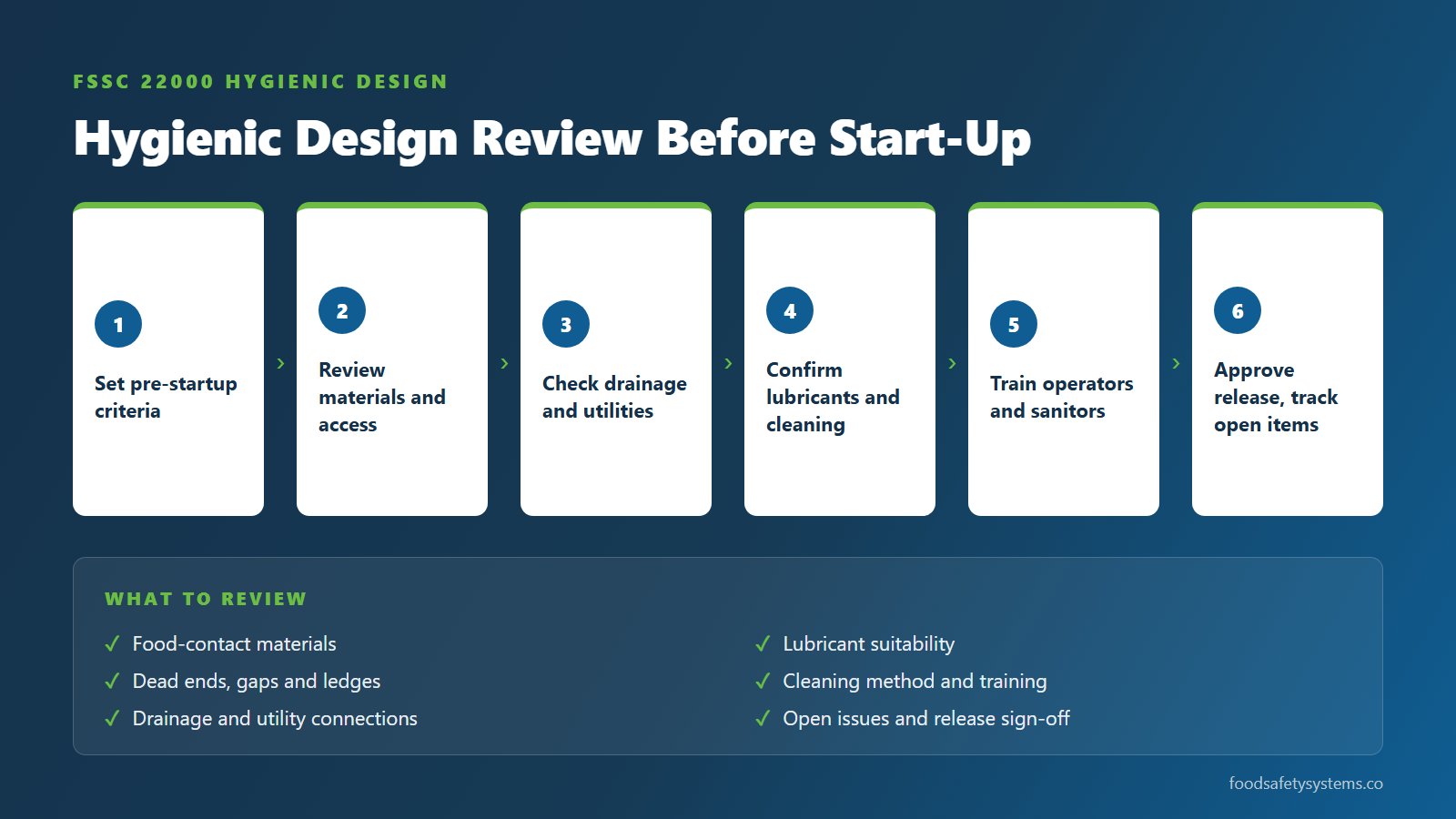
Six steps for a hygienic design review before commissioning
1. Set pre-startup criteria
Establish criteria covering materials, accessibility, cleaning methods, drainage, utility connections, lubrication, operator training and release approval. Agree them before installation starts.
2. Review materials and access
Inspect the installed equipment against the criteria. Look for dead ends, gaps, ledges and hollow sections where residues or moisture could collect.
3. Check drainage and utility connections
Confirm that equipment and floors drain properly and that water, air and steam connections suit the intended use. Our page on hygienic design for utilities covers the utility checks in more detail.
4. Confirm lubricants and cleaning method
Check that lubricants are suitable where incidental product contact is possible. Then run the intended cleaning method and confirm the equipment can be cleaned and inspected as planned.
5. Train operators and sanitation staff
Make sure operators, sanitation crews and maintenance staff know how to run, clean and service the equipment before routine use. Our page on training and competence explains how to record this.
6. Approve release and track open items
Record unresolved issues and verify corrections before routine operation. Release should be a documented decision, ideally linked to your start-up and changeover procedures.
Records and evidence to keep
- The agreed pre-startup criteria and the completed review checklist.
- Material and lubricant information relevant to food safety.
- Cleaning trial results and the approved cleaning instruction.
- Training records for operators, sanitation and maintenance staff.
- An open-items list with owners, dates and verification of closure.
- The signed release approval.
Example scenario
A bakery installs a new slicer for a product line. During the pre-startup review, the sanitation lead finds a hollow guard that traps crumbs and cannot be opened for cleaning. The team also finds that the cleaning instruction has not been written yet.
As a result, the release is put on hold. The supplier modifies the guard, sanitation completes a cleaning trial and operators are trained. Once the open items are closed and verified, the food safety manager signs the release.
U.S. FDA context
For facilities subject to FDA rules, 21 CFR 117.40 sets Current Good Manufacturing Practice requirements for equipment and utensils. Among other things, equipment must be designed and made of materials so that it is adequately cleanable and adequately maintained. Equipment must also be installed so as to facilitate cleaning and maintenance of the equipment and of adjacent spaces.
These requirements apply independently of FSSC 22000 certification. A pre-startup review is a practical way to show you considered them before the equipment entered production.
Hygienic design review checklist
- Pre-startup criteria are documented and agreed before installation.
- Materials and lubricants suit the product, chemicals and temperatures.
- Surfaces are accessible for cleaning and inspection, with no obvious harborage points.
- Drainage and utility connections have been checked.
- The cleaning method has been trialled and the instruction approved.
- Training is complete and open items are verified before release.
Frequently asked questions
Is a hygienic design review the same as equipment verification?
Not quite. The review happens before release to production. Ongoing FSSC 22000 hygienic equipment verification then confirms the equipment stays in a suitable condition.
Does used or relocated equipment need a review?
Yes, in most cases. Moving equipment can change access, drainage and utility connections, so the same criteria should be applied.
Who signs the release?
The person named in your procedure, often the food safety lead together with operations. The key point is that the decision and its evidence are recorded.
How Consultare Inc. Group can help
Consultare Inc. Group can help organize FSSC 22000-oriented change-control records, commissioning checklists, prerequisite program reviews and improvement tracking. Exact deliverables depend on the approved scope. Facility management retains responsibility for approving and implementing changes. We do not promise certification, regulatory approval or an audit outcome.
- FSSC 22000 implementation readiness: commissioning controls checked before your audit.
- FSSC 22000 and FDA compliance integration: align equipment controls with Part 117.
- Corrective action support: closure of open commissioning items.
Need help managing your FSSC 22000 responsibilities?
Discuss your products, process, records, risks and next steps with our team. Contact us or book a free consultation.
Prefer to organize your compliance activities yourself? Create a free SystemsBuilder account to structure commissioning checklists, training records and corrective actions.
Technical sources: FSSC 22000, 21 CFR 117.40 and EHEDG (voluntary hygienic design guidance). This article is educational; requirements depend on your products, certification scope and applicable regulations. Food Safety Systems is an independent consultancy and is not affiliated with the FSSC 22000 Foundation or FDA.