
Refrigerated rice foods show why process exposure and packaging conditions must be examined together. An FSSC 22000 food safety management system (FSMS) depends on a sound hazard analysis, well-chosen control measures and effective prerequisite programs (PRPs). Cooked rice and rice noodles can support growth of spore-forming bacteria if cooling is slow. Reduced-oxygen packaging (ROP) can then change which hazards matter most.
Quick answer: FSSC 22000 sites making refrigerated rice foods should identify significant cooling and packaging hazards, select suitable control measures, verify monitoring performance and review whether PRPs and corrective actions work. Where FDA’s preventive controls rule applies, 21 CFR Part 117 obligations remain separate from certification.
This guide is for FSSC 22000 sites, food safety team leaders and chilled food manufacturers. For a related process-control topic, see fermented food process controls and validation.
Six areas to review for refrigerated rice foods
Map process exposure and intended use
Describe each operation from cooking to packing. Then distinguish ready-to-eat rice noodles from products that consumers cook again. Intended use changes how much the cooling step must achieve. See product description and intended use.
Review biological hazards
Assess growth and toxin formation by spore-forming organisms such as Bacillus cereus and, under reduced oxygen, Clostridium botulinum. Relate each risk to formulation, pH, water activity and time-temperature history. See conduct a hazard analysis.
Determine control measures and categories
Use your hazard analysis to set suitable controls and classify them as PRPs, operational PRPs or CCPs. Not every temperature measure automatically becomes a CCP. Instead, the classification should follow the documented methodology.
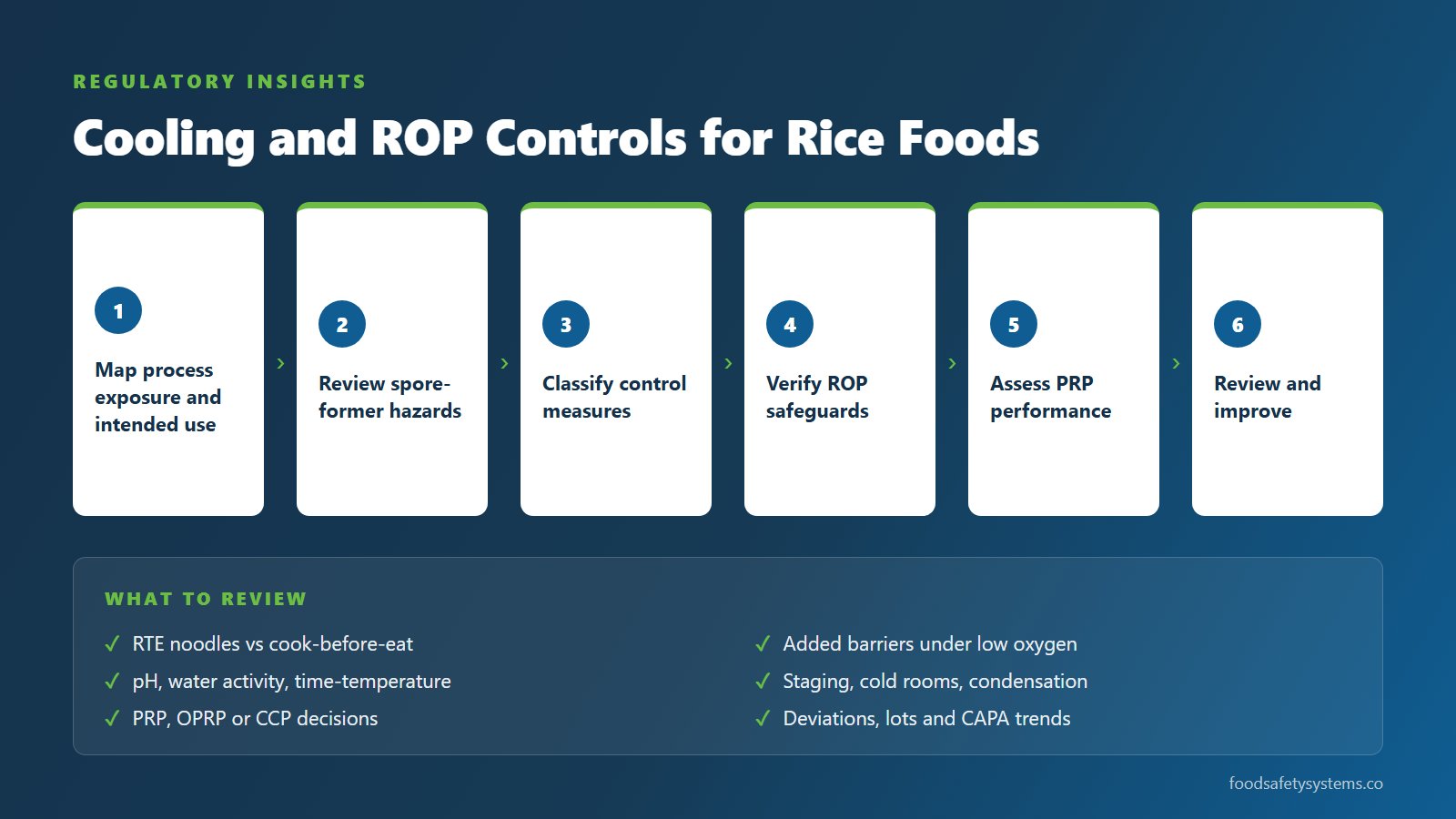
Verify reduced-oxygen packaging safeguards
Check whether oxygen restriction changes the hazard profile. If it does, confirm whether scientifically justified additional barriers are needed, such as validated time and temperature limits. See process validation.
Assess prerequisite program performance
Review equipment, hygienic practices, staging areas and cold room operation. Also check condensation, personnel training and recordkeeping. See temperature control measures.
Use verification and management review
Review deviations, verification trends and corrective-action effectiveness. In addition, revisit process assumptions whenever recipes, equipment or volumes change. Bring the results to management review.
Refrigerated rice foods checklist
- Confirm the products, intended use, regulatory scope and current process flow.
- Review the hazard analysis against actual time-temperature exposure and packaging.
- Verify scientifically justified process criteria, monitoring methods and records.
- Identify deviations and affected lots, and record any corrective action.
- Confirm management oversight, ongoing verification and record availability.
Frequently asked questions
Is refrigeration a prerequisite program or a critical control point?
It depends. The classification follows your documented hazard analysis and the control strategy under your food safety system.
Why assess reduced-oxygen packaging separately?
Reduced-oxygen conditions can change the significance of certain hazards. Controls must suit the product and process.
Does FSSC 22000 certification show FDA approval?
No. Certification and FDA regulatory responsibilities are separate.
How Consultare Inc. Group can help
Consultare Inc. Group supports FSSC 22000 readiness reviews, FSMS and PRP assessments, cooling and packaging-control evaluations, internal audits, verification planning and improvement support. Work is scoped to the product, facility and agreed engagement.
- FSSC 22000 implementation readiness: cooling and ROP controls checked before your audit.
- FSSC 22000 and FDA compliance integration: align your FSMS with Part 117.
- Corrective action support: lot assessment and fixes that hold.
Need help managing your FSSC 22000 responsibilities?
Discuss your food, process, documentation and improvement priorities with our team. Contact us or book a free consultation.
Prefer to organize your compliance activities yourself? Create a free SystemsBuilder account to structure process, monitoring and corrective-action records.
Technical sources: FSSC 22000 and 21 CFR Part 117. This article is educational; requirements depend on your products, certification scope and applicable regulations. Food Safety Systems is an independent consultancy and is not affiliated with the FSSC 22000 Foundation or FDA.