
Listeria prevention in RTE operations depends on sanitation and environmental controls that work during live production. Ready-to-eat (RTE) sites move products, people, equipment and packaging between preparation, chilled holding and dispatch. When exposed food is handled after a lethality step, written procedures are not enough. Temperature monitoring, documented deviations and verified corrective actions also help keep unsafe product from leaving the site.
Quick answer: an FSSC 22000 food safety management system (FSMS) should connect hazard analysis, prerequisite programs (PRPs), risk-based environmental monitoring, verification, corrective action and management review. Where FDA’s preventive controls rule applies, sanitation controls under 21 CFR 117.135(c)(3) and environmental monitoring under 117.165(a)(3) remain separate legal duties.
This guide is for food safety managers running an ISO 22000-based FSMS or pursuing FSSC 22000 certification. For a broader view of sanitation verification, see Listeria risk management and sanitation PRPs.
Six steps for Listeria prevention in RTE operations
Connect hazard analysis with PRPs and operational controls
Identify environmental pathogen and temperature-control risks at each exposed RTE step. Include processing, handling, storage and distribution. Then decide which measures act as PRPs, operational PRPs or CCPs. See conduct a hazard analysis.
Assess personnel and material flow
Examine movement between dishwashing, raw handling, RTE preparation and dispatch. Mobile carts and shared equipment belong in cleaning and zoning decisions too. See production risk zone segregation.
Build environmental monitoring that detects trends
Define swab sites, timing, frequencies, target organisms, methods and response steps. Review repeat findings across lines and sites, because they may share a route. See environmental monitoring.
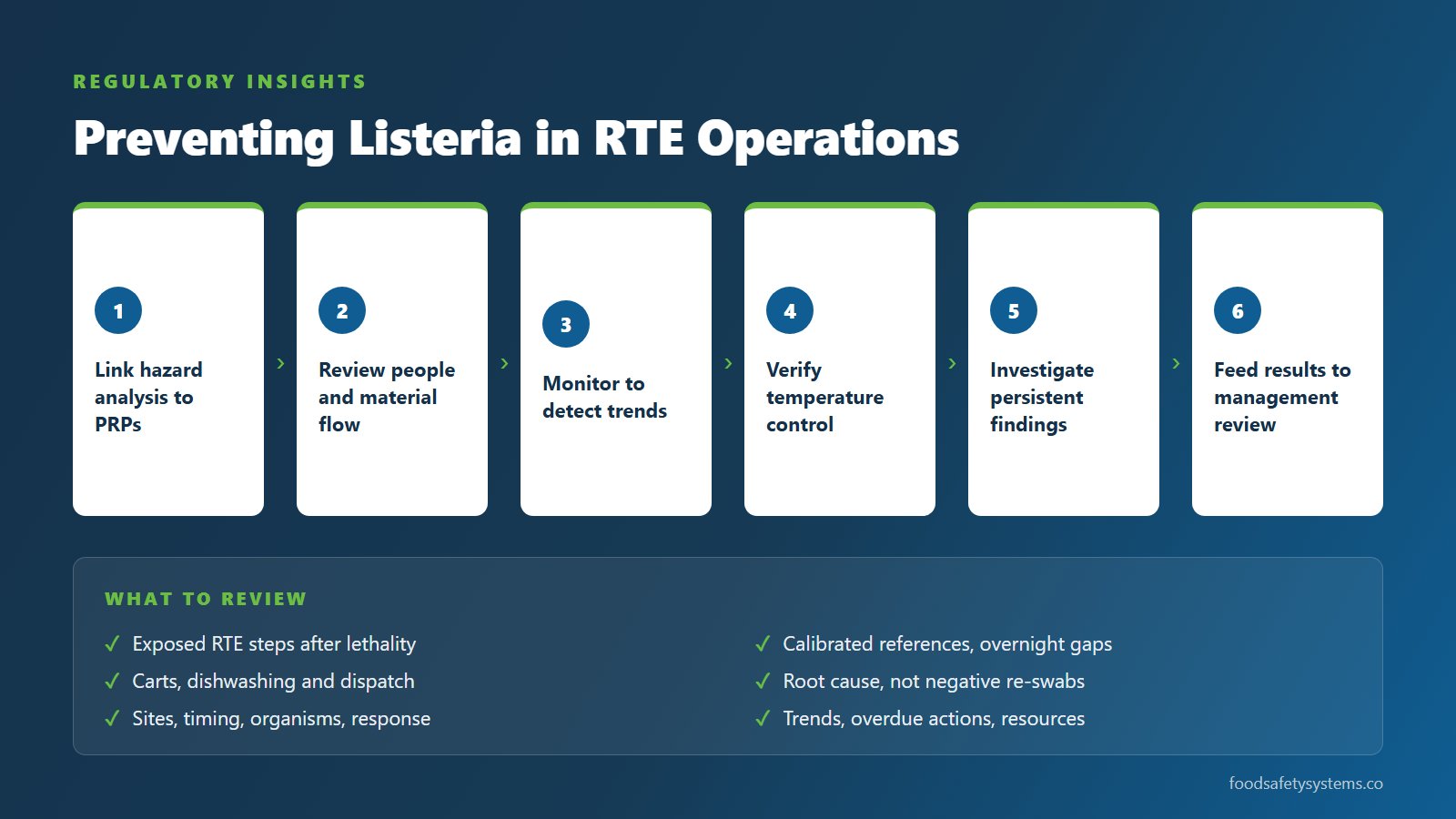
Validate and verify temperature control
Make sure holding criteria and measuring methods reflect product risk. Compare instruments against calibrated references. In addition, review gaps in overnight monitoring. See calibration of measuring equipment.
Investigate persistent findings systematically
Use risk assessment, root cause analysis, targeted sampling and equipment inspection. Do not close a recurring issue on negative follow-up swabs alone. Where Part 117 applies, 21 CFR 117.150 sets out corrective action duties.
Feed results into management review
Bring environmental trends, overdue actions, verification outcomes and resource needs to leadership. Include process changes across all relevant facilities. As a result, decisions rest on the full picture.
Listeria prevention in RTE operations checklist
- Map exposed-food steps and potential contamination routes.
- Check that control procedures are followed during live production.
- Document risk-based monitoring methods, frequencies and records.
- Define investigation and product-assessment steps for deviations.
- Verify corrective-action effectiveness before closure.
Frequently asked questions
Does FSSC 22000 replace 21 CFR Part 117?
No. Organizations must separately evaluate their applicable U.S. regulatory obligations.
Should environmental monitoring include non-food-contact surfaces?
Where warranted, yes. Floors, wheels, drains, cooler areas and traffic zones can reveal contamination routes.
How should repeat findings affect the FSMS?
They should prompt a reassessment of controls, an investigation of common causes and effectiveness checks, with management oversight.
How Consultare Inc. Group can help
Consultare Inc. Group supports FSSC 22000 FSMS readiness, PRP and hazard analysis reviews, environmental monitoring assessments, verification, internal audits and continual improvement. Services depend on the agreed scope and each facility’s requirements.
- FSSC 22000 implementation readiness: RTE sanitation and monitoring checked before your audit.
- FSSC 22000 and FDA compliance integration: align your FSMS with Part 117.
- Corrective action support: root cause work that stops repeat positives.
Need help managing your FSSC 22000 responsibilities?
Discuss your facility, products, hazards, procedures and improvement priorities with our team. Contact us or book a free consultation.
Prefer to organize your compliance activities yourself? Create a free SystemsBuilder account to structure monitoring results, procedures and corrective actions.
Technical sources: FSSC 22000 and 21 CFR Part 117. This article is educational; requirements depend on your products, certification scope and applicable regulations. Food Safety Systems is an independent consultancy and is not affiliated with the FSSC 22000 Foundation or FDA.