
FSSC 22000 produce safety depends on how well a site controls water and harvest-container risks during routine work. Fresh produce operations need to watch how agricultural water, bins and handling practices can carry contaminants to food. Recirculated water, vegetative debris and incomplete risk-assessment decisions all show why documented controls must work on the floor, not just on paper. This article gives general risk-management guidance and does not comment on any named farm.
Quick answer: in an FSSC 22000 food safety management system (FSMS), evaluate water-use and harvest-container risks through hazard analysis, applicable prerequisite programs (PRPs), operational controls and verified records. Confirm your certification scope and sector requirements first. Where the FDA Produce Safety Rule applies, its agricultural water requirements in 21 CFR Part 112, Subpart E remain separate legal obligations.
This guide is for fresh produce packers and processors, food safety teams, internal auditors and FSMS coordinators. For a related produce topic, see our article on FSSC 22000 sprout safety.
Six areas to review for FSSC 22000 produce safety
Define the FSMS scope and process interactions
First, identify whether growing, harvesting, packing or processing falls within your certification scope. Then confirm which sector PRPs apply to each activity. A clear scope prevents gaps between the field and the packing shed.
Evaluate water-related hazards at each use
Next, separate preharvest irrigation exposure from water used during harvest or postharvest handling. Consider the source, the potential for contact, recirculation, debris and operating conditions. Under the Produce Safety Rule, 21 CFR 112.43 covers assessing water used in growing covered produce other than sprouts, while 112.44 covers water used in harvesting, packing and holding. See conduct a hazard analysis.
Set hygienic prerequisite controls for containers
Address harvest-bin design, cleaning, traffic flow, storage and material segregation. In addition, prevent soil and vegetative debris from contacting produce. See cleaning and sanitation.
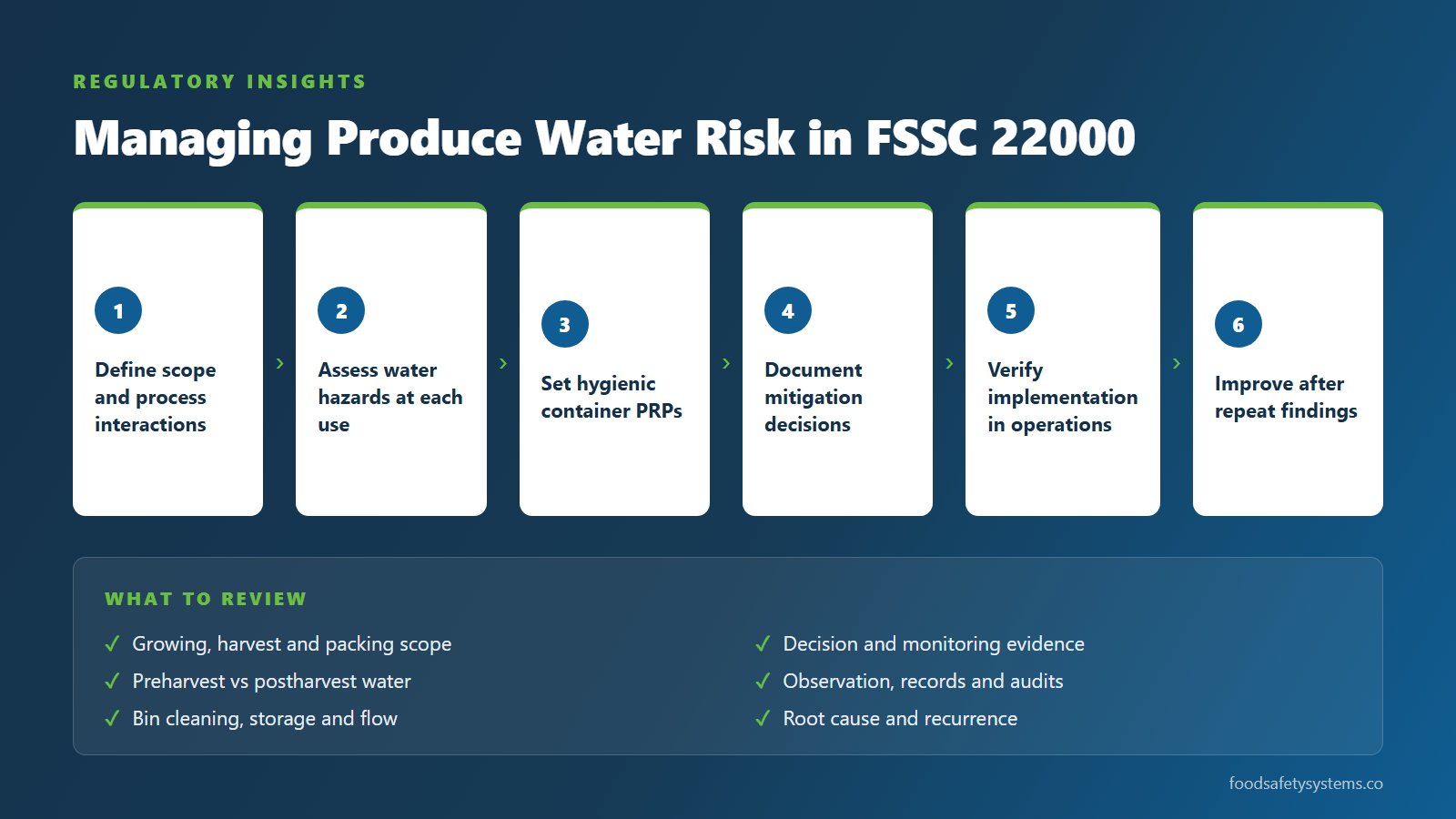
Document risk-based mitigation decisions
When a water assessment identifies a reasonably foreseeable hazard, record the specific mitigation decision. Then keep the monitoring or implementation evidence that shows the decision was carried out. An unrecorded decision is hard to defend at audit.
Verify implementation, not just written procedures
Use observation, record checks, internal audits, trend review and management review to test whether procedures actually work. Watch routine operations, not only the documents. See internal audits and utilities control for water and air.
Improve the system after repeat findings
Document the root cause and share lessons across sites. Complete actions with measurable evidence, and then check whether they prevented recurrence. See corrective and preventive actions.
FSSC 22000 produce safety checklist
- Confirm the FSSC 22000 version and certification scope with your certification body.
- Separate preharvest water controls from harvest and postharvest water controls.
- Review harvest-container sanitation PRPs and storage practices.
- Document a decision for each identified water risk.
- Verify corrective actions during live operations.
Frequently asked questions
Is FSSC 22000 the same as the FDA Produce Safety Rule?
No. FSSC 22000 is a certification scheme. Produce Safety Rule obligations under 21 CFR Part 112 depend on the law and on each operation’s circumstances.
Should all water hazards be treated as CCPs?
No. Control classification depends on your hazard analysis and the food safety management framework. Some water risks are managed through PRPs or operational PRPs.
How is improvement demonstrated?
Through documented monitoring, verification, corrective-action effectiveness and management review outputs.
How Consultare Inc. Group can help
Consultare Inc. Group supports FSSC 22000 readiness, hazard-analysis facilitation, PRP reviews, water risk controls, internal audits and continual-improvement procedures. Services are tailored to the agreed scope.
- FSSC 22000 implementation readiness: water and container controls checked before your audit.
- FSSC 22000 and FDA compliance integration: align your FSMS with Part 112 where it applies.
- Corrective action support: verification that repeat findings stay closed.
Need help managing your FSSC 22000 responsibilities?
Discuss your operation, documentation, risk assessments and compliance priorities with our team. Contact us or book a free consultation.
Prefer to organize your compliance activities yourself? Create a free SystemsBuilder account to structure procedures, monitoring records, supplier information and corrective actions.
Technical sources: FSSC 22000 and 21 CFR Part 112, Subpart E. This article is educational; requirements depend on your products, certification scope and applicable regulations. Food Safety Systems is an independent consultancy and is not affiliated with the FSSC 22000 Foundation or FDA.