
Quick answer: FSSC 22000 seafood cold storage works when the hazard analysis drives real controls. That means risk-based time and temperature criteria, sanitation PRPs, data-logger review and documented corrective actions. The exact scope depends on your certification and products.
Cold-stored and repackaged seafood shows why a food safety management system (FSMS) must connect to actual products and operating conditions. A cold room can look compliant on paper and still fail. For example, set points may be fine while product temperatures drift, or ice tools may spread contamination between lots. Meanwhile, FDA seafood HACCP duties under 21 CFR Part 123 remain separate legal obligations.
This guide is for seafood cold stores, distributors and repackers that run an FSSC 22000 FSMS, as well as their quality and operations managers. For receiving criteria and incoming deliveries, see our companion guide on the FSSC 22000 seafood cold chain.
Six steps to control FSSC 22000 seafood cold storage
Map product flows and hazard ownership
First, follow each product and packaging type through receiving, refrigerated storage, ice application, repackaging and dispatch. Then assign an owner to every step where a hazard can be introduced or grow. As a result, no cold-room activity falls between departments. See conduct a hazard analysis.
Apply risk-based time and temperature criteria
Not all seafood carries the same risk. Histamine-forming fish, such as tuna and mackerel, need tight time and temperature control. In contrast, vacuum-packed or other reduced-oxygen packaged fish may also require controls for Clostridium botulinum. Therefore, set criteria per product group rather than one rule for the whole room. See temperature control measures.
Build reliable prerequisite programs
Specify how food-contact tools, ice scoops, shovels and totes are cleaned and stored. In addition, define sanitation checks, personnel practices and facility conditions such as condensate and door seals. These PRPs create the hygienic conditions that cold storage controls depend on.
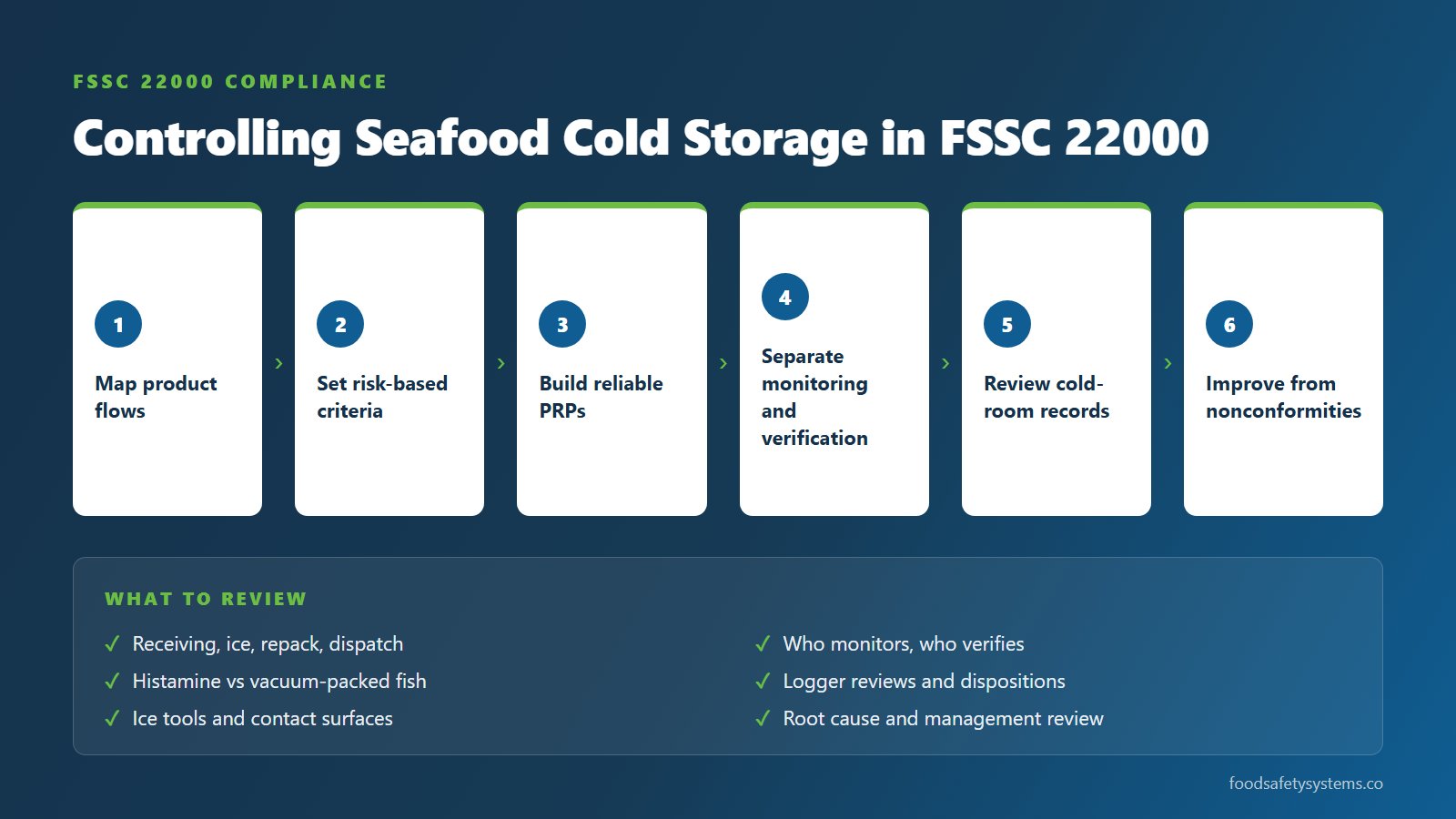
Define monitoring and verification separately
Monitoring shows whether a parameter stays under control right now. Verification, on the other hand, checks whether procedures and records are effective over time. Assign different people or frequencies to each so that one does not quietly replace the other. See calibration and verification of measuring equipment.
Retain documented cold-room reviews
Record how often data-logger results are reviewed and who reviews them. Also capture each exception and the product disposition that followed. A complete trail lets an auditor see that excursions were found, evaluated and closed.
Evaluate and improve nonconformities
Use root-cause analysis for repeated excursions or sanitation failures. Next, bring the trends into management review and confirm that corrective actions prevent recurrence. See corrective and preventive actions.
FSSC 22000 seafood cold storage checklist
- Identify the product, process, responsible operator and applicable FDA requirements.
- Maintain written hazard analyses, procedures and records appropriate to each activity.
- Confirm that transport evidence and receiving decisions address temperature-related hazards.
- Verify monitored refrigeration conditions and prompt investigation of deviations.
- Review species identification, allergen labeling and segregation in repackaging. Fish is a major food allergen, so labels must match the species packed.
- Document sanitation observations, corrective actions and effectiveness checks.
Frequently asked questions
Are all temperature controls CCPs under FSSC 22000?
No. Whether a control is a CCP, an operational PRP or a PRP depends on the hazard analysis and the ISO 22000 methodology.
Why is sanitation important in a cold store?
Ice-handling tools and product-contact equipment can transfer contamination between lots. Low temperatures slow many pathogens but do not make poor hygiene safe.
Can the FSMS replace FDA seafood HACCP rules?
No. Applicable Part 123 obligations must be met in addition to certification requirements.
How Consultare Inc. Group can help
Consultare Inc. Group supports FSSC 22000 gap assessments, seafood hazard analysis, PRP reviews, refrigeration monitoring reviews, internal audit support and corrective action effectiveness checks. Services are tailored to the agreed scope.
- FSSC 22000 implementation readiness: cold storage controls checked before your audit.
- FSSC 22000 and FDA compliance integration: align your FSMS with Part 123.
- Corrective action support: verification that cold-room fixes hold.
Need help managing your FSSC 22000 responsibilities?
Discuss your seafood products, operational risks, records and improvement priorities with our team. Contact us or book a free consultation.
Prefer to organize your compliance activities yourself? Create a free SystemsBuilder account to structure monitoring records, product records and corrective actions.
Technical sources: FSSC 22000 and 21 CFR Part 123. This article is educational; requirements depend on your products, certification scope and applicable regulations. Food Safety Systems is an independent consultancy and is not affiliated with the FSSC 22000 Foundation or FDA.