
A food safety management system can track many external regulatory requirements. Applicable law, customer requirements and certification scheme provisions all land on the same desk. However, they come from different sources and carry different consequences. When they blur together, a legal duty can look like an audit item, or an audit item can look like law.
Quick answer: list legal obligations separately from certification and customer requirements. For each one, record the legal reference, site applicability, responsible person, due date and evidence link. Then use management review to address incomplete tasks and material discrepancies.
This guide is for FSMS coordinators, regulatory leads and quality managers. For how responsibilities are assigned, see our article on FDA registration duties in FSSC 22000 governance.
Three sources of obligation, three different owners
Law applies because of what a facility does and where it operates. FDA Food Facility Registration is one example. Certification scheme requirements apply because the site chose FSSC 22000 certification. Customer requirements apply because of contracts or supplier programs.
These sources can overlap, but they do not replace each other. FDA registration renewal applies to covered establishments regardless of their FSSC 22000 certification status. Likewise, a certificate does not show that a legal filing was made. Keeping the sources apart makes it clear who must act and what proof is needed.
The 2026 FDA renewal requirement in brief
Under section 415 of the Federal Food, Drug, and Cosmetic Act (21 U.S.C. 350d) and 21 CFR Part 1, Subpart H, facilities that must register with FDA have to renew between October 1 and December 31 of each even-numbered year. For this cycle, the deadline is December 31, 2026. FDA states that updating a registration is a different function from renewing it, so an earlier update does not count as the renewal. A registration that is not renewed by the deadline is considered expired.
FDA currently recognizes the DUNS number as an acceptable Unique Facility Identifier (UFI). It uses the UFI to verify the facility address. There is no fee for registration or renewal. Applicability and exemptions depend on each facility’s activities, so they need a facility-specific assessment. See the FDA biennial renewal user guide and the FDA renewal reminder for current details.
Six steps to track external regulatory requirements in an FSSC 22000 system
Identify every source of obligation
Build a list of laws, regulations, customer specifications and scheme documents that apply to the business. Note where each one comes from and how the team will hear about changes. For FDA, that can include constituent updates and the registration user guide.
Separate law from scheme and customer requirements
Use separate sections or a source field in the register. A legal requirement should never sit under a certification heading. As a result, an auditor or manager can see at a glance which items are legal duties.
Assess applicability for each site
Decide whether each legal requirement applies to each facility, and record the reason. For FDA registration, a facility-specific assessment is needed, because applicability and exemptions depend on activities. Revisit the decision when activities change.
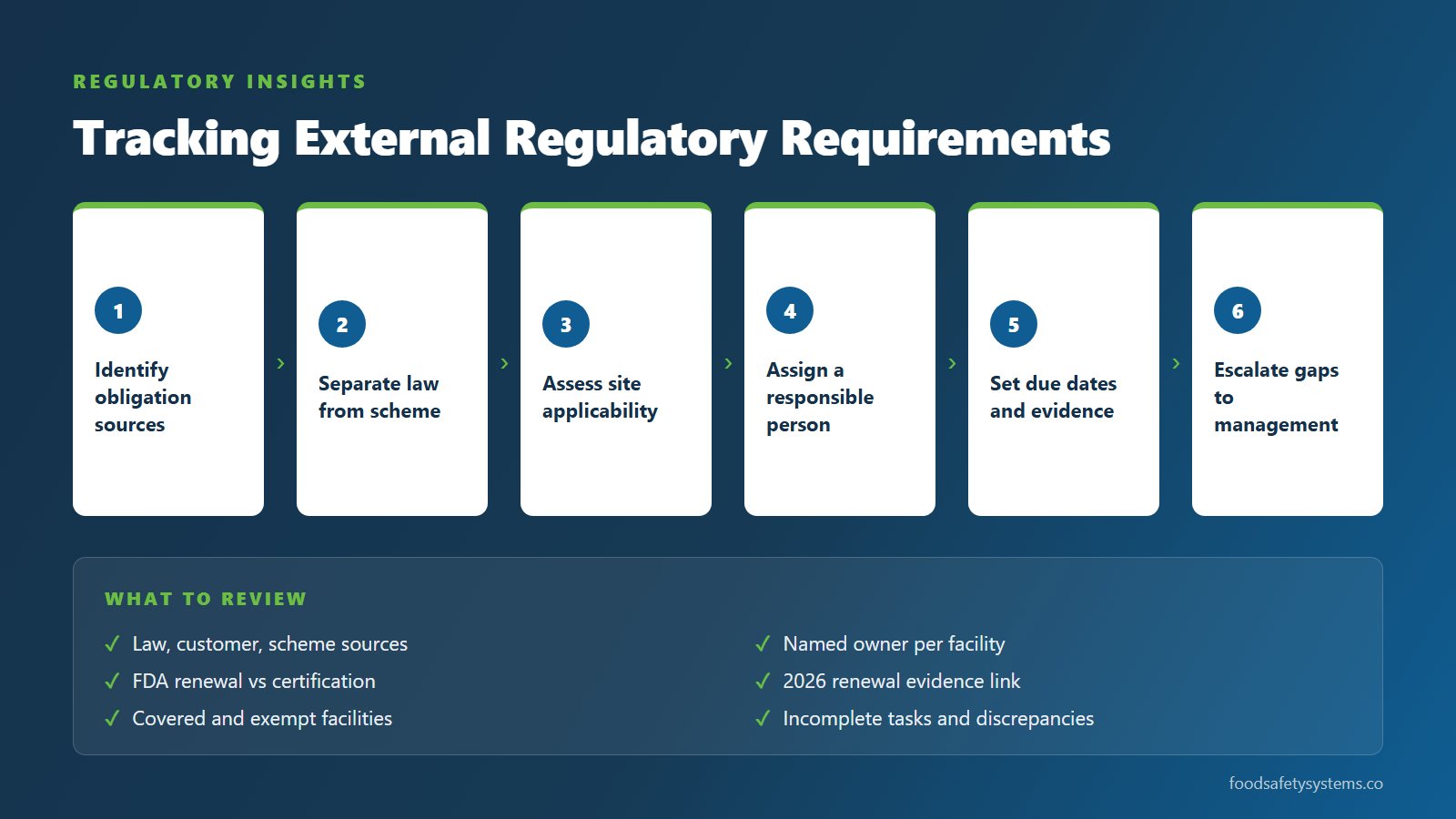
Assign a responsible person
Name one person for each requirement at each site. For the FDA renewal, that person should be authorized to submit for the facility, or should coordinate with the person who is. Record a backup as well.
Set due dates and define evidence
Give each item a due date and say what proof closes it. For the 2026 FDA renewal, the due date is December 31, 2026, and the proof is a facility-specific renewal confirmation. Store that proof as a controlled record under your document control rules.
Escalate gaps to management
Bring incomplete tasks and material discrepancies to management review. Record decisions and follow-up actions. Then confirm completion at the next review.
Who does what
- Regulatory lead: maintains the list of legal obligations and monitors official updates.
- FSMS coordinator: maintains scheme requirements and links them to the FSMS.
- Commercial or technical lead: captures customer requirements from contracts and supplier programs.
- Site responsible person: completes site-level tasks and supplies evidence.
- Top management: reviews gaps and provides resources to close them.
Records to keep
- A register that shows the source, legal reference and applicability of each requirement.
- Applicability decisions for each site, with reasons and dates.
- The responsible person, due date and evidence link for each item.
- The 2026 FDA renewal confirmation for each covered facility.
- Management review minutes and follow-up actions.
Common mistakes
Teams often list the FDA renewal under certification tasks, which suggests the certification body will check it. Others track customer requirements in emails rather than the register. Some registers name a department instead of a person. In addition, many teams record a due date but never define the evidence that proves completion.
Example workflow
A food manufacturer reviews its obligations in the summer before an even year. The regulatory lead lists FDA registration renewal as a legal item for two covered sites. Meanwhile, the FSMS coordinator lists the FSSC 22000 audit separately, and a customer’s specification review sits in a third section.
In October, each covered site renews, and the evidence is linked. The certification audit happens in a different month, with its own records. Finally, management review confirms that all three items are closed on their own terms.
External regulatory requirements checklist
- List external regulatory requirements separately from certification and customer requirements.
- Assign a responsible person for each applicable facility.
- Confirm the required 2026 FDA renewal was completed for covered sites.
- Define the evidence that closes each item.
- Retain evidence and management follow-up records.
Frequently asked questions
Does FSSC 22000 certification cover FDA registration?
No. FDA registration renewal applies to covered facilities regardless of certification status. The FSSC 22000 system can track it, but the filing is made to FDA separately.
Why separate legal and scheme requirements?
They have different sources, owners and consequences. Separating them makes it clear which items are legal duties and what proof each one needs.
What evidence closes the 2026 renewal item?
A facility-specific renewal confirmation for the current cycle, checked against your records. An earlier registration update does not replace it.
How Consultare Inc. Group can help
Consultare Inc. Group supports FSSC 22000 management systems, legal requirements registers, management reviews and internal audit preparation. Services are tailored to the agreed scope.
- FSSC 22000 and FDA compliance integration: legal and scheme duties mapped side by side.
- Post-certification compliance management: registers kept current between audits.
- Internal audit support: obligations tested against evidence.
Need help managing your FSSC 22000 responsibilities?
Discuss your facilities, registration records and compliance tasks with our team. Contact us or book a free consultation.
Prefer to organize your compliance activities yourself? Create a free SystemsBuilder account to structure legal obligations, responsibilities and evidence links.
Official sources: FDA Online Registration of Food Facilities, the FDA biennial renewal user guide, the FDA 2026 renewal reminder, 21 U.S.C. 350d and 21 CFR Part 1, Subpart H. This article is educational and is not legal advice or an official statement of FDA policy. Requirements may change, and their applicability depends on your facility and operations, so verify current requirements with FDA and qualified professionals. Food Safety Systems is an independent consultancy and is not affiliated with, endorsed by or authorized to act for the FSSC 22000 Foundation or FDA.