
Management meetings cover food safety hazards, operational issues and legal compliance, often in the same hour. FDA renewal risks belong on that agenda, but in the right place. A late or incomplete registration renewal is a regulatory status issue. It is not a food safety hazard, and reporting it as one confuses both the hazard analysis and the decision that leadership needs to make.
Quick answer: report FDA renewal as its own regulatory status line. Show covered facilities, verified renewals, unresolved DUNS or data differences and the decisions needed. Then record actions, owners and due dates, and verify completion at the next meeting.
This guide is for FSMS coordinators, regulatory leads and anyone who reports compliance status to leadership. For measuring progress, see our article on FDA registration renewal readiness.
The 2026 FDA renewal requirement in brief
Under section 415 of the Federal Food, Drug, and Cosmetic Act (21 U.S.C. 350d) and 21 CFR Part 1, Subpart H, facilities that must register with FDA have to renew between October 1 and December 31 of each even-numbered year. For this cycle, the deadline is December 31, 2026. FDA states that updating a registration is a different function from renewing it, so an earlier update does not count as the renewal. A registration that is not renewed by the deadline is considered expired.
FDA currently recognizes the DUNS number as an acceptable Unique Facility Identifier (UFI). It uses the UFI to verify the facility address. There is no fee for registration or renewal. Applicability and exemptions depend on each facility’s activities, so they need a facility-specific assessment. See the FDA biennial renewal user guide and the FDA renewal reminder for current details.
Why classification matters
An FSSC 22000 hazard analysis deals with biological, chemical and physical hazards in food. A missed FDA renewal does not make food unsafe. However, it does have regulatory and commercial consequences, because FDA considers an unrenewed registration expired.
Reporting the issue in the right category keeps both processes honest. The food safety team does not have to bend the hazard analysis around an administrative task. Meanwhile, leadership sees a clear regulatory risk with a clear owner. The management system supports visibility and accountability, but certification does not replace the required FDA filing.
Six steps to communicate FDA renewal risks to management
Classify the item as regulatory status
Put FDA renewal under legal or regulatory compliance in the meeting pack, not under food safety hazards. State the obligation in one line, with the December 31, 2026 deadline. This framing helps leadership weigh it correctly.
Report status by facility
Show each covered facility on its own line. Use simple, evidence-based states such as “not started,” “submitted, awaiting verification” and “verified.” Avoid a single company-wide percentage that hides one problem site.
Flag DUNS and data differences
List any unresolved DUNS differences, address mismatches or account access problems. Say what the difference is and who is working on it. These are often the issues that delay a renewal late in the window.
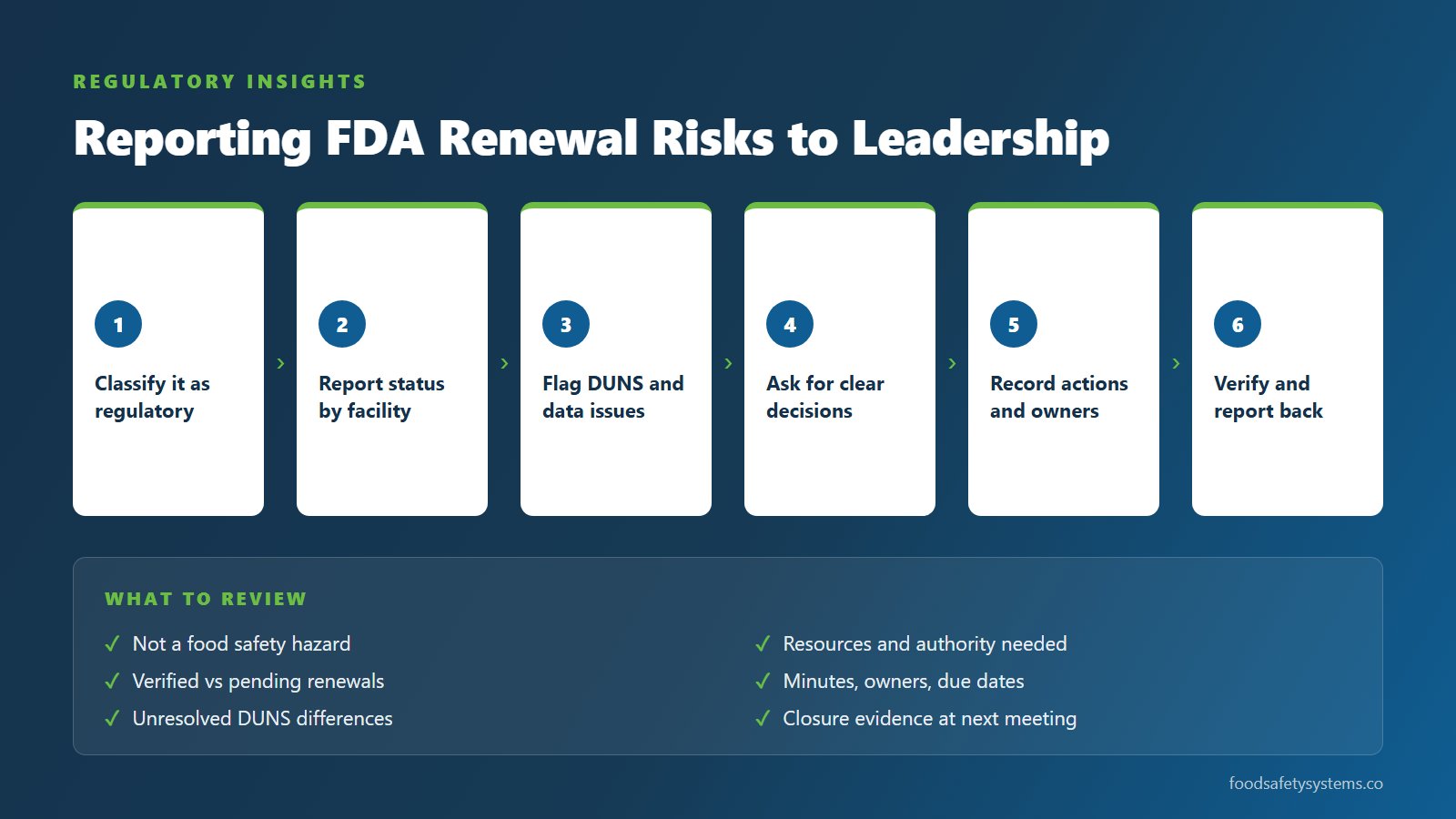
Ask for clear decisions
Tell leadership exactly what you need. For example, approval to involve an outside agent, time from a site manager, or a decision on an applicability question. A report without a request often produces no action.
Record actions and owners
Capture each decision in the minutes with an owner and a due date. Use the same action tracking you use for other compliance items. Our article on FSSC 22000 internal communication covers escalation routes that also suit this kind of issue.
Verify and report back
At the next meeting, report whether each action closed and what evidence proves it. A verified, facility-specific confirmation is the proof for the renewal itself. Then record any lessons for the next cycle in management review.
What a one-page status report can include
- The obligation, its legal basis and the deadline.
- Covered facilities and any exempt or undecided sites.
- Renewal status per facility, based on evidence.
- Open DUNS, address or access issues, with owners.
- Decisions requested from leadership.
Who does what
- Regulatory lead: prepares the status report and confirms the evidence.
- FSMS coordinator: places the item on the agenda and tracks actions.
- Site managers: supply facility data and resolve local issues.
- Top management: makes decisions, provides resources and monitors progress.
Common mistakes
Some teams log the renewal in the hazard analysis, which inflates hazard records with an administrative item. Others report “on track” without evidence. A third mistake is raising the issue without a specific request, so the meeting ends with no decision. Finally, minutes often record a discussion but no owner or due date.
Example workflow
In early October 2026, the regulatory lead presents a one-page report. Two of three covered sites have verified renewals. The third has a DUNS address difference, so the lead asks for time from the site manager.
Leadership approves the request, and the minutes record the owner and a due date in November. The difference is resolved, and the site renews. At the next meeting, the lead shows the confirmation, and the action closes.
Checklist for reporting FDA renewal risks
- Separate FDA renewal risks from technical hazard assessments.
- Report evidence-based renewal progress by facility.
- Identify issues that need management decisions.
- Record actions with owners and due dates.
- Verify completion and report back at the next meeting.
Frequently asked questions
Is a missed FDA renewal a food safety hazard?
No. It is a regulatory status issue with real consequences, but it does not change the hazards in food. Report it under legal compliance.
How detailed should the management report be?
Short and evidence-based. One line per facility, the open issues and the decisions needed is usually enough.
Does FSSC 22000 certification reduce the FDA risk?
No. Certification and FDA renewal are separate. Covered facilities still have to renew with FDA, whatever their certification status.
How Consultare Inc. Group can help
Consultare Inc. Group supports FSSC 22000 management review, compliance reporting, governance processes and continuous improvement. Services are tailored to the agreed scope.
- FSSC 22000 and FDA compliance integration: regulatory status built into your reviews.
- Post-certification compliance management: reporting kept current between audits.
- Corrective action support: open issues closed with evidence.
Need help managing your FSSC 22000 responsibilities?
Discuss your facilities, registration records and compliance tasks with our team. Contact us or book a free consultation.
Prefer to organize your compliance activities yourself? Create a free SystemsBuilder account to structure status reports, management decisions and follow-up actions.
Official sources: FDA Online Registration of Food Facilities, the FDA biennial renewal user guide, the FDA 2026 renewal reminder, 21 U.S.C. 350d and 21 CFR Part 1, Subpart H. This article is educational and is not legal advice or an official statement of FDA policy. Requirements may change, and their applicability depends on your facility and operations, so verify current requirements with FDA and qualified professionals. Food Safety Systems is an independent consultancy and is not affiliated with, endorsed by or authorized to act for the FSSC 22000 Foundation or FDA.