
An unresolved DUNS mismatch or a missing renewal confirmation can be entered in an internal corrective action system. That is a sensible way to make sure it gets fixed. However, FDA renewal corrective actions need careful wording. The record should describe the actual problem, not automatically declare a food safety failure.
Quick answer: describe the discrepancy accurately, confirm whether registration is required and find out what was submitted. Then agree a valid solution, assign an owner and a realistic date, and close the action only after documented verification.
This guide is for FSMS coordinators, CAPA owners and regulatory leads. Once the action is resolved, our article on closing FDA renewal actions covers the final closure check.
The 2026 FDA renewal requirement in brief
Under section 415 of the Federal Food, Drug, and Cosmetic Act (21 U.S.C. 350d) and 21 CFR Part 1, Subpart H, facilities that must register with FDA have to renew between October 1 and December 31 of each even-numbered year. For this cycle, the deadline is December 31, 2026. FDA states that updating a registration is a different function from renewing it, so an earlier update does not count as the renewal. A registration that is not renewed by the deadline is considered expired.
FDA currently recognizes the DUNS number as an acceptable Unique Facility Identifier (UFI). It uses the UFI to verify the facility address. There is no fee for registration or renewal. Applicability and exemptions depend on each facility’s activities, so they need a facility-specific assessment. See the FDA biennial renewal user guide and the FDA renewal reminder for current details.
What counts as a renewal discrepancy
Typical discrepancies include a DUNS number whose address does not match the registration, a missing confirmation for a covered site, or an account that the authorized person cannot access. Others include an applicability decision that was never recorded, or an update mistaken for a renewal.
None of these is a food safety failure in itself. Instead, each is an administrative or regulatory gap. FSSC 22000 governance supports the corrective action process, but it does not create or fulfill FDA registration obligations on its own.
Six steps to document FDA renewal corrective actions
Describe the real discrepancy
Write a factual problem statement. For example: “Site B renewal confirmation not on file; DUNS address differs from registration address.” Avoid labels such as “food safety nonconformity” unless the facts support them.
Confirm registration status
Check whether the facility is required to register, and record the basis. Then find out what was actually submitted and when. A site that is not subject to registration needs a documented nonapplicability decision, not a renewal.
Find the cause
Ask why the gap happened. Common causes include outdated contact details, lost account access, unclear ownership or a data change that was never reflected. Use your usual corrective and preventive action method, scaled to the issue.
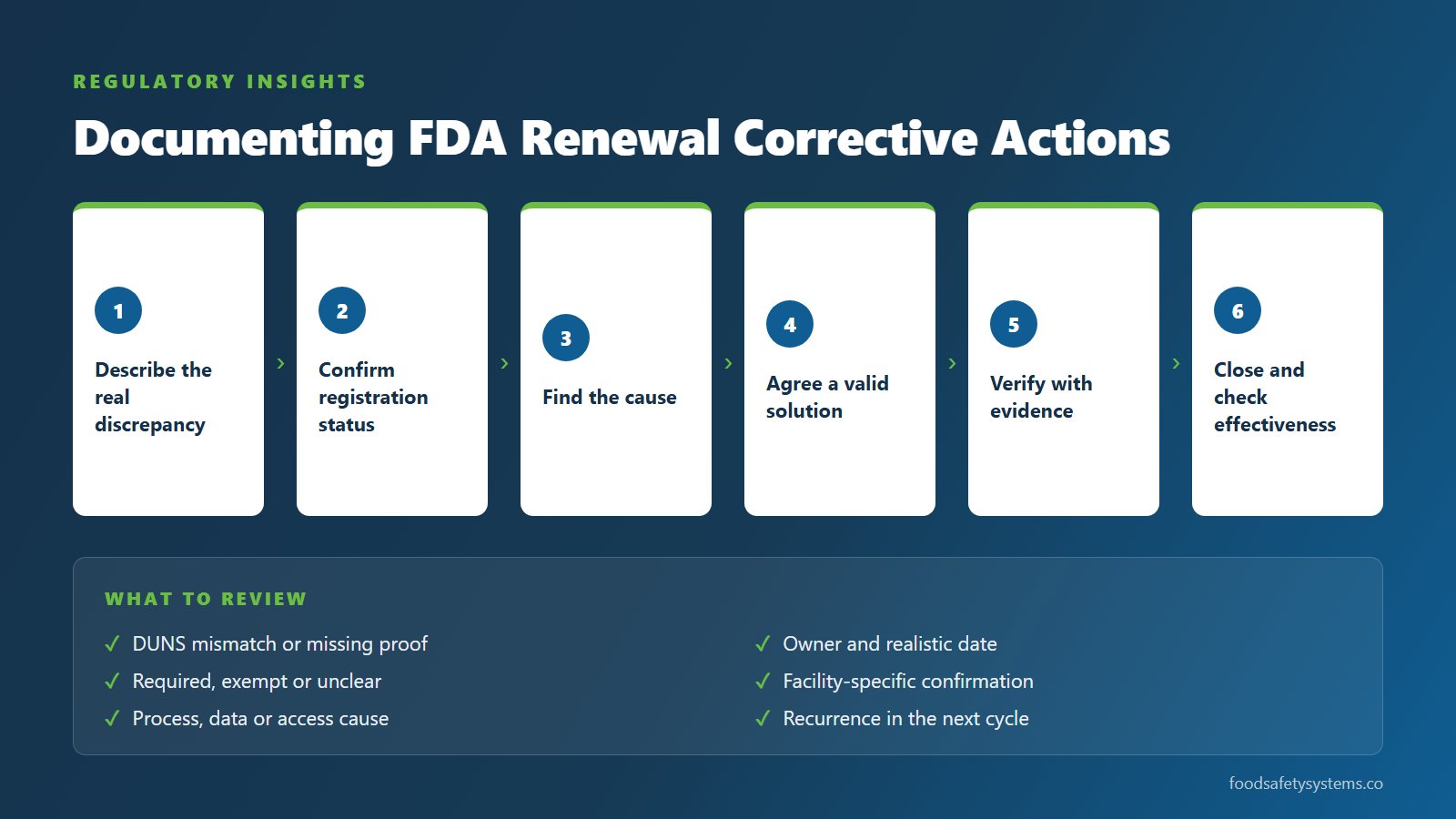
Agree a valid solution
Choose a fix that actually resolves the problem. That may mean correcting DUNS details, restoring account access or completing the renewal inside the window. Assign an owner and a realistic completion date before December 31, 2026.
Verify with evidence
Close the action only when appropriate evidence confirms the fix. For a renewal, that means a facility-specific confirmation for the current cycle that matches your records. Keep it under your document control and record-keeping rules.
Close and check effectiveness
Record who verified the evidence and when. Then check, at the next cycle or review, that the cause did not recur. Bring recurring issues to management review.
What a good corrective action record contains
- A factual problem statement and the affected facility.
- The registration status and the basis for it.
- The cause, in a sentence or two.
- The agreed solution, owner and due date.
- The verification evidence, verifier and closure date.
- An effectiveness check planned for the next cycle.
Who does what
- CAPA owner: writes the record and drives the action to closure.
- Regulatory lead: confirms applicability and what FDA requires.
- Authorized submitter: completes the renewal or correction.
- Verifier: checks the evidence before closure.
Common mistakes
Some teams record the issue as a food safety failure, which distorts trend data. Others close the action when the task is assigned, not when it is verified. Unrealistic due dates are also common, especially late in the window. Finally, many records skip the cause, so the same gap returns two years later.
Example workflow
In October 2026, an internal check finds that Site B has no renewal confirmation on file. The CAPA owner records the facts and confirms that Site B is covered. The regulatory lead then finds that the DUNS address differs from the registration address.
The site manager corrects the DUNS details, and the authorized submitter renews in November. The verifier compares the confirmation with the records and closes the action. Finally, an effectiveness check is set for the 2028 cycle.
FDA renewal corrective actions checklist
- Describe the discrepancy accurately in FDA renewal corrective actions.
- Assign an owner and a realistic completion date.
- Verify registration status and supporting evidence.
- Close only after documented verification.
- Check effectiveness at the next cycle.
Frequently asked questions
Should a renewal gap be logged as a food safety nonconformity?
Usually not. It is a regulatory or administrative gap. Describe it accurately so trend data and the hazard analysis stay meaningful.
When can the corrective action be closed?
When evidence confirms the issue is resolved. For a renewal, that is a facility-specific confirmation for the current cycle that matches your records.
Does fixing the action in the FSSC 22000 system complete the FDA duty?
No. The FSMS tracks the action, but the renewal or correction itself must be made with FDA.
How Consultare Inc. Group can help
Consultare Inc. Group supports FSSC 22000 implementation, CAPA programs, compliance process reviews and internal audit support. Services are tailored to the agreed scope.
- Corrective action support: problem statements, causes and verified closure.
- FSSC 22000 and FDA compliance integration: renewal tasks built into your FSMS.
- Internal audit support: closed actions sampled and tested.
Need help managing your FSSC 22000 responsibilities?
Discuss your facilities, registration records and compliance tasks with our team. Contact us or book a free consultation.
Prefer to organize your compliance activities yourself? Create a free SystemsBuilder account to structure corrective actions, registration evidence and verification records.
Official sources: FDA Online Registration of Food Facilities, the FDA biennial renewal user guide, the FDA 2026 renewal reminder, 21 U.S.C. 350d and 21 CFR Part 1, Subpart H. This article is educational and is not legal advice or an official statement of FDA policy. Requirements may change, and their applicability depends on your facility and operations, so verify current requirements with FDA and qualified professionals. Food Safety Systems is an independent consultancy and is not affiliated with, endorsed by or authorized to act for the FSSC 22000 Foundation or FDA.