
An FDA registration renewal dashboard gives FSSC 22000 teams one view of every facility that must renew. It shows who owns each renewal, where it stands and what evidence supports it. As a result, managers can see problems while there is still time to fix them before December 31, 2026.
Quick answer: track each applicable establishment, its legal owner, the authorized submitter, the renewal status, DUNS reconciliation, the evidence source and any exceptions. Review unresolved items regularly. However, never treat an internal “complete” status as proof that FDA received the renewal; only the confirmation record shows that.
This guide is for FSSC 22000 coordinators, regulatory leads and quality managers who report compliance status to site or corporate leadership. It builds on our article on measuring FDA registration renewal readiness, which covers the metrics. Here, the focus is the dashboard itself: its fields, its owners and how people use it.
What the dashboard is, and what it is not
The dashboard is a voluntary management aid. It organizes information you already hold, so leaders can act on gaps. It does not submit anything to FDA, and it does not replace technical food safety verification.
FDA registration is also not FDA approval or certification. Likewise, FSSC 22000 certification does not satisfy the registration duty. Keep these points visible on the dashboard itself, for example in a short header note, so nobody misreads a green status.
Six steps to build an FDA registration renewal dashboard
1. Define the facility scope
Start from your facility register. List every establishment that may need to register, including warehouses and co-located sites. Record the applicability decision for each one, because applicability and exemptions require facility-specific review.
2. Assign owners and authorized submitters
Name the legal owner, the internal owner and the person authorized to submit each renewal. Add a backup for each submitter. Under 21 CFR 1.230(b), a renewal submitted by someone other than the owner, operator or agent in charge must include a statement that the submitter is authorized.
3. Track status in clear stages
Use stages that cannot be confused. For example: not started, data checked, submitted, confirmation received, verified. In particular, separate pending submission from verified completion, since a submitted task without a confirmation is still open.
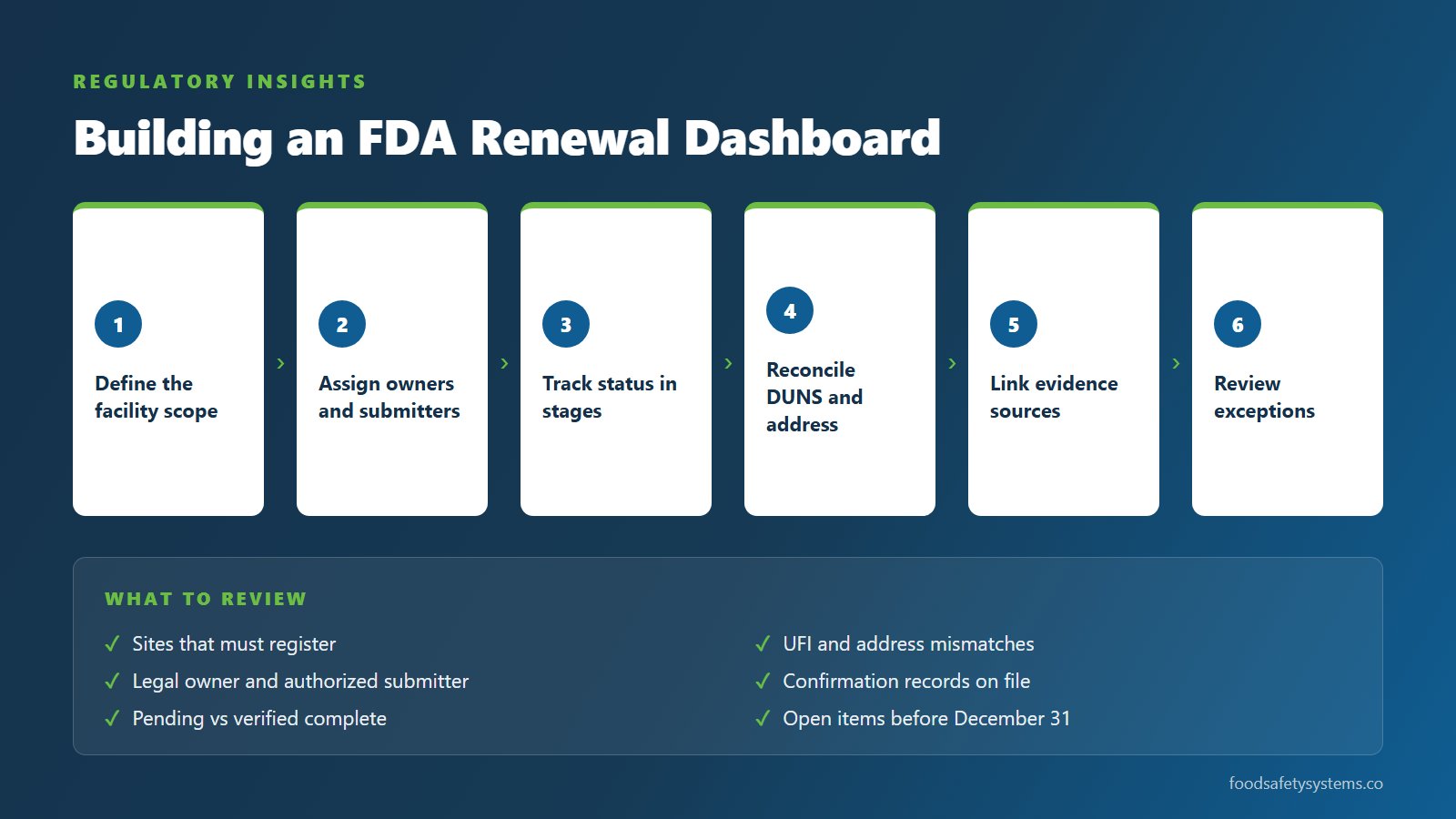
4. Reconcile DUNS and facility data
FDA currently recognizes the DUNS number as an acceptable Unique Facility Identifier. Therefore, compare the facility name and address in your registration with the DUNS record. Flag any mismatch as an exception with an owner and a due date.
5. Link each status to an evidence source
Every “verified” entry should point to a controlled record, such as the renewal confirmation. Store it under document control and record-keeping rules. A link or record number beats a free-text comment.
6. Review exceptions on a fixed rhythm
Set a review frequency that tightens as December approaches. For example, many teams move to weekly reviews in December. Escalate missing confirmations, mismatches and unassigned tasks, and track them through corrective and preventive actions where needed.
Who does what
- Regulatory or quality lead: owns the dashboard, sets the fields and confirms applicability decisions.
- Authorized submitter: completes the renewal and files the confirmation as a controlled record.
- Site manager: confirms that facility data, such as the address and activities, is current.
- Reviewer: checks the evidence before a status moves to “verified”. Ideally, this is not the submitter.
- Senior management: reviews exceptions, removes blockers and records decisions.
Records to keep
- The facility register with applicability decisions and their dates.
- The list of authorized submitters and backups.
- Renewal confirmations for each facility, filed by cycle.
- The exception log, with owners, actions and closure dates.
- Dashboard snapshots or meeting notes that show when issues were reviewed.
Common mistakes
The most frequent mistake is a status that runs ahead of the evidence. For instance, a task is marked done when the submitter says it is done, but no confirmation is filed. Another is a dashboard that lists only certified sites, so other establishments that must register drop out of view.
Teams also overload dashboards. Too many columns hide the few that matter. So keep the core fields, and move detail into the linked records. Finally, an update made earlier in the year is sometimes counted as the renewal, which it is not.
Example workflow
In early October, the regulatory lead refreshes the facility register and opens one dashboard row per facility. Next, site managers confirm facility data, and the lead reconciles each DUNS record. Submitters then renew in the FDA system and file the confirmations.
After that, a reviewer checks each confirmation against its row and marks it verified. Meanwhile, open exceptions appear at each weekly meeting until they close. In January, the dashboard is archived with the cycle records, and lessons feed the next cycle.
2026 FDA renewal facts to keep in view
- Legal basis: section 415 of the Federal Food, Drug, and Cosmetic Act (21 U.S.C. § 350d) and 21 CFR Part 1, Subpart H.
- Window: facilities required to register renew between October 1 and December 31 of each even-numbered year.
- Deadline: FDA considers a registration expired if it is not renewed by December 31, 2026.
- Update is not renewal: an update earlier in the year does not replace the biennial renewal.
- No fee: FDA does not charge for registration or renewal.
- Unique Facility Identifier: FDA currently recognizes the DUNS number as an acceptable UFI.
Applicability and any exemptions need a facility-by-facility assessment. Check the FDA biennial renewal user guide before you rely on any internal summary.
FDA registration renewal dashboard checklist
- Maintain a current facility register with applicability decisions.
- Name the legal owner, authorized submitter and backup for each facility.
- Separate pending submission from verified completion.
- Reconcile DUNS and address data, and log every mismatch.
- Escalate mismatches and missing confirmations.
- Retain objective closure records for each facility.
Frequently asked questions
Does a green dashboard status mean FDA renewal is complete?
Not by itself. Renewal is complete when FDA’s system shows it, and your confirmation record proves it. The dashboard only summarizes that evidence.
Is a renewal dashboard an FSSC 22000 requirement?
No. It is a voluntary management aid. FSSC 22000 expects you to manage applicable legal requirements, and a dashboard is one practical way to show how you do it.
How often should management review the dashboard?
Set a rhythm that fits your size. Many teams review monthly in October and weekly in December, when the deadline is close.
How Consultare Inc. Group can help
Consultare Inc. Group supports FSSC 22000 management systems, compliance dashboards, management reviews and continual improvement. Services are tailored to the agreed scope.
- FSSC 22000 and FDA compliance integration: regulatory workflows inside your FSMS.
- FSSC 22000 implementation readiness: processes checked before your audit.
- Audit readiness coaching: internal audit and evidence review support.
Need help managing your FSSC 22000 responsibilities?
Discuss your facilities, records, responsibilities and next steps with our team. Contact us or book a free consultation.
Prefer to organize your compliance activities yourself? Create a free SystemsBuilder account to structure facility registers, renewal records and corrective actions.
Regulatory sources: FDA biennial registration renewal user guide, FDA renewal reminder, FDA online food facility registration and 21 CFR Part 1, Subpart H. This article is educational and is not legal advice or an official statement of FDA policy. Requirements may change and depend on your facility, operations and certification scope; verify current requirements with official FDA sources and consult qualified regulatory professionals. FSSC 22000 certification does not replace FDA food facility registration. Food Safety Systems is an independent consultancy and is not affiliated with, endorsed by or acting for the FSSC 22000 Foundation or FDA.