
A food fraud assessment for H-E-B suppliers starts with a simple fact: a low ingredient price is not a safeguard against hidden substitution. Food fraud can begin upstream. A diluted oil, a substituted spice, a misrepresented origin or an altered certificate may pass through purchasing without any obvious manufacturing defect. A structured vulnerability assessment helps management see where incentives and weak oversight meet.
Quick answer: list the ingredients and claims most open to fraud, and assess each supply chain for price pressure, complexity, provenance and supplier reliability. Rank the vulnerabilities with documented criteria and apply proportionate controls. Then review the assessment whenever suppliers or markets change. Confirm any customer-specific expectations with the relevant H-E-B supplier or purchasing contact.
This guide is for food manufacturers, importers, brand owners and quality teams preparing for possible H-E-B supply. It builds on our broader guide to FSSC 22000 food fraud mitigation. If you are still choosing a scheme, start with choosing a certification scheme for H-E-B suppliers.
Where food fraud fits in FSSC 22000 and FDA rules
The FSSC 22000 scheme includes additional requirements on food fraud mitigation. Check the exact wording in the current scheme documents on fssc.com. A vulnerability assessment considers ingredients, suppliers, supply chain complexity, fraud history, market pressure and how easily fraud would be detected. Mitigation measures should then respond to the actual risks found.
FDA rules sit alongside the scheme. Where the Preventive Controls for Human Food rule applies, the hazard analysis under 21 CFR 117.130 must consider hazards that may be intentionally introduced for economic gain. That is different from FDA’s intentional adulteration rule in 21 CFR Part 121, which targets acts intended to cause wide-scale public health harm. Both have scope limits and exemptions, so confirm what applies to your facility.
Six steps in a food fraud assessment for H-E-B suppliers
List vulnerable materials and claims
Identify high-value ingredients and those with a history of fraud. Include claims such as origin, organic, species or variety. In addition, note materials where a substitution would be hard to see in the finished product.
Assess supply chain factors
Look at price changes, provenance, the number of intermediaries and supplier reliability. A new distributor or a sudden discount deserves attention. Use your FSSC 22000 supplier control records as an input.
Rank with documented criteria
Score each material against set criteria, such as opportunity, motivation and detectability. Record who scored it and why. As a result, the ranking can be repeated and challenged, instead of resting on one person’s opinion.
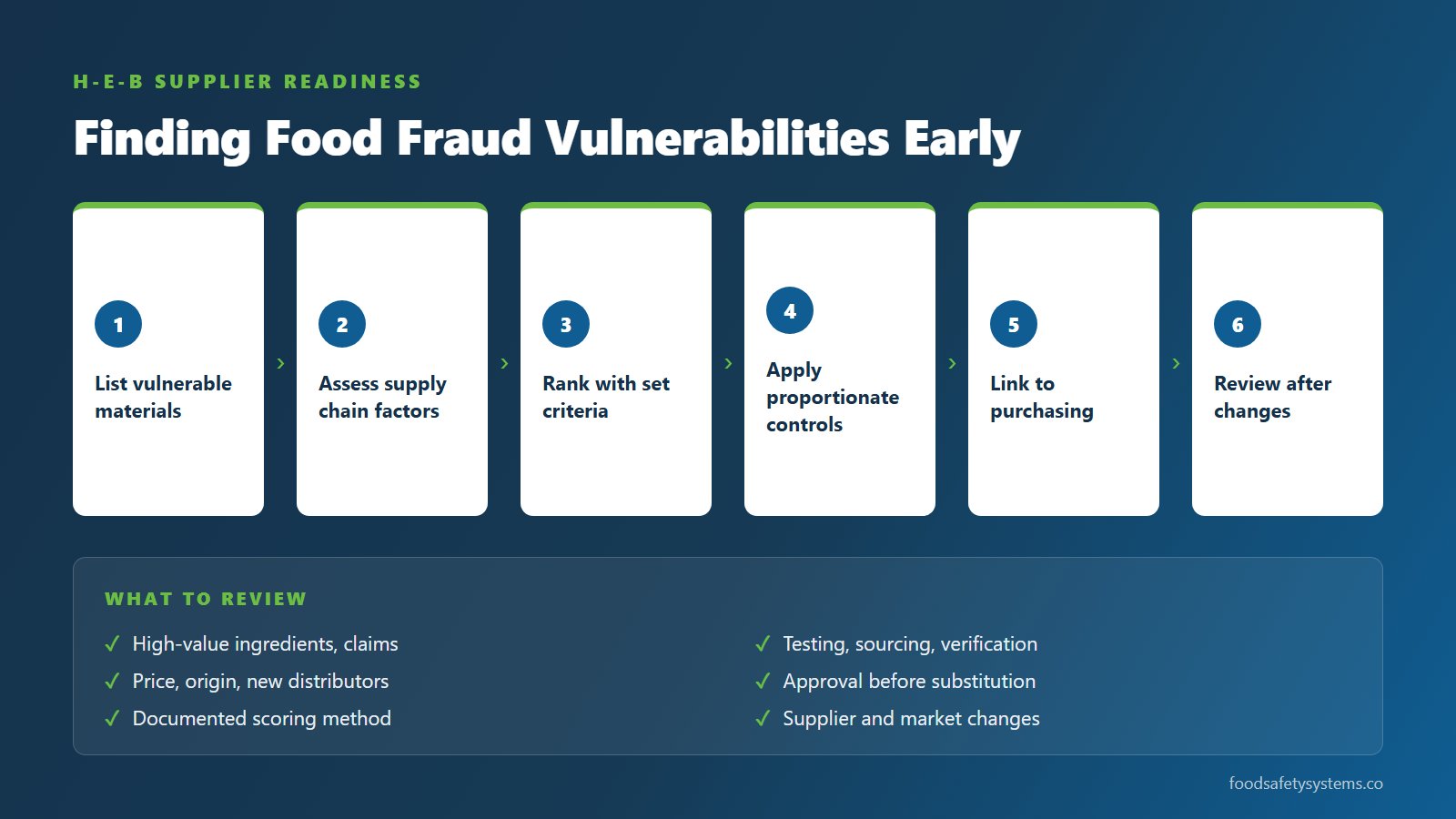
Apply proportionate controls
Match controls to the ranking. Options include authenticity testing, supplier qualification, approved-source lists, certificate checks and tighter specifications. Low-risk materials may need only routine checks, while high-risk ones need more.
Link the assessment to purchasing
Make sure purchasing cannot switch suppliers or accept substitutions without a food safety review. Otherwise, a cost-saving decision can bypass every control you documented. Our page on product authenticity and integrity covers related controls.
Review after changes
Reassess when suppliers, origins, prices or geopolitical conditions change. Also review on a planned schedule. Keep each version, so you can show how the assessment evolved.
A practical H-E-B supplier scenario
A supplier offers a lower-cost ingredient for a Texas-oriented specialty salsa just before a proposed H-E-B launch. The origin information is inconsistent, and a new distributor is involved. A vulnerability review may show the need for authenticity testing, supplier qualification or tighter purchasing approval before the change is accepted.
The decision and its rationale should be on file. That way, the team can explain why the new source was accepted, delayed or rejected.
Common gaps
- A one-page generic checklist that ignores the business factors driving fraud.
- Scores with no written criteria, so nobody can explain the ranking.
- Controls that do not match the highest-ranked risks.
- Purchasing changes made without a food safety review.
- An assessment that has not been updated since the supplier list changed.
Unexamined substitution risks can harm product authenticity, claims, quality and consumer trust. Moreover, a certificate alone does not show that these risks are being managed.
Records to keep
- The vulnerability assessment with criteria, scores, assessors and dates.
- The mitigation plan, including testing, sourcing and verification measures.
- Supplier approval files, certificates and authenticity test results.
- Change records showing review of new suppliers, origins or substitutions.
- Review history and the triggers for each update.
Food fraud assessment for H-E-B suppliers: readiness checklist
- Identify high-value or historically vulnerable ingredients and claims.
- Assess supply complexity, price changes, provenance and supplier reliability.
- Rank vulnerabilities using documented criteria.
- Specify proportionate mitigation, testing, sourcing or verification measures.
- Review the assessment after supplier, geopolitical or market changes.
Frequently asked questions
Is food fraud the same as food defense?
No. Food fraud is deception for economic gain, such as substitution or dilution. Food defense addresses intentional acts meant to cause harm. FSSC 22000 treats them as separate topics.
Does H-E-B publish a food fraud checklist for suppliers?
Public information does not set out a uniform, detailed food safety checklist for all H-E-B suppliers. Verify current expectations with the appropriate H-E-B purchasing or supplier team.
How often should the assessment be reviewed?
Review it on a planned schedule and whenever suppliers, origins, prices or market conditions change. The scheme documents and your customer may set further expectations.
How Consultare Inc. Group can help
Consultare Inc. Group supports FSSC 22000 readiness, food fraud vulnerability assessment procedures, mitigation plan documentation and supplier control improvements. Certification itself is issued by an independent accredited certification body.
- FSSC 22000 food fraud prevention: how retail suppliers structure fraud controls.
- Supplier verification support: approval and monitoring that match the risk.
- FSSC 22000 implementation readiness: gaps found before your audit.
Need help with your food fraud assessment?
Share your highest-risk ingredients, origins, supplier map and current authenticity checks, so we can focus on the biggest gaps. Contact us or book a free consultation.
Prefer to organize your compliance activities yourself? Create a free SystemsBuilder account to structure supplier information, assessments and corrective actions.
Technical sources: the FSSC 22000 scheme, 21 CFR 117.130, 21 CFR Part 121 and H-E-B supplier information. This article is educational and is not legal advice or a statement of H-E-B supplier policy. Applicability depends on your products, facility and customer arrangements. Food Safety Systems is an independent consultancy and is not affiliated with, sponsored or approved by H-E-B, the FDA or the FSSC 22000 Foundation. H-E-B-specific requirements must be confirmed directly with the relevant H-E-B supplier or purchasing contact.