
Quick answer: To review foreign supplier records with confidence, start from the hazards in each imported food and the verification activity you chose for that supplier. Then request only the records that show those hazards are controlled. A qualified individual should assess them, document the conclusions and follow up on gaps. Under FDA’s Foreign Supplier Verification Program (FSVP) rule, record review is one of several verification options, not a universal requirement.
This guide is for growing and scaling food brands that import ingredients or finished products into the United States. It suits founders, supplier quality leads and food safety managers who now handle more suppliers than their review process was built for.
Why supplier records pile up as a brand scales
Growth rarely adds suppliers one at a time. A new product line can bring a co-manufacturer, three ingredient sources and a packaging change in the same quarter. Each supplier then sends questionnaires, certificates, specifications and lab reports in its own format.
As a result, many teams end up with folders full of documents but few documented conclusions. The goal is not paperwork volume. Instead, you need a repeatable, risk-based process that shows how each record supports your verification decision for each food.
What the FSVP rule says about record review
Under 21 CFR 1.506, an importer must determine and document which verification activities, and how often, give adequate assurance that hazards requiring a control are significantly minimized or prevented. Review of the foreign supplier’s relevant food safety records is one listed option. The others are onsite audits, sampling and testing, and other appropriate activities.
When you rely on record review, you must keep documentation of each review. That includes the review dates, the general nature of the records reviewed, the conclusions, any corrective actions taken for significant deficiencies, and evidence that a qualified individual did the review. Under 21 CFR 1.503, a qualified individual has the education, training or experience needed for the task and can read the language of the records.
However, record review is not always enough on its own. When the supplier controls a hazard with a reasonable probability of serious adverse health consequences or death, the rule expects an onsite audit before first import and at least annually. The importer may instead make an adequate written determination that other activities or less frequent auditing are appropriate. Some importers and foods also qualify for exemptions or modified requirements.
Six steps to review foreign supplier records
1. Define the food, supplier and hazards
Confirm the imported food, the foreign supplier, the manufacturing facility and the hazards requiring a control. Also note who controls each hazard: the supplier, its raw material supplier or another entity in the chain. Your FSVP hazard analysis should drive this step.
2. Map the evidence you need
Build a simple evidence map for each food and supplier pair. List the hazard, the control, the verification activity chosen and the record that would show it works. A standard template helps consistency, but the content must still reflect product risk and supplier history.
3. Request relevant records
Ask for records that show the control is operating, such as process monitoring logs, audit findings, applicable test results and corrective action records. Avoid asking every supplier for an identical certificate pack. Targeted requests get better answers and save time on both sides.
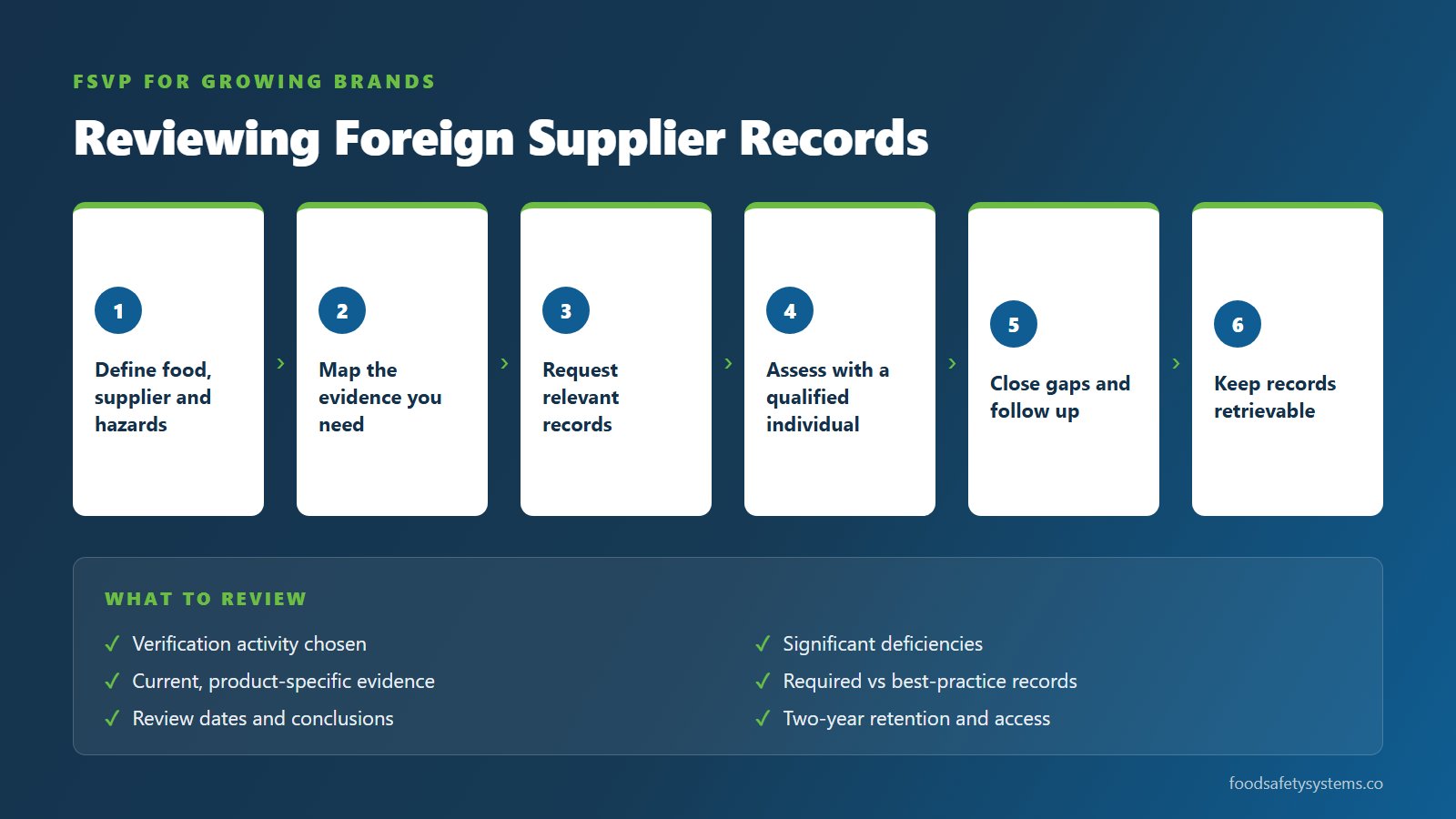
4. Assess with a qualified individual
The reviewer checks whether the evidence is current, specific to the product and facility, understandable and relevant to the hazard. They then write a clear conclusion. After all, a document that simply exists is not the same as a record that has been evaluated.
5. Close gaps and follow up
Flag missing, outdated or inconsistent records. Next, request clarification, set due dates and track open items to closure. Where a review finds a significant deficiency, document the corrective action and consider whether the supplier’s approval or verification activities should change.
6. Keep records retrievable
Under 21 CFR 1.510, FSVP records must be legible, signed and dated where required, and available promptly to FDA on request. Offsite records must be retrievable within 24 hours. Most records must be kept for at least two years. See our page on document control and record-keeping for a practical structure.
Common gaps in growing brands
- Records are collected but never reviewed or concluded.
- The same template is used for a low-risk dry ingredient and a high-risk ready-to-eat product.
- Supplier evidence is shared informally by email or chat and never filed.
- Open questions have no owner or due date.
- Legally required FSVP records are mixed with customer requests and best-practice documents.
How FSVP record review relates to an FSSC 22000 system
FSVP is a U.S. importer obligation, and FSSC 22000 certification does not satisfy it by itself. Even so, the two can share a lot of work. An FSSC 22000 system already expects control of purchased materials and of externally provided processes, products and services. That supplier control process can host your FSVP evidence map, review records and follow-up.
A supplier’s own FSSC 22000 certificate and audit report can be one useful input to the review. However, the qualified individual still has to judge whether it covers the right site, product and hazard. Read more in FSSC 22000 supplier control for imported materials and on our supplier approval and monitoring page.
Example: a snack brand adds two co-manufacturers
A U.S. snack brand adds a seasoning blender abroad and a second nut roaster. The team receives forty documents in two weeks. Rather than filing everything, the quality lead maps the hazards first. For roasted nuts, the key hazard is Salmonella, controlled by the roaster’s process. So the review focuses on roasting validation, monitoring records and corrective actions.
For the seasoning blend, the reviewer looks at allergen controls and ingredient sourcing. Two gaps appear: an outdated process record and an allergen statement that does not match the label. Both go into a findings register with owners and due dates. The final review record then states what was reviewed, when, by whom and what was concluded.
Checklist to review foreign supplier records
- Confirm the food, supplier, facility and hazards requiring a control.
- Document why record review is an appropriate verification activity, and how often.
- Request records linked to each hazard and control.
- Have a qualified individual assess and conclude, with the review date.
- Record significant deficiencies and corrective actions.
- Separate required FSVP records from optional or customer documents.
- Store records so they can be produced promptly and retained for the required period.
Frequently asked questions
Is reviewing supplier records required for every imported food?
No. It is one of several verification activities. The importer chooses activities and frequency based on its evaluation of the food and the supplier, unless an exemption or modified requirement applies.
Can a certificate replace a record review?
Not on its own. A certificate can support the review, but the qualified individual must still judge its scope and relevance and document a conclusion.
Who can review foreign supplier records?
A qualified individual with the right education, training or experience, who can read the records’ language. They do not have to be your employee.
How Consultare Inc. Group can help
Consultare Inc. Group supports growing brands with evidence inventories, product and supplier records mapping, findings registers, supplier information requests and action tracking. The importer keeps its regulatory responsibilities and final supplier decisions. Services are tailored to the agreed scope.
- Supplier verification support: structured review of supplier evidence.
- FSSC 22000 and FDA compliance integration: align supplier control with FSVP records.
- FSVP Services: dedicated FSVP program support from our network.
Need help managing your FSVP supplier records?
Discuss your products, suppliers, records and next steps with our team. Contact us or book a free consultation.
Prefer to organize your compliance activities yourself? Create a free SystemsBuilder account to structure supplier records, review findings and corrective actions.
Technical sources: 21 CFR 1.503, 21 CFR 1.506 and 21 CFR 1.510. This article is educational and is not legal advice, FDA approval or a guarantee of compliance. FSVP obligations vary by food, importer, supplier and any exemption or modified requirement, so have your conclusions reviewed by a qualified individual. Food Safety Systems is an independent consultancy and is not affiliated with the FSSC 22000 Foundation or FDA.