
Preventive maintenance and food safety risk are closely linked, even when production is meeting its output targets. Worn seals, temporary repairs and overdue work orders can quietly become normal. However, a maintenance failure can create a contamination risk long before a machine actually stops. An FSSC 22000 food safety management system (FSMS) gives you a structure to connect maintenance decisions with hazard control, records and management oversight.
Quick answer: identify the equipment whose failure could contaminate food, and rank preventive maintenance tasks by food safety risk, not only by downtime. Then control repairs, tools and line release, and assess product impact when something fails. Finally, trend recurring breakdowns and take them to management review. If you are preparing for possible H-E-B supply, confirm the retailer’s current requirements directly with your H-E-B contact, because certification does not guarantee acceptance.
This guide is for food manufacturers and brands preparing for possible H-E-B supply, as well as quality, maintenance and operations managers. For the wider equipment view, see our article on FSSC 22000 equipment maintenance.
Why maintenance belongs in your food safety system
FSSC 22000 combines ISO 22000, the applicable prerequisite program (PRP) standard for your sector and the scheme’s additional requirements. Maintenance, hygienic equipment and contamination prevention therefore sit inside the FSMS, not beside it. Evaluate them against the scheme version and food chain category that apply to your site, as published on fssc.com.
In the United States, FDA’s current good manufacturing practice rule also expects equipment to be adequately maintained. Under 21 CFR 117.40, equipment and utensils must be maintained to protect against allergen cross-contact and contamination. They must also be used so that lubricants, metal fragments or other contaminants do not adulterate food. Certification and legal compliance remain separate questions.
Keep a clear boundary between government obligations, the certification scheme and any additional requirements a customer sets. H-E-B publishes general supplier information and uses an access-controlled supplier portal for authorized business interactions. Public information does not set one detailed food safety checklist for every supplier, so verify current expectations with the relevant H-E-B supplier or purchasing team.
Six steps to link preventive maintenance and food safety risk
Map contamination-sensitive assets
List food-contact equipment and assets that can affect product, such as conveyors, seals, gaskets, guards, fillers, sieves and magnets. For each one, describe how it can fail and what that failure could introduce: metal, plastic, lubricant, allergen residue or microbial harborage. See equipment maintenance and calibration.
Rank tasks by food safety risk
Prioritize preventive maintenance by food safety consequence as well as by downtime history. A low-cost seal that sheds fragments into open product deserves more attention than an expensive part behind a guard. As a result, the schedule reflects risk instead of convenience.
Control repairs, tools and line release
Define how tools, spare parts and food-grade lubricants are controlled during work. Temporary repairs need an owner, an expiry date and a permanent fix. After maintenance, require cleaning, a parts and tools check and a documented line release before production restarts. See facility maintenance and repair.
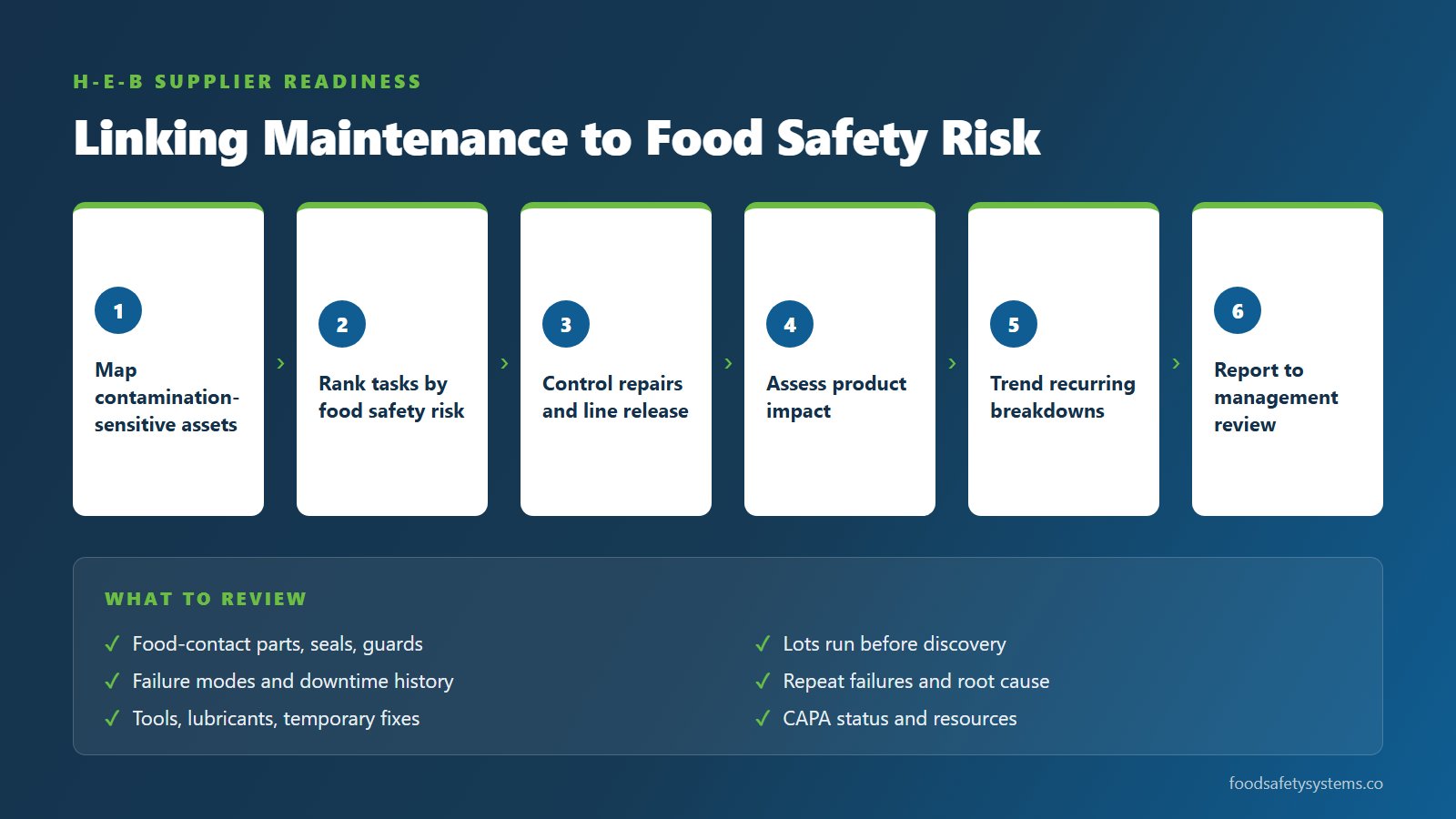
Assess product impact after a failure
When a part is found damaged, ask what ran before the damage was discovered. Identify the time window, the lots involved and the possible contaminant. Then record a product decision, such as release, hold, rework or disposal, with the name of the person who approved it.
Trend recurring breakdowns
Repeated replacement of the same part is a signal, not a routine task. Review work orders for patterns by line, asset and failure mode. Then use root cause analysis to decide whether design, materials, frequency or training needs to change. See corrective and preventive actions.
Report to management review
Bring maintenance performance into management review. Include overdue preventive tasks, open temporary repairs, product-impact assessments and corrective action status. In this way, leaders can see whether resources match the risk.
Common gaps auditors and customers notice
- Maintenance logs that record the repair but not the potential product exposure.
- Temporary fixes, such as tape or cable ties, that stay in place for months.
- No documented hygiene clearance before the line restarts.
- Preventive maintenance schedules based only on manufacturer intervals, with no food safety review.
- Contractors working on lines without the same tool and hygiene controls as employees.
Records to keep
- A critical-equipment list with failure modes and food safety consequences.
- The preventive maintenance schedule and completion status.
- Work orders, including temporary repairs and their closure.
- Post-maintenance cleaning, inspection and line release records.
- Product-impact assessments and disposition decisions.
- Trend reports and the related corrective actions.
Example: a damaged conveyor seal
A dry-ingredient packaging operation repeatedly replaces a damaged conveyor seal. The maintenance log records each repair, but not the potential foreign-material exposure to product that ran before discovery.
If this product is presented for H-E-B consideration, the team should first settle the evidence question. Which lots ran during the exposure window? Was product inspected, held or released, and who decided? Why does the seal keep failing? Assign clear owners for these answers before describing the program as ready. A certificate or a signed statement helps only when it addresses the actual issue.
Preventive maintenance and food safety risk checklist
- Identify food-contact and contamination-sensitive assets and their failure modes.
- Prioritize preventive maintenance tasks by food safety risk and downtime history.
- Control tools, lubricants, temporary repairs and post-maintenance cleaning and line release.
- Record inspections, work orders, deviations and product-impact assessments.
- Trend recurring breakdowns and connect them to corrective actions and management review.
- Confirm current H-E-B expectations for your product and facility with the relevant H-E-B contact.
Frequently asked questions
Is preventive maintenance a food safety topic or an engineering topic?
Both. Engineering owns the work, but the food safety team should decide which failures could affect product and how those risks are controlled and verified.
Does FSSC 22000 certification guarantee acceptance as an H-E-B supplier?
No. Certification can support supplier readiness, but acceptance depends on H-E-B’s own current requirements and commercial decisions. Confirm them with your H-E-B contact.
What should we do when a part is found damaged during production?
Stop and assess. Define the exposure window, identify affected lots, decide on product disposition and record the decision. Then investigate the root cause so the failure does not repeat.
How Consultare Inc. Group can help
Consultare Inc. Group supports FSSC 22000 gap assessments, maintenance procedure development, risk-based documentation and audit preparation. Support is tailored to the agreed scope.
- FSSC 22000 implementation readiness: maintenance and hygiene gaps found before your audit.
- Retail and wholesale food safety solutions: documentation prepared for buyer reviews.
- Corrective action support: recurring failures closed with effectiveness evidence.
Is your maintenance program ready for customer scrutiny?
Share your critical-equipment list, sample work orders and recent audit findings, so we can focus on the most important gaps. Contact us or book a free consultation.
Prefer to organize your compliance activities yourself? Create a free SystemsBuilder account to structure maintenance records, product-impact assessments and corrective actions.
Technical sources: the FSSC 22000 scheme, 21 CFR 117.40 and H-E-B’s public supplier information. This article is educational and is not legal advice or a statement of H-E-B supplier policy; applicability depends on your product, facility and customer arrangements. Food Safety Systems is an independent consultancy and is not affiliated with, sponsored or approved by H-E-B, the FDA or the FSSC 22000 Foundation. H-E-B-specific supplier requirements must be confirmed directly with the relevant H-E-B supplier or purchasing contact.