
Quick answer: FSVP supplier corrective actions work when every food safety concern is linked to a specific food, supplier and lot, investigated on the facts, and closed with objective evidence. Under FDA’s Foreign Supplier Verification Program (FSVP) rule, you must promptly take appropriate corrective action when a foreign supplier is not producing food to the required standard, and document it. Where the problem surfaced outside your FSVP, you must also check whether the program itself needs to change.
This guide is for scaling food brands that import ingredients or finished products and now juggle supplier issues across more products, co-packers and contacts. It fits supplier quality teams, food safety managers and the decision makers who approve supplier actions.
Why supplier issues slip as a brand scales
Growth can outpace supplier management. A small team often handles an issue through emails and calls. Then a contact leaves, a product moves to a new site, and the corrective action is lost.
Over time, repeated issues become normal and open items are carried forward from one review to the next. The fix is not more paperwork. Instead, you need a simple workflow that separates significant food safety concerns from routine follow-ups and tracks each one to documented resolution.
What the FSVP rule says about corrective actions
Under 21 CFR 1.508, you must promptly take appropriate corrective actions if you determine that a foreign supplier does not produce the food under processes and procedures that give at least the same level of public health protection as the applicable FDA preventive controls or produce safety requirements. The same applies if the food is adulterated, or misbranded for major food allergen labeling.
That determination can come from complaints, your verification activities, a reevaluation of the food and supplier, or any other relevant information. The right action depends on the circumstances. It could include discontinuing use of the supplier until the cause is adequately addressed. Either way, you must document the corrective actions you take.
In addition, if you learn of such a problem by means other than your verification activities or reevaluations, you must promptly investigate whether your FSVP is adequate and modify it when appropriate. Separately, 21 CFR 1.506 requires you to review verification results promptly and act under 1.508 when they do not give adequate assurance. None of this limits other FDA obligations, such as those relating to recalls.
Six steps for FSVP supplier corrective actions
1. Capture the concern
Log every food safety concern in one register as soon as it arrives. Record the source, such as a complaint, test result, audit finding or regulatory notice. Also record the date and who received it. An email in one person’s inbox is not a record.
2. Link product, lot and supplier
Match the concern to the correct imported food, foreign supplier, manufacturing site and lot or time period. This step prevents action against the wrong supplier. It also shows whether other products from the same site may be affected.
3. Investigate the facts
Obtain the supplier’s explanation and supporting evidence. Then consider the hazard, the food safety implications and the supplier’s prior performance. A qualified individual should judge whether the concern is significant and whether product decisions are needed.
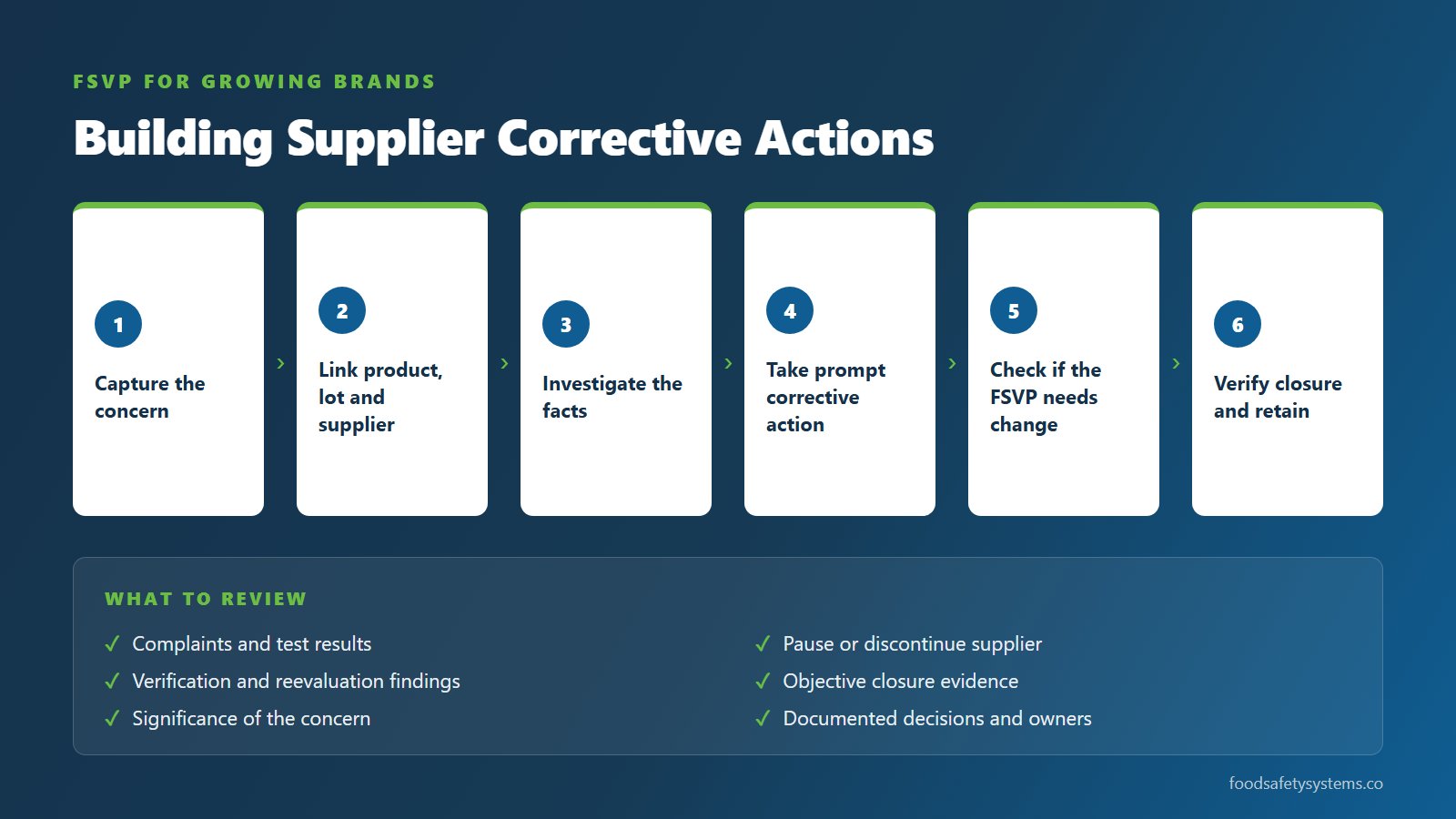
4. Take prompt corrective action
Decide what the situation requires. Options include holding affected product, requiring a supplier root cause and corrective action, increasing verification, or suspending the supplier until the cause is addressed. Assign an owner and a due date to each action.
5. Check whether the FSVP needs to change
Ask whether your hazard analysis, supplier evaluation or verification activities missed something. If the issue came from outside your verification activities, this check is required. Often the answer is a change in activity or frequency, which should trigger a documented foreign supplier reevaluation.
6. Verify closure and retain records
Seek objective evidence before closing an action, such as new test results, records or an audit. An email assurance is rarely enough. Keep the investigation, decisions, supplier communications and corrective action records retrievable under 21 CFR 1.510.
Common gaps in growing brands
- Supplier issues tracked in personal inboxes rather than a shared register.
- Repeated issues accepted as normal without escalation.
- Action owners change and open items are carried forward indefinitely.
- Closure accepted on the supplier’s word without evidence.
- No link between corrective actions and changes to supplier approval or verification.
How supplier corrective actions relate to an FSSC 22000 system
FSVP is a U.S. importer obligation, and FSSC 22000 certification does not satisfy it by itself. Still, an FSSC 22000 system already includes corrective action, root cause analysis and control of externally provided processes, products and services. Your FSVP supplier corrective actions can use the same register and workflow, provided the FSVP-specific decisions and records are captured.
Likewise, a supplier’s FSSC 22000 corrective action records can be useful evidence of closure. However, you still decide whether they address your concern. For related guidance, see corrective and preventive actions (CAPA) and corrective actions.
Example: repeated foreign matter complaints
A growing granola brand receives three consumer complaints about small stones in a batch of imported oats. The supplier quality lead logs each complaint and links all three to two lots from the same overseas mill. Product from those lots is placed on hold.
The mill reports a damaged destoner screen and sends repair records. However, the team asks for evidence, not just a statement. They request post-repair inspection data and test the next three lots. Meanwhile, they add a periodic review of the mill’s equipment maintenance records to the verification plan. The action closes only when results confirm the fix, and every step is documented.
FSVP supplier corrective actions checklist
- Log every concern in one register with source, date and receiver.
- Link each concern to the food, supplier, site and lot.
- Have a qualified individual assess significance and product impact.
- Take prompt, documented corrective action with owners and due dates.
- Decide whether to continue, restrict or discontinue use of the supplier.
- Check whether the hazard analysis, evaluation or verification activities must change.
- Close with objective evidence and keep records retrievable.
Frequently asked questions
When must an importer take FSVP corrective action?
When it determines that a foreign supplier is not producing food to the required level of public health protection, or that the food is adulterated or misbranded for major food allergens. The action must be prompt and documented.
Do I have to stop using the supplier?
Not always. The rule says the appropriate action depends on the circumstances. Discontinuing use until the cause is addressed is one possible option.
Does FSVP corrective action replace a recall?
No. FSVP corrective action does not limit other FDA obligations, including those relating to recalls.
How Consultare Inc. Group can help
Consultare Inc. Group helps growing brands design supplier incident registers, evidence intake procedures, escalation workflows and corrective action tracking. The importer remains accountable for decisions such as supplier suspension or recall-related activity. Services are tailored to the agreed scope.
- Corrective action support: verification that supplier fixes hold.
- Supplier verification support: follow-up verification after an issue.
- FSSC 22000 and FDA compliance integration: one register for CAPA and FSVP actions.
Need help managing FSVP supplier corrective actions?
Discuss your products, suppliers, open issues and next steps with our team. Contact us or book a free consultation.
Prefer to organize your compliance activities yourself? Create a free SystemsBuilder account to structure supplier issues, investigations and corrective actions.
Technical sources: 21 CFR 1.506, 21 CFR 1.508 and 21 CFR 1.510. This article is educational and is not legal advice, FDA endorsement, supplier approval or a guarantee of compliance. FSVP obligations vary by food, importer, supplier and any exemption or modified requirement, so have your conclusions reviewed by a qualified individual. Food Safety Systems is an independent consultancy and is not affiliated with the FSSC 22000 Foundation or FDA.