
Quick answer: A risk-based FSVP hazard analysis is a written, product-specific evaluation of the known or reasonably foreseeable hazards in each food you import. It rates each hazard’s probability without controls and its severity, then decides which hazards require a control. Under 21 CFR 1.504, that analysis must be written regardless of its outcome. It then drives supplier evaluation, approval and verification.
This guide is for growing food brands, distributors and procurement teams that import food into the United States and are adding products, ingredients or suppliers faster than their food safety files can keep up.
Why your hazard analysis falls behind as you grow
New launches and supplier changes often move faster than food safety paperwork. A brand adds a flavor, switches a co-packer or sources a familiar ingredient from a new country. Each change can alter the hazards that should be assessed. However, the hazard analysis on file often still describes the original product.
Under the standard FSVP requirements, importers must identify and evaluate known or reasonably foreseeable hazards for each type of food they import. The analysis covers biological hazards, chemical hazards (including radiological hazards, allergens, pesticide and drug residues, natural toxins and unapproved additives) and physical hazards. It must also consider hazards that occur naturally, are introduced unintentionally or may be introduced intentionally for economic gain.
The evaluation then addresses two questions for each hazard. How likely is it to occur in the absence of controls? And how severe would the illness or injury be? The rule also lists factors to consider, such as formulation, raw materials, transportation, storage and distribution, packaging and labeling, sanitation and intended or reasonably foreseeable use.
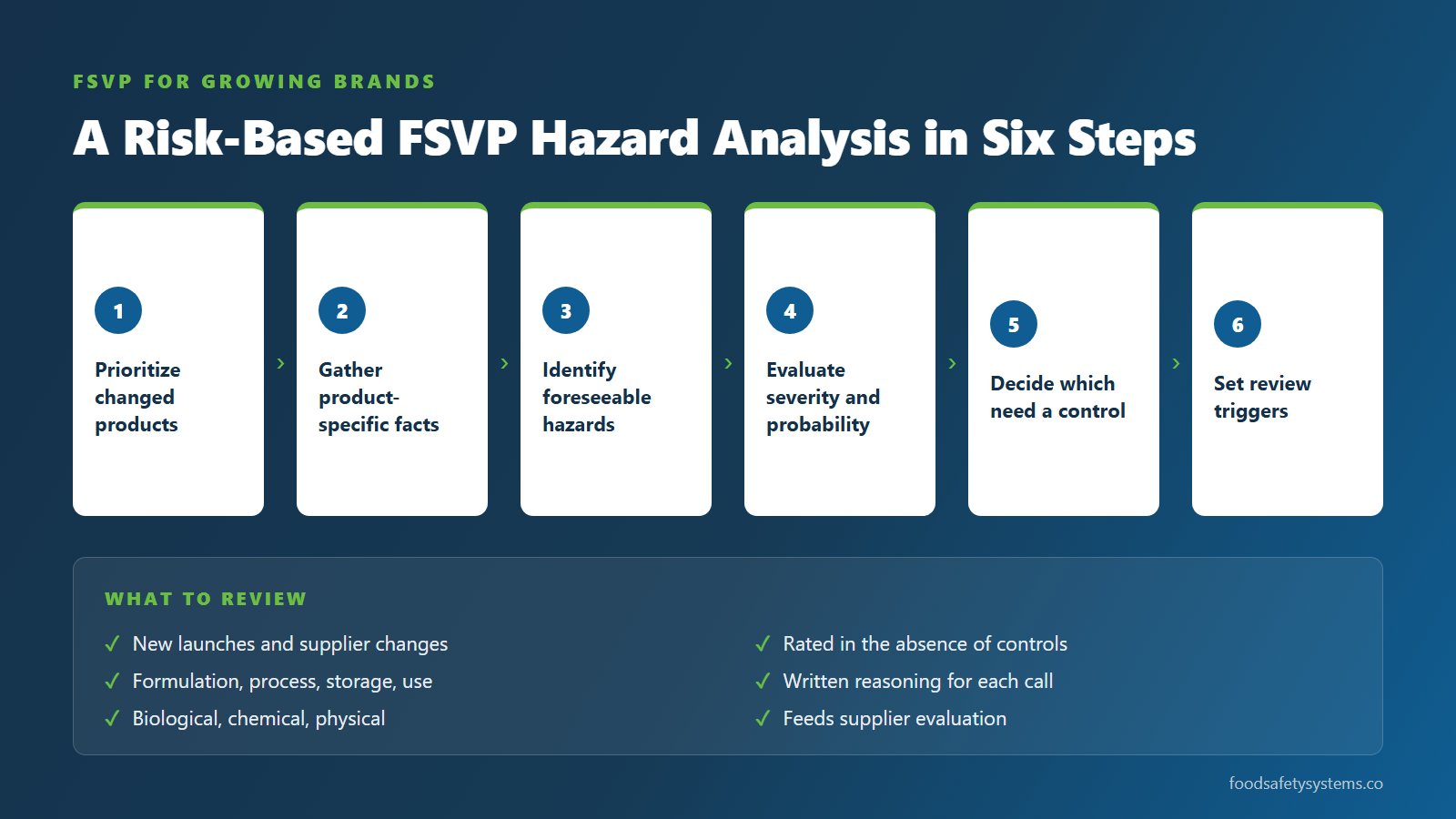
Six steps to a risk-based FSVP hazard analysis
1. Prioritize the products with missing or changed information
Start where the gap is largest. List imported foods and flag new products, reformulations, new suppliers, new manufacturing sites and new sourcing countries. Then work through the flagged items first instead of rewriting every file at once.
2. Gather product-specific facts
Avoid generic templates. Collect the formulation, ingredient sources, processing steps, packaging, storage and transport conditions and intended use. A ready-to-eat snack and an ingredient that a customer will cook raise different questions.
3. Identify known or reasonably foreseeable hazards
Work through biological, chemical and physical hazards for that specific food. Use experience, illness data, scientific reports and other relevant information. For ingredient-level chemical hazards, our article on chemical hazard assessment for fruit ingredients shows how this works in practice.
4. Evaluate severity and probability without controls
Rate each hazard as if no controls were in place. This step is where many files fall short. Teams often assume the supplier’s process works and skip the reasoning. Instead, record how likely the hazard is and how serious the consequence would be.
5. Decide which hazards require a control, and document why
Separate hazards that require a control from those that do not. Write down the reasoning for each decision, not just the result. If you find no hazards requiring a control, the rule says supplier evaluation and verification under 1.505 and 1.506 are not required, except for covered produce under Part 112. Even then, the written analysis must stay on file.
6. Set review triggers
Link the analysis to supplier onboarding and change management. A new supplier, formulation change, new hazard information or a recall in the category should prompt a review. As a result, the analysis stays current as the portfolio grows.
Common gaps in growing brands’ hazard analyses
- No current, product-specific written hazard analysis can be found for an imported food.
- The file lists hazards but does not show how severity and probability were judged.
- The analysis was written for the original supplier or recipe and never revisited.
- Allergens, economically motivated adulteration or environmental pathogens in ready-to-eat foods are missing.
- A supplier’s hazard analysis is relied on without a documented review.
The last point deserves attention. The rule allows you to review and assess another entity’s hazard analysis, including your foreign supplier’s, if a qualified individual conducted it. Still, you must document your review and assessment, including that a qualified individual did the work.
Records to keep
- The written hazard analysis for each type of food, signed and dated when completed and when modified.
- Supporting information used, such as specifications, process descriptions and scientific references.
- Your documented review of any hazard analysis prepared by another entity.
- Evidence that a qualified individual developed and performed the FSVP activities.
FSVP records must be available to FDA on request. Under 21 CFR 1.510, offsite records must be retrievable within 24 hours. In addition, records about your procedures and evaluations must be kept for at least two years after their use is discontinued.
Example: a new spice blend from a new supplier
Consider a snack brand that adds a seasoning blend from a new overseas supplier. The existing hazard analysis covers a plain product made with domestic ingredients. A review flags several new questions. These include pathogens in dried spices, undeclared allergens in the blend and possible economically motivated adulteration such as color additives.
The team rates each hazard without controls and decides which require a control. It also records who will control them. That decision then shapes the next steps: the risk-based foreign supplier evaluation, supplier approval and the verification activities that follow.
How FSVP hazard analysis relates to an FSSC 22000 system
FSVP is a U.S. importer obligation. FSSC 22000 is a certification scheme for food safety management systems. Certification does not satisfy FSVP by itself. Even so, the two can share information. Your FSMS hazard analysis, purchased-material specifications and controls on externally provided processes can feed the FSVP file. Likewise, a supplier’s FSSC 22000 certificate and audit report can be one input to your review. For the certification side, see FSSC 22000 supplier control for imported materials and our guide to conducting a hazard analysis.
Modified requirements apply in some cases, for example to very small importers under 21 CFR 1.512. Some foods are exempt from FSVP altogether. Therefore, confirm which provisions apply to each food before you build the file.
Risk-based FSVP hazard analysis checklist
- List each imported food, its supplier and any recent changes.
- Confirm whether the food is exempt or subject to modified requirements.
- Identify biological, chemical and physical hazards, including economically motivated ones.
- Rate probability without controls and severity for each hazard.
- Document which hazards require a control, why, and who will control them.
- Sign and date the analysis, and set triggers for review.
Frequently asked questions
Can we use our foreign supplier’s hazard analysis?
Yes, if a qualified individual prepared it. You must document your review and assessment of it, including evidence of the preparer’s qualifications.
What if we find no hazards requiring a control?
The hazard analysis must still be written. In that case, supplier evaluation and verification under 1.505 and 1.506 are not required, except for covered produce.
Does our FSSC 22000 hazard analysis count as the FSVP hazard analysis?
Not automatically. It can provide useful information, but the FSVP analysis must address each imported food under Subpart L and be reviewed by a qualified individual.
How Consultare Inc. Group can help
Consultare Inc. Group helps growing brands set up a repeatable hazard analysis review, assess product and supplier information and organize changes that need qualified evaluation. Deliverables can include a documented review scope, organized hazard findings, prioritized evidence requests and follow-up recommendations. Services are tailored to the agreed scope, and the importer remains responsible for its FSVP obligations.
- Supplier verification support: connect hazard findings to supplier evidence.
- FSSC 22000 and FDA compliance integration: align your FSMS with FSVP records.
- FSVP Services: our sister site dedicated to FSVP programs.
Need help managing your FSVP responsibilities?
Discuss your imported foods, suppliers, records, risks and next steps with our team. Contact us or book a free consultation.
Prefer to organize your compliance activities yourself? Create a free SystemsBuilder account to structure supplier records, verification activities and corrective actions.
Technical sources: 21 CFR Part 1, Subpart L and FDA’s FSVP rule page. This article is educational information, not legal advice, FDA approval or a compliance guarantee. FSVP obligations vary by food, importer and applicable exemptions or modified requirements, so confirm current requirements and have specific conclusions reviewed by an appropriately qualified individual. Food Safety Systems is an independent consultancy and is not affiliated with the FSSC 22000 Foundation or FDA.