
An FDA registration closeout is the structured end to a renewal cycle. It confirms that every covered facility renewed, that the evidence is complete and that open issues are resolved. It is also an opportunity to examine how well your organization identified obligations, completed submissions and kept its confirmation records.
Quick answer: for the 2026 FDA Food Facility Registration renewal, review the applicable sites, submission authority, evidence of completion and open discrepancies. Close or escalate each gap. Then archive the cycle records and capture improvement actions for the next cycle.
This guide is for FSSC 22000 coordinators and quality managers who own the end-of-cycle review. It covers the closeout of the whole cycle. For closing individual renewal actions, see our article on closing FDA renewal actions.
Why a formal closeout is worth the effort
Without a closeout, a cycle simply fades away. Records end up in inboxes, and lessons are forgotten by the next renewal in 2028. A short, formal closeout prevents both problems.
However, keep its role clear. The management system aids coordination, but it does not replace the official FDA renewal. Nor does it replace technical food safety verification. FSSC 22000 certification and FDA registration remain separate.
Six steps for an FDA registration closeout
1. Confirm the site population
Compare the facility list at the start of the cycle with the list today. Add new sites, and note closed or changed ones. Applicability and exemptions require facility-specific assessment, so record any new decisions.
2. Check the renewal status of every site
Give each site a final status, such as renewed, not required or open. Keep in mind that FDA considers a registration expired if it is not renewed by December 31, 2026. So an open site needs urgent attention, not a closeout note.
3. Verify objective evidence and authorized actions
Check that each renewed site has its confirmation on file. Also confirm that the submitter was authorized. Under 21 CFR 1.230(b), a renewal submitted by someone other than the owner, operator or agent in charge must include a statement of authority.
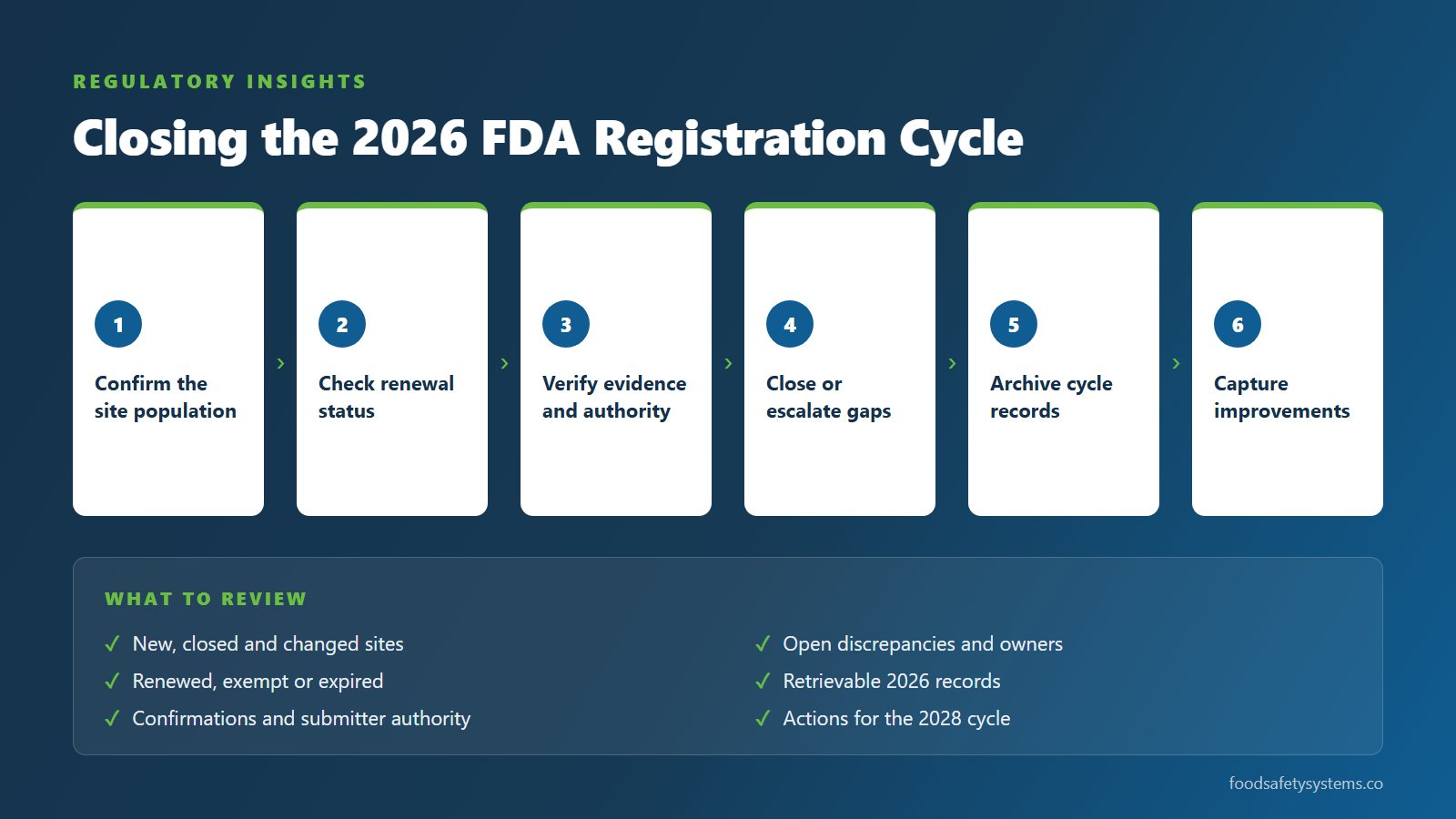
4. Close or escalate unresolved discrepancies
Review every open discrepancy, such as an address that does not match the DUNS record. FDA currently recognizes DUNS as an acceptable Unique Facility Identifier. Close each item with evidence, or escalate it with an owner and a date.
5. Archive the cycle records
File the confirmations, decisions and exception log together, under your document control and record-keeping rules. Label them by cycle. That way, auditors and the next team can find them quickly.
6. Capture improvement actions for the next cycle
Ask what slowed the team down. For example, late data checks, missing backups or unclear authority. Turn each finding into an action with an owner. Our article on FDA renewal lessons shows how to analyze root causes.
Who does what
- Regulatory or quality lead: runs the closeout and prepares the summary.
- Site managers: confirm site changes and help resolve local discrepancies.
- Authorized submitters: provide any missing confirmations.
- Reviewer: checks the evidence independently before the cycle is closed.
- Top management: accepts the closeout and approves improvement actions.
Records to keep
- The final site list with status and applicability decisions.
- Renewal confirmations for every renewed site.
- Evidence of submitter authority.
- The closed exception log, including escalations.
- The closeout summary and the improvement action list.
Common mistakes
A frequent mistake is closing the cycle with open items still listed. If a site has no confirmation, the cycle is not complete. So escalate it instead of archiving it.
Another mistake is skipping the improvement step. Teams are tired after December, and the review slips. Yet the lessons are freshest right then. Finally, records are sometimes archived without labels, so the next team cannot tell which cycle they belong to.
Example workflow
In mid-December, the quality lead compares the site list with the confirmation records. One new warehouse appears in the list, and its renewal is confirmed. Next, a reviewer checks submitter authority for each site.
In early January, the lead closes the last address discrepancy and files all records under a “2026 cycle” label. Management then reviews the closeout summary at management review. Three improvement actions are approved for the 2028 cycle, each with an owner.
2026 FDA registration renewal requirements
- Legal basis: section 415 of the Federal Food, Drug, and Cosmetic Act (21 U.S.C. § 350d) and 21 CFR Part 1, Subpart H.
- Window: facilities required to register renew from October 1 through December 31 of each even-numbered year.
- Deadline: the 2026 renewal period closes on December 31, 2026.
- Update is not renewal: an earlier update does not replace the required renewal.
- No fee: FDA does not charge for registration or renewal.
- Unique Facility Identifier: FDA currently recognizes the DUNS number as an acceptable UFI.
Applicability and any exemptions need a facility-by-facility assessment. Check the FDA biennial renewal user guide before you rely on any internal summary.
FDA registration closeout checklist
- Confirm the site population and renewal status.
- Verify objective evidence and authorized actions.
- Close or escalate unresolved discrepancies.
- Archive the cycle records under a clear label.
- Capture improvement actions for future cycles.
Frequently asked questions
When should the closeout happen?
Start in December, while there is still time to fix gaps. Finish the improvement review in January, when lessons are fresh.
Can we close the cycle if one site is still open?
No. An open site needs escalation, not archiving. Close the cycle only when every covered site is renewed or has a documented decision.
Does the closeout replace management review?
No. It feeds management review with a clear summary and a list of improvement actions.
How Consultare Inc. Group can help
Consultare Inc. Group supports FSSC 22000 management systems, management reviews, compliance closeout and continual improvement. Services are tailored to the agreed scope.
- FSSC 22000 and FDA compliance integration: regulatory workflows inside your FSMS.
- FSSC 22000 implementation readiness: processes checked before your audit.
- Audit readiness coaching: internal audit and evidence review support.
Need help managing your FSSC 22000 responsibilities?
Discuss your facilities, records, responsibilities and next steps with our team. Contact us or book a free consultation.
Prefer to organize your compliance activities yourself? Create a free SystemsBuilder account to structure closeout records, renewal evidence and improvement actions.
Regulatory sources: FDA biennial registration renewal user guide, FDA renewal reminder, FDA online food facility registration and 21 CFR Part 1, Subpart H. This article is educational and is not legal advice or an official statement of FDA policy. Requirements may change and depend on your facility, operations and certification scope; verify current requirements with official FDA sources and consult qualified regulatory professionals. FSSC 22000 certification does not replace FDA food facility registration. Food Safety Systems is an independent consultancy and is not affiliated with, endorsed by or acting for the FSSC 22000 Foundation or FDA.