
Food defense is often overlooked until a security event or an audit raises uncomfortable questions. A risk-based food defense vulnerability assessment, with proportionate controls and practised responses, helps a site prepare for intentional contamination threats. For FSSC 22000 certified suppliers working toward Walmart supply relationships, it also shows that these risks are managed deliberately.
Quick answer: identify vulnerable areas and processes, then assess whether existing safeguards really work. Next, create proportionate mitigation plans, train and test responses, and reassess after operational changes. Also check whether FDA’s intentional adulteration rule applies to your facility, and confirm Walmart’s current supplier requirements directly.
This guide is for quality managers, food defense coordinators, FSMS teams and site security leads at food manufacturers. Walmart’s applicable requirements can depend on the product, facility, commercial relationship and current law. Therefore, check Walmart’s current supplier policies before treating any recommended practice as a mandatory Walmart rule. For the wider picture, see FSSC 22000 for Walmart food suppliers.
How FDA’s intentional adulteration rule fits in
In the United States, 21 CFR Part 121 sets mitigation strategies to protect food against intentional adulteration. Covered facilities must prepare a written vulnerability assessment for each type of food, and it must consider an inside attacker (21 CFR 121.130). They must also implement written mitigation strategies at each actionable process step (21 CFR 121.135).
However, the rule does not apply to every operation. 21 CFR 121.5 exempts, for example, very small businesses, the holding of food (except in liquid storage tanks) and packing or labeling where the food-contact container stays intact. Very small businesses must still provide documentation of their exemption on request. Therefore, confirm your applicability before you design the program.
Six steps for a food defense vulnerability assessment
Identify vulnerable areas and processes
Review exposed food, ingredients, access points, utilities, deliveries and operations where intentional interference could occur. Keep food defense threats separate from food fraud and from unintentional food safety hazards. For the economically motivated side, see FSSC 22000 food fraud mitigation.
Assess existing safeguards
Consider access controls, visitor practices, employee awareness, restricted areas, response procedures and incident reporting. A camera or a locked door should not automatically count as adequate control for every vulnerability. See visitor and contractor controls.
Create proportionate mitigation plans
Link each action to an identified risk, an owner, an implementation date and a verification method. In addition, protect detailed vulnerability records from unnecessary disclosure. For a broader planning view, see food defense plans for food manufacturers.
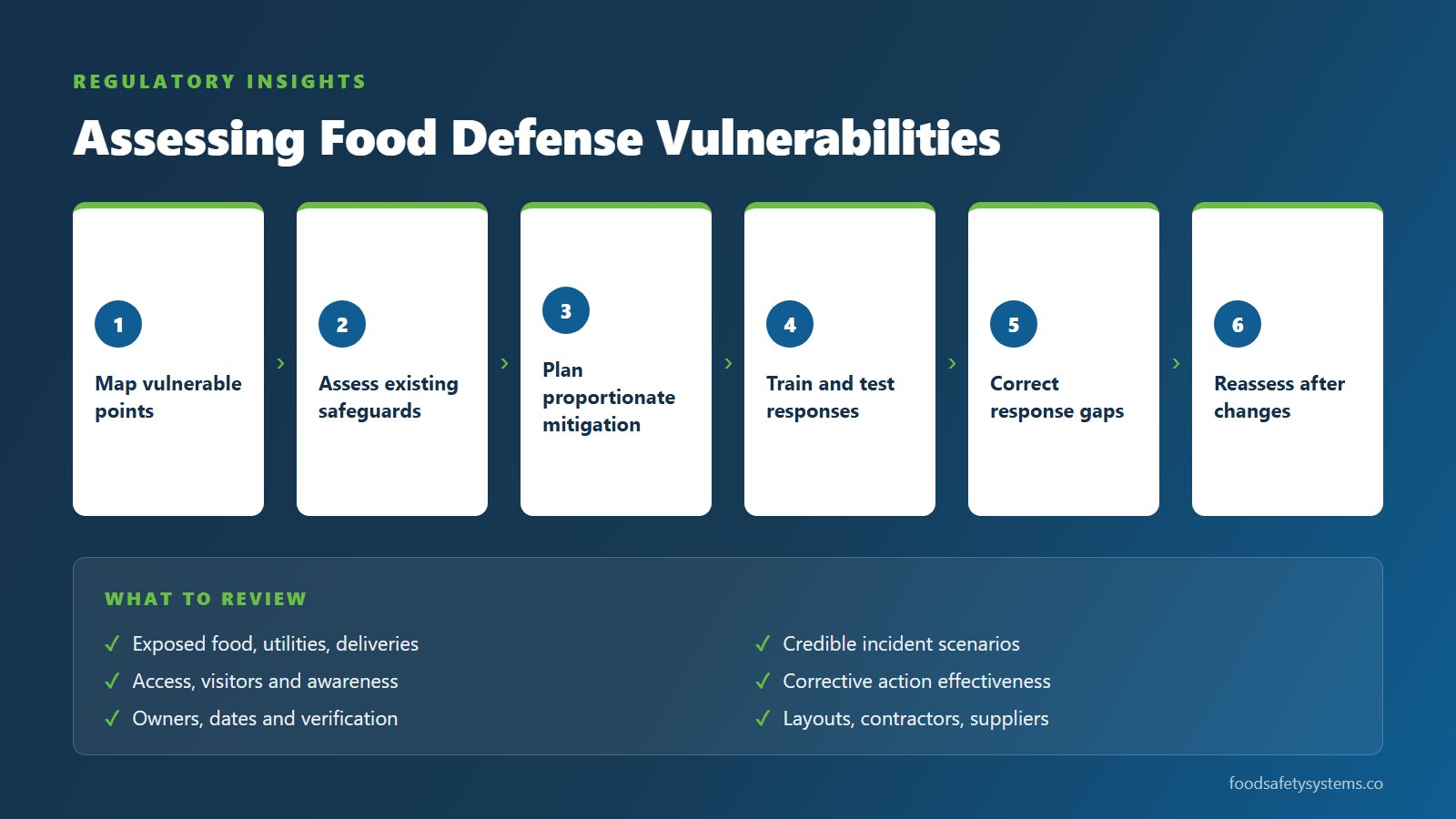
Train and test responses
Check that personnel understand food defense and know how to report concerns. Then practise credible incident scenarios that are relevant to the site. See training and competence.
Correct the gaps exercises reveal
Record response gaps after each exercise. Then assign corrective actions and verify that they worked. As a result, the program improves with every test.
Reassess after operational changes
Re-evaluate the assessment when facility layouts, contractors, suppliers or product exposure change. Use the current FSSC 22000 scheme documents published on fssc.com, and independently verify any separate Walmart supplier requirements.
Food defense vulnerability assessment checklist
- Identify vulnerable areas and processes.
- Assess existing safeguards, including an inside attacker.
- Create proportionate mitigation plans with owners.
- Train and test responses.
- Correct the gaps exercises reveal.
- Update after operational changes.
- Check whether 21 CFR Part 121 applies to the facility.
- Verify the applicable Walmart supplier program and all relevant product and facility requirements.
- Assign owners for documentation, follow-up actions and periodic review.
Frequently asked questions
What is the difference between food defense and food fraud?
Food defense addresses intentional contamination meant to cause harm. Food fraud addresses deliberate adulteration or substitution for economic gain. Assess them separately.
Does every food facility need an FDA food defense plan?
No. Part 121 has exemptions, such as very small businesses and most food holding. Check 21 CFR 121.5 for your operation.
Does FSSC 22000 certification guarantee acceptance by Walmart?
No. Certification can support readiness, but Walmart’s own current requirements decide. Confirm them directly with the relevant Walmart contact.
How Consultare Inc. Group can help
Consultare Inc. Group supports food businesses through compliance gap assessments, program development, documentation control, audit preparation and corrective action coordination. Services are adapted to the specific product, site and customer program.
- FSSC 22000 and FDA compliance integration: Part 121 applicability and assessment methods.
- Food safety training and education: food defense awareness and training evidence.
- Audit readiness coaching: mitigation plans and improvement tracking.
Are there food defense vulnerabilities your team has not evaluated?
Discuss a confidential assessment approach with our team. Contact us or book a free consultation.
Prefer to organize your compliance activities yourself? Create a free SystemsBuilder account to structure vulnerability assessments, mitigation actions and exercise records.
Technical sources: the FSSC 22000 scheme, ISO 22000, 21 CFR Part 121 and Walmart’s supplier audits and certifications page. This article is educational and is not legal advice or a statement of Walmart supplier policy; requirements depend on your products, certification scope and applicable regulations. Food Safety Systems is an independent consultancy and is not affiliated with or endorsed by the FSSC 22000 Foundation, FDA or Walmart Inc. Walmart-specific supplier requirements must be confirmed directly with the relevant Walmart contact.