
Quick answer: A food defense plan for food manufacturers protects product from intentional adulteration meant to cause wide-scale public health harm. Where FDA’s Intentional Adulteration rule (21 CFR Part 121) applies, the written plan includes a vulnerability assessment and mitigation strategies for actionable process steps. It also covers monitoring, corrective actions and verification. First, however, confirm whether the rule applies to your facility.
Food defense differs from food safety programs that address unintentional contamination. It also differs from food fraud, which is deliberate deception for economic gain. All three matter, but each needs its own assessment; for the fraud side, see our guide to FSSC 22000 food fraud mitigation. Certain FDA-regulated facilities are covered by the Intentional Adulteration rule under FSMA, while others are exempt or have modified requirements. So do not assume a particular plan format is legally required until you have checked.
FSSC 22000 adds its own expectation. The Version 7 scheme requires a food defense threat assessment and plan developed by competent personnel. The plan must be implemented through the FSMS, comply with applicable legislation, cover the products and processes in scope and be kept up to date.
This guide is for food safety managers, PCQIs, plant security leads and manufacturers preparing to supply retailers such as Costco. For the wider FDA picture, see FSMA preventive controls.
Six steps to build a food defense plan for food manufacturers
Determine whether Part 121 applies
Review your activities, foods and the exemptions in 21 CFR 121.5. For example, the rule does not apply to very small businesses as defined in Part 121. It also excludes holding food, except in liquid storage tanks, and packing or labeling where the food-contact container stays intact. Animal food and certain farm activities are exempt too. A very small business must still provide documentation of its exemption on request.
Where the rule applies, identify the required plan elements. Then use current FDA guidance and qualified individuals to prepare them.
Conduct a vulnerability assessment
Evaluate each point, step or procedure to identify significant vulnerabilities and actionable process steps. Under 21 CFR 121.130, the method must at least consider three factors. These are the potential public health impact, the degree of physical access to the product and the ability of an attacker to contaminate it. The assessment must also consider an inside attacker.
Write down the method, assumptions, steps reviewed, rationale and conclusions. In particular, explain why each step was or was not identified as actionable. The assessment should reflect the real facility layout and operating practices.
Select and implement mitigation strategies
For each actionable process step, establish mitigation strategies that significantly minimize or prevent the identified vulnerability. Strategies may involve access controls, supervision, process controls or other measures suited to the facility. Assign responsibility for implementation and monitoring. Also check that strategies still work during maintenance, shift changes and contractor or visitor access.
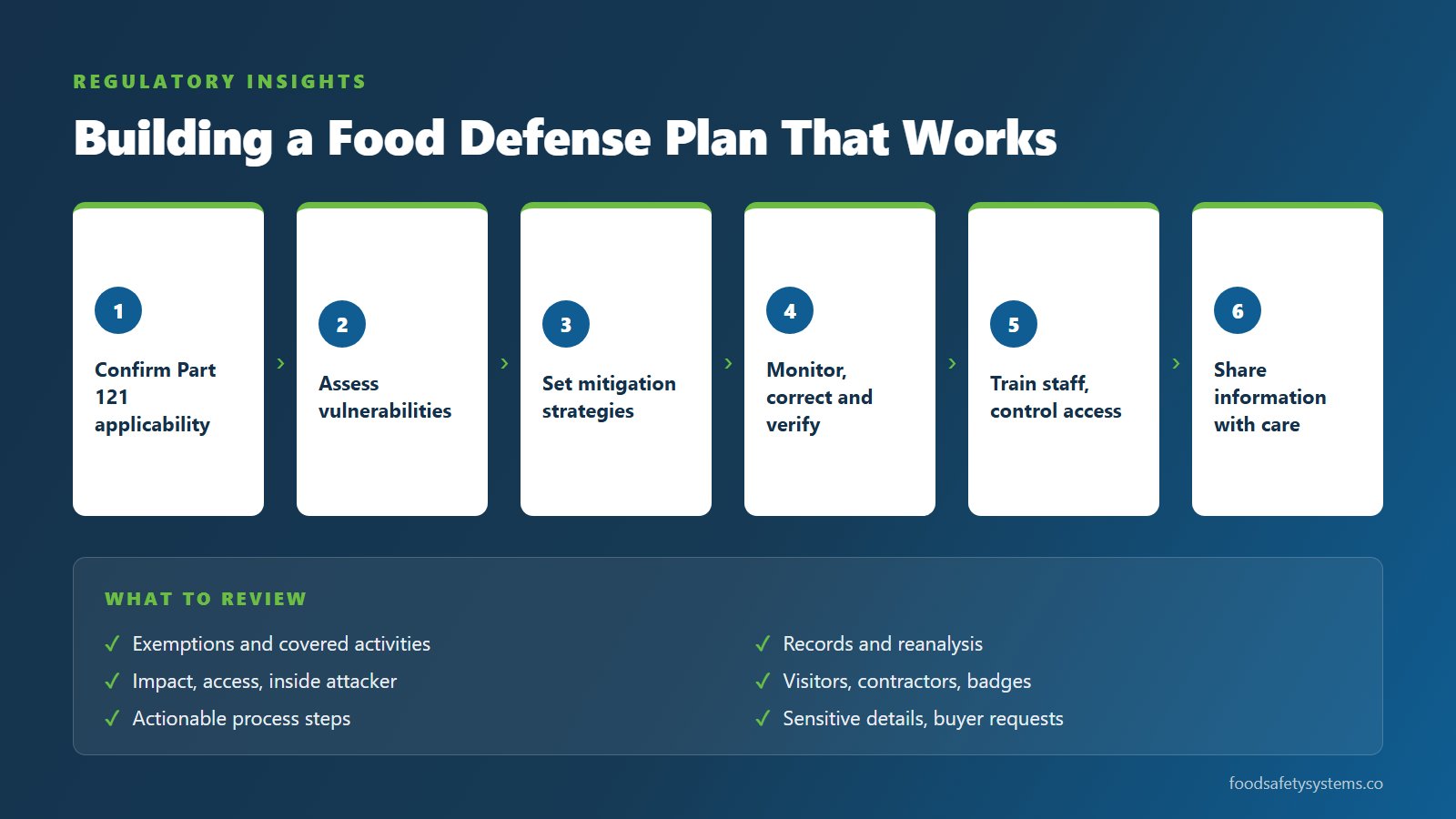
Define monitoring, corrective action and verification
Decide how each mitigation strategy is monitored and what happens when it is not properly implemented. Next, define how you verify that the food defense system works as intended. Keep records of implementation, monitoring, corrective actions, verification and any required reanalysis. Protect sensitive food defense information from unnecessary disclosure. See document control and record-keeping.
Train employees and control access
Provide food defense awareness training and job-specific training for personnel responsible for mitigation strategies. Include temporary staff and contractors where relevant to the risk. Use visitor management, identification, restricted areas and key or badge controls suited to the facility. Train employees to report suspicious activity without encouraging unsafe confrontation. See visitor and contractor controls.
Share food defense information with care
Keep food defense documents controlled, and decide which details can be shared with customers, auditors and regulators. Some vulnerability details are sensitive, so share them only with authorized parties. Confirm Costco’s specific supplier information requests directly with your Costco buyer. A food defense plan does not, by itself, meet every customer requirement or guarantee supplier approval.
Food defense plan for food manufacturers: checklist
- Determine whether 21 CFR Part 121 applies and whether an exemption exists.
- Conduct and document a facility-specific vulnerability assessment where required.
- Identify actionable process steps under the applicable rule.
- Implement and monitor mitigation strategies.
- Define corrective actions, verification and reanalysis.
- Train responsible personnel and protect sensitive records.
Frequently asked questions
Is a food defense plan the same as a food fraud plan?
No. Food defense addresses intentional adulteration meant to cause harm. Food fraud addresses deception for economic gain, which FDA handles through the preventive controls hazard analysis rather than Part 121.
Does every FDA-registered facility need a Part 121 food defense plan?
No. Exemptions cover very small businesses, most holding of food and some packing and labeling activities, among others. Check 21 CFR 121.5 for your operation.
Does FSSC 22000 certification satisfy Part 121?
No. Certification and FDA obligations are separate, so Part 121 requirements must be met on their own where they apply.
How Consultare Inc. Group can help
Consultare Inc. Group supports food defense applicability screening, documentation gap assessments, vulnerability-assessment coordination, mitigation strategy documentation, training coordination and internal review. Sensitive vulnerability assessments are handled with appropriate confidentiality and qualified expertise.
- FSSC 22000 and FDA compliance integration: align your food defense plan with Part 121.
- FSSC 22000 implementation readiness: food defense reviewed before your audit.
- Food safety training and education: awareness and job-specific food defense training.
Is your facility prepared to address intentional adulteration risks?
Review your food defense documentation, applicability questions, mitigation strategies and training records with our team. Contact us or book a free consultation.
Prefer to organize your compliance activities yourself? Create a free SystemsBuilder account to structure monitoring records, corrective actions and training evidence.
Technical sources: FDA: FSMA Final Rule for Mitigation Strategies to Protect Food Against Intentional Adulteration, FDA: Food Defense, 21 CFR Part 121 and FSSC 22000. This article is educational, not legal advice; applicability depends on your products, facility, activities and current law. Food Safety Systems is an independent consultancy and is not affiliated with the FSSC 22000 Foundation, FDA or Costco Wholesale. Costco-specific supplier requirements must be confirmed with the Costco buyer.