
FSSC 22000 food fraud prevention protects ingredients, packaging and finished products from intentional deception for economic gain. It rests on a documented vulnerability assessment, proportionate supplier controls and current mitigation records. For manufacturers and importers considering Walmart supply relationships, the priority is to show that these controls work in practice. Equally, the controls must be supported by up-to-date evidence.
Quick answer: define the food fraud scope and rank vulnerabilities with credible factors. Then apply proportionate mitigation, update the assessment when suppliers or markets change and keep the work inside your FSMS. Finally, confirm Walmart’s current supplier requirements directly, rather than assuming a mandatory certification path.
This guide is for quality managers, purchasing teams and FSMS coordinators at food manufacturers and importers. Walmart’s supplier requirements can differ by product, facility and type of commercial relationship. Therefore, check Walmart’s current supplier policies before treating any recommended practice as a mandatory Walmart rule. For the wider readiness picture, see FSSC 22000 for Walmart food suppliers.
Six steps for FSSC 22000 food fraud prevention
Define the food fraud scope
Identify where substitution, dilution, misrepresentation or counterfeiting could affect ingredients, packaging and finished products. Food fraud analysis focuses on intentional deception for economic gain. As a result, keep it distinct from accidental food safety hazards and from food defense threats, which aim to cause harm. See our food defense plan guide for the second topic.
Rank vulnerabilities using credible factors
Consider historical incidents, supply chain complexity, pricing pressure, detectability, geographic sourcing and supplier transparency. For each rating, record the rationale, the information sources and the affected material or product. A step-by-step method is set out in our FSSC 22000 food fraud vulnerability assessment guide.
Build proportionate mitigation measures
Use approved supplier programs, specifications, authenticity checks, purchasing oversight or targeted testing where they fit the risk. Testing is not automatically required for every material. Instead, choose verification methods based on the assessed vulnerability and the effectiveness of existing controls. See supplier and raw material approval.
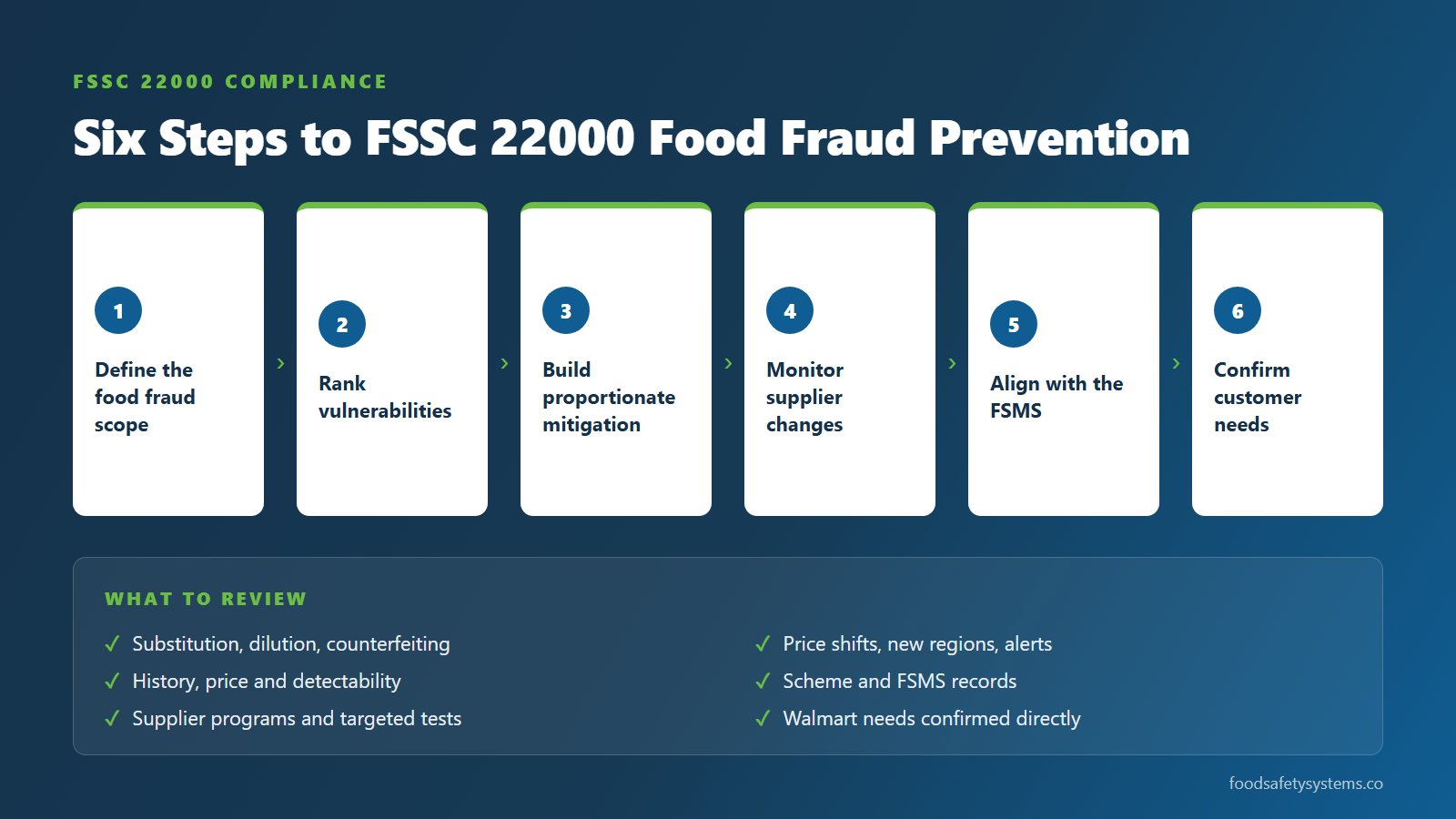
Review results and supplier changes
Update the assessment when unusual price changes, new sourcing regions, complaints, regulatory alerts or supplier changes appear. Keep records of corrective actions and, where relevant, of management review decisions. See product authenticity and integrity.
Keep food fraud work inside the FSMS
Make sure food fraud activities align with the applicable FSSC 22000 scheme requirements and your documented food safety management system. In practice, that means controlled documents, assigned owners and evidence that the plan is reviewed. See management review procedures.
Keep certification and retailer expectations separate
FSSC 22000 certification and Walmart supplier selection are distinct processes. Consequently, avoid claiming that Walmart mandates this scheme for all categories. Confirm the applicable supplier program and any category requirements directly with the relevant Walmart contact.
FSSC 22000 food fraud prevention checklist
- Define the food fraud scope for ingredients, packaging and finished products.
- Rank vulnerabilities using credible, documented factors.
- Build proportionate mitigation measures.
- Review results when prices, sources or suppliers change.
- Connect the work to certification and retailer expectations.
- Verify the applicable Walmart supplier program and all relevant product and facility requirements.
- Assign owners for documentation, follow-up actions and periodic review.
Frequently asked questions
How is food fraud different from food defense?
Food fraud is intentional deception for economic gain. Food defense addresses deliberate acts meant to cause harm. Each needs its own assessment and controls.
Does every material need authenticity testing?
No. Testing is one option among several. Choose it where the assessed vulnerability and the strength of other controls justify it.
Does FSSC 22000 certification guarantee acceptance by Walmart?
No. Certification can support readiness, but Walmart’s own current requirements decide. Confirm them directly with Walmart.
How Consultare Inc. Group can help
Consultare Inc. Group supports food businesses through compliance gap assessments, program development, documentation control, audit preparation and corrective action coordination. Services are adapted to the specific product, site and customer program.
- FSSC 22000 implementation readiness: food fraud controls checked before your audit.
- Supplier verification support: approval and monitoring for higher-risk materials.
- Retail and wholesale food safety solutions: evidence prepared for buyer reviews.
Where is your food supply chain most vulnerable to fraud?
Discuss your materials, suppliers and vulnerability assessment with our team. Contact us or book a free consultation.
Prefer to organize your compliance activities yourself? Create a free SystemsBuilder account to structure vulnerability ratings, supplier information and mitigation records.
Technical sources: the FSSC 22000 scheme, ISO 22000 and Walmart’s supplier audits and certifications page. This article is educational and is not legal advice or a statement of Walmart supplier policy; requirements depend on your products, certification scope and applicable regulations. Food Safety Systems is an independent consultancy and is not affiliated with or endorsed by the FSSC 22000 Foundation, FDA or Walmart Inc. Walmart-specific supplier requirements must be confirmed directly with the relevant Walmart contact.