
Quick answer: FSSC 22000 food fraud mitigation starts with a documented vulnerability assessment of your materials and supply routes. Each significant vulnerability then gets a proportionate control, an accountable owner and a review trigger. The Version 7 scheme expects the assessment and the food fraud mitigation plan to be developed by competent people, implemented through the FSMS and kept up to date.
Food fraud is intentional deception for economic gain, such as substitution, dilution or misrepresentation. It differs from unintentional process errors. It also differs from food defense, which deals with intentional contamination for malicious purposes. In the U.S., facilities subject to the preventive controls rule must also consider hazards intentionally introduced for economic gain in their hazard analysis under 21 CFR 117.130.
This guide is for FSMS coordinators, procurement and technical teams, and manufacturers preparing to supply major retailers such as Costco. Regulatory duties depend on the product, facility and transaction, and retailer-specific conditions should be verified directly with the buyer. For the underlying program, see our page on product authenticity and integrity.
Six steps for FSSC 22000 food fraud mitigation
Define the scope of the assessment
Evaluate the ingredients, packaging, services and supply routes relevant to the site. Keep the focus on economically motivated deception. Unintentional process errors belong in the hazard analysis, while malicious contamination belongs in your food defense plan.
Score vulnerability factors
Consider historical incidents, commodity value, supply chain complexity and ease of substitution. Detection difficulty, geographic instability and the maturity of existing controls matter as well. Record the evidence behind each rating. Do not apply a scoring formula without explaining its assumptions.
Target effective mitigation
Possible actions include verified source qualification, authenticity testing, tamper controls and traceability. Documented purchasing specifications and exception alerts also help. Tie each action to the assessed scenario rather than applying the same control everywhere. See supplier and raw material approval and traceability systems.
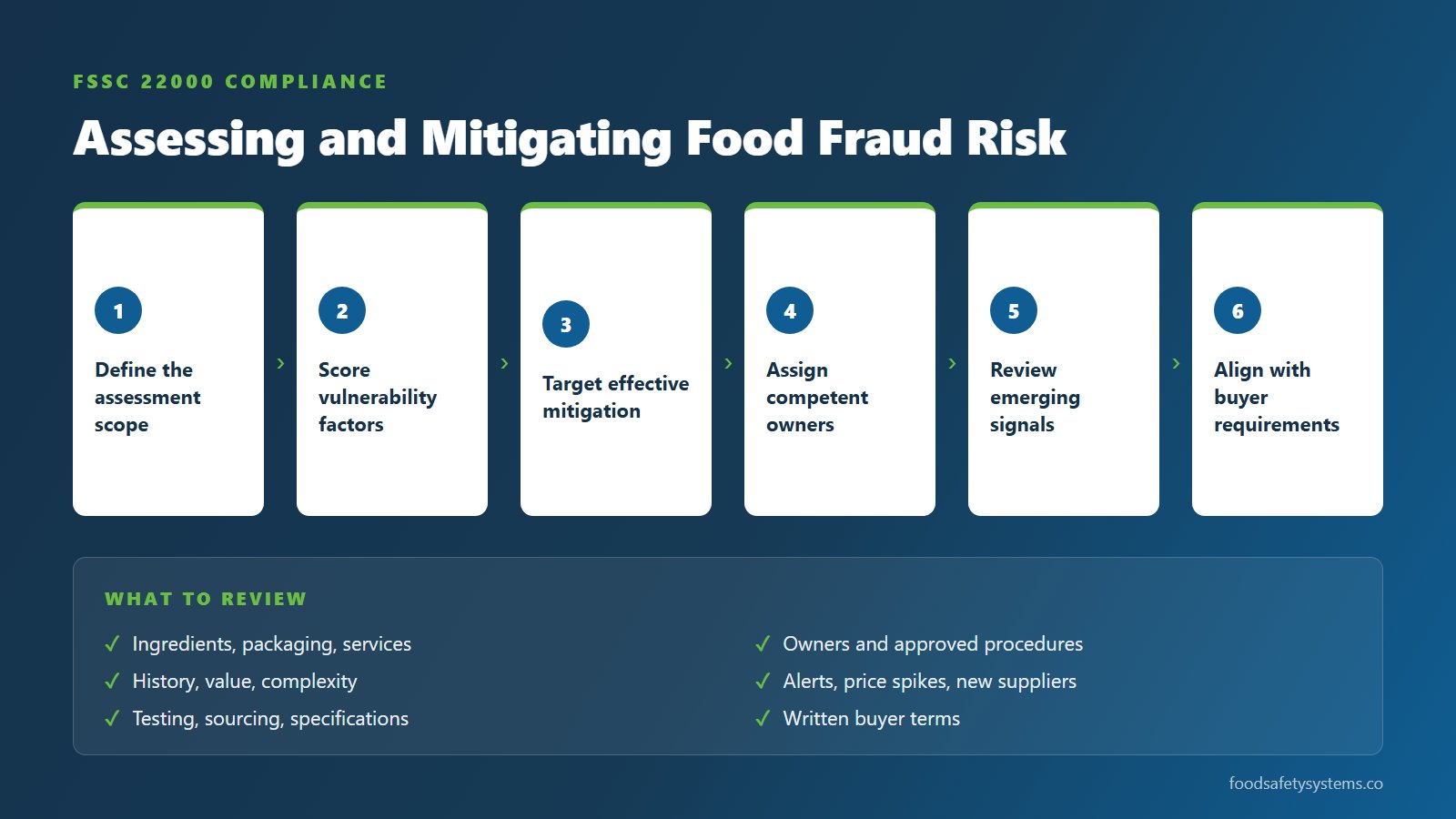
Assign competent owners
Name an accountable owner for each mitigation action and for the plan as a whole. The people who build and maintain the assessment need appropriate knowledge and competence. In addition, keep the approved procedures current and the plan connected to your FSMS.
Review emerging signals
Revisit high-risk materials after new fraud alerts, price spikes, supplier changes or unusual specifications. Procurement, technical staff and leadership should share concerns quickly. For imported materials, see our guide to FSSC 22000 supplier control.
Understand the retailer relationship
A documented food fraud program can strengthen a supplier dossier for a Costco prospect. However, the FSSC scheme and separately negotiated retailer requirements must be evaluated independently. Confirm Costco-specific requirements in writing with your Costco buyer, because certification does not guarantee acceptance.
FSSC 22000 food fraud mitigation checklist
- Confirm applicable regulation, certification scope and buyer-specific requirements in writing.
- Identify the accountable process owner and current approved procedures.
- Collect recent objective records tied to the correct facility, product and lots.
- Resolve exceptions with documented corrective actions and effectiveness checks.
- Test record retrieval and make the review package available to authorized reviewers.
Frequently asked questions
What is the difference between food fraud and food defense?
Food fraud is deception for economic gain. Food defense protects against intentional adulteration meant to cause harm. FSSC 22000 expects a separate assessment and plan for each; see our food defense plan guide.
Does FSSC 22000 require a food fraud vulnerability assessment?
Yes. The scheme requires a food fraud vulnerability assessment and a food fraud mitigation plan, implemented through the FSMS and kept up to date.
When should the assessment be reviewed?
Review it at a defined interval and whenever new fraud alerts, price spikes, supplier changes or unusual specifications appear.
How Consultare Inc. Group can help
Consultare Inc. Group supports food safety program development, supplier documentation, regulatory readiness, quality system improvement and project coordination. Services are tailored to the agreed scope.
- Supplier verification support: source qualification for high-risk materials.
- FSSC 22000 implementation readiness: food fraud assessment reviewed before your audit.
- FSSC 22000 and FDA compliance integration: align fraud controls with your Part 117 hazard analysis.
Need help managing your FSSC 22000 responsibilities?
Discuss your food fraud assessment and mitigation plan with our team. Share your product category, manufacturing location, current program and expected distribution timeline so the discussion can focus on the most important gaps. Contact us or book a free consultation.
Prefer to organize your compliance activities yourself? Create a free SystemsBuilder account to structure supplier information, assessments and corrective actions.
Technical sources: FSSC 22000 scheme documents, FDA: Economically Motivated Adulteration (Food Fraud) and 21 CFR 117.130. This article is educational, not legal advice or a statement of Costco supplier approval policy; requirements may change. Food Safety Systems is an independent consultancy and is not affiliated with the FSSC 22000 Foundation, FDA or Costco Wholesale. Costco-specific supplier requirements must be confirmed with the Costco buyer.