
FSSC 22000 hygienic equipment controls matter most where residues collect: seams, interfaces and parts that are hard to take apart. FDA inspections of dietary supplement plants often find residue in exactly these places, alongside incomplete specifications and production records. Those are FDA CGMP findings, not FSSC 22000 nonconformities, but they show how quickly problems repeat when prerequisite programs (PRPs), monitoring and management review are disconnected. A well-scoped food safety management system (FSMS) brings equipment design, sanitation PRPs, product information, verification and corrective action together. Which requirements apply depends on the scheme version and your food chain category.
This guide is for FSMS teams, facility managers, auditors and technical leads implementing ISO 22000-based systems.
Six areas to review for FSSC 22000 hygienic equipment
Assess hygienic design and maintenance
Evaluate equipment interfaces, seams, disassembly and repair practices to reduce residue build-up, and make sure maintenance work is signed off for cleanability as well as function. See equipment suitability and maintenance and equipment and facility design for risk zones.
Make sanitation PRPs measurable
Define cleaning responsibilities, frequencies, methods and checks that match the site’s hazards and materials, with acceptance criteria someone can verify. See our cleaning and sanitation guide.
Review allergen and cross-contact pathways
On shared lines, map product sequences, material residues, cleaning changeovers and rework practices. Related guide: allergen management.
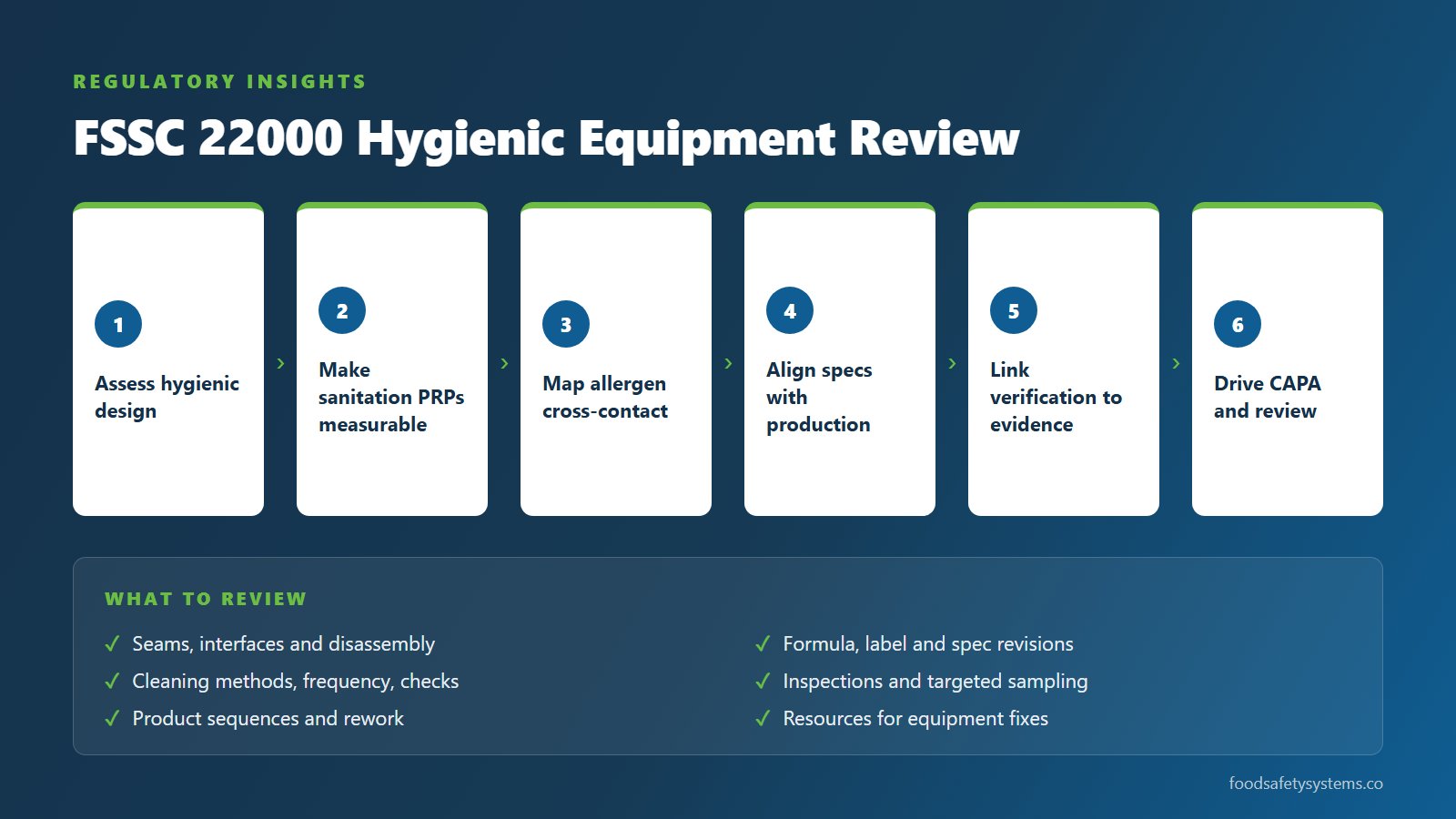
Keep specifications aligned with production
Review formula approval, finished product characteristics, label data and document revisions together, so a recipe change always reaches the label. See FSSC 22000 specifications and product information.
Link verification to evidence
Use inspections, record reviews, targeted sampling where justified and follow-up to test whether controls work. Strong evidence ties inspection results, approved procedures, corrective actions and trends to the risks you identified. See environmental monitoring.
Drive improvement through CAPA and review
Track repeat issues, escalate fixes that did not work and confirm that management allocates resources for equipment or process changes. Retraining alone rarely fixes recurring residue findings. See corrective and preventive actions and management review.
FSSC 22000 hygienic equipment checklist
- Have you identified which FDA regulations and certification requirements apply to the actual product and activities?
- Have you reviewed cleanability, shared-equipment risks, cleaning SOPs and evidence they are followed?
- Are finished product specifications, approved formulas, labels and production records consistent?
- Are deviations, root cause, corrective action, verification evidence and owners documented?
Frequently asked questions
Does FSSC 22000 establish compliance with 21 CFR Part 111?
No. FSMS certification and dietary supplement CGMP are separate frameworks, and the regulatory requirements stay binding on their own.
Must every equipment seam be tested?
Testing or inspection should follow risk, equipment suitability and the requirements that apply.
What is strong verification evidence?
Documented inspection results, approved procedures, record reviews, corrective action evidence and trend analysis tied to the identified risks.
How Consultare Inc. Group can help
Consultare Inc. Group provides FSSC 22000 readiness reviews, FSMS and PRP development, hygienic design and sanitation assessments, internal audits, verification programs and CAPA support, tailored to the product, facility and requirements involved.
- FSSC 22000 implementation readiness: check sanitation PRPs and equipment hygiene before your audit.
- Food safety system development: build measurable cleaning, changeover and allergen programs.
- Corrective action support: close recurring residue findings with verified root-cause action.
Need help managing your FSSC 22000 responsibilities?
Discuss your products, equipment, facility operations, specifications, manufacturing records and improvement priorities with our team. Contact us or book a free consultation.
Prefer to organize your compliance activities yourself? Create a free SystemsBuilder account to manage records, accountability and follow-up. Software supports, but does not replace, required regulatory activities or professional judgment.
Technical sources: FSSC 22000 and 21 CFR Part 111. This article is educational; requirements depend on your products, certification scope and applicable regulations. Food Safety Systems is an independent consultancy and is not affiliated with the FSSC 22000 Foundation.