
Quick answer: Prioritize FDA renewal checks by potential impact, outstanding information and lead time. Facilities with missing identifiers or unclear authorization need attention first. Remember, though, that the deadline is fixed for every covered facility, whatever monitoring level you assign. This is administrative prioritization, not a food safety hazard assessment.
This guide is for compliance managers and FSMS coordinators, especially in companies with several sites. For multi-site programs, see our multi-site certification support.
FDA biennial renewal requirements for 2026
Under 21 U.S.C. § 350d, FDA requires food facilities subject to registration to renew between October 1 and December 31 of each even-numbered year. A prior registration update does not substitute for the 2026 renewal. FDA currently recognizes DUNS as an acceptable Unique Facility Identifier. Moreover, FDA does not charge a registration renewal fee.
The registration rules and exemptions must be assessed against each facility’s circumstances.
Six steps to prioritize FDA renewal checks
Maintain a list of covered facilities
Keep one list of facilities, whether registration applies to each, and the current renewal status. Without it, you cannot rank anything.
Flag missing identifiers or unresolved authorization
Mark records where the DUNS number is missing or does not match. Also flag cases where nobody with authority can complete the submission.
Rank checks by impact, gaps and lead time
Give more attention to facilities with open information gaps and long lead times. In contrast, a facility with complete data and a ready registrant needs only a confirmation.
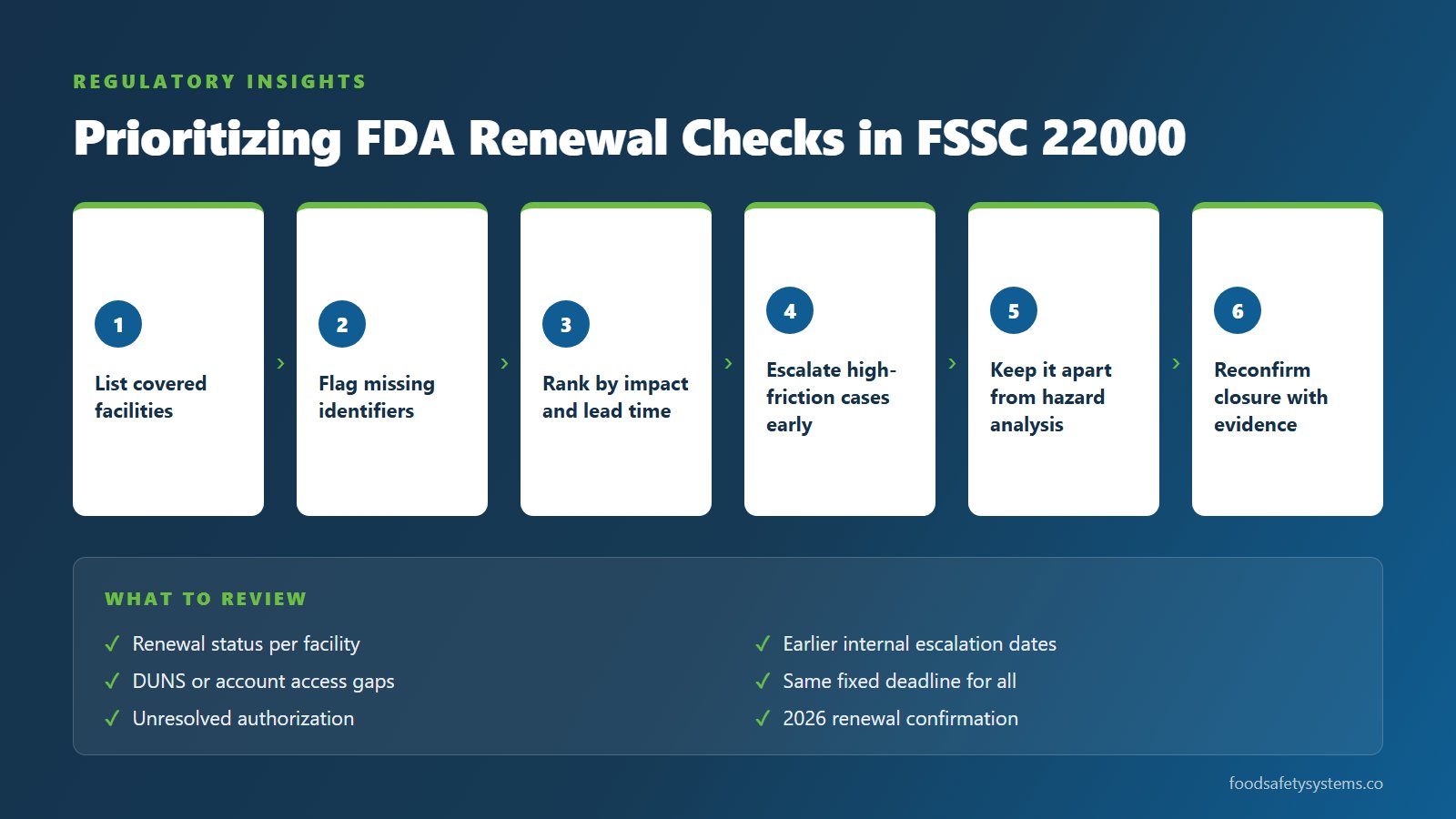
Set earlier escalation dates for high-friction cases
Bring escalation dates forward where access or DUNS problems remain open. Agree who escalates and to whom. See FSSC 22000 internal communication and escalation.
Keep it separate from hazard analysis
This ranking is an administrative compliance method. It is not a substitute for the product hazard assessment your FSMS requires. See conduct a hazard analysis.
Reconfirm closure with objective renewal evidence
Close a check only when the 2026 renewal confirmation is on file. A status note or an old update is not enough. See FSSC 22000 verification of records.
FDA renewal checks checklist
- Maintain a list of covered facilities and renewal status.
- Flag records with missing identifiers or unresolved authorization.
- Set earlier escalation dates for high-friction cases.
- Reconfirm closure with objective renewal evidence before December 31, 2026.
Frequently asked questions
Does a low-priority facility get more time to renew?
No. The deadline is fixed for every covered facility. Prioritization only decides where your team looks first.
Is this the same as the FSSC 22000 hazard analysis?
No. It ranks administrative follow-up. Food safety hazards are still assessed through your FSMS hazard analysis.
What counts as objective renewal evidence?
The confirmation that the 2026 renewal was completed, kept as a controlled record and clearly separate from earlier updates.
How Consultare Inc. Group can help
Consultare Inc. Group supports FSSC 22000 systems, compliance registers, management review and continuous improvement. We can help you find gaps, organize records and coordinate regulatory readiness before the December 31, 2026 deadline. Services are tailored to the agreed scope.
- FSSC 22000 and FDA compliance integration: compliance registers linked to your FSMS.
- Post-certification compliance management: ongoing monitoring of obligations.
- Corrective action support: close gaps with evidence.
Need help managing your FSSC 22000 responsibilities?
Discuss your products, process, records, risks and next steps with our team. Contact us or book a free consultation.
Prefer to organize your compliance activities yourself? Create a free SystemsBuilder account to structure regulatory deadlines, registration records and corrective actions.
Regulatory sources: FDA Biennial Registration Renewal User Guide, FDA 2026 renewal reminder, 21 U.S.C. § 350d and 21 CFR Part 1, Subpart H. Technical source: FSSC 22000. This article is educational and is not legal advice; registration requirements and exemptions depend on your facility’s operations. Food Safety Systems is an independent consultancy and is not affiliated with the FSSC 22000 Foundation or FDA.