
Quick answer: Food safety culture in manufacturing shows in what people do on every shift, not in a poster or a policy. Leaders set objectives and provide resources. Employees receive role-specific training and can report problems without fear. The site then measures observable practices and acts on the results.
A food safety management system depends on more than written procedures. Employees need to understand why controls matter, and leaders must fund the resources to run them. In addition, problems must be reported and fixed without delay. For manufacturers pursuing retail customers, a strong culture supports consistent execution across shifts, products and sites. Treat it as an operational discipline, not a slogan or a one-time training event.
FSSC 22000 makes this explicit. Version 7 of the scheme, published by the FSSC 22000 Foundation in May 2026, asks senior management to set food safety and quality culture objectives. These objectives are supported by a documented plan with targets and timelines, and the plan feeds management review. It covers communication, training, employee feedback and engagement, and performance measurement. Check fssc.com and your certification body for the version and transition timing that apply to your audit.
This guide is for plant managers, FSMS coordinators, training leads and manufacturers preparing to supply large retailers such as Costco. For the foundations, see our page on establishing and maintaining a food safety culture.
Six steps to build food safety culture in manufacturing
Show leadership commitment
Senior management should define food safety responsibilities and provide adequate resources. Leaders should also set measurable objectives and review performance against them. Most importantly, they model the rules themselves, including hygiene, visitor, reporting and escalation rules. See food safety and quality objectives.
Act on management review
Management review should consider audit results, deviations, complaints and training effectiveness. Staffing, maintenance needs and recurring hazards belong on the agenda too. Assign an accountable owner to each action and track it through closure. See management review procedures.
Train for each role and verify competence
Training should reflect each employee’s role, language needs, literacy, equipment and exposure to hazards. For example, a production operator may need hands-on instruction on allergen changeovers. Warehouse staff, by contrast, may need training on temperature control, stock rotation and lot identification. Verify competence through observation, demonstration or questioning, because attendance records alone do not prove that someone can do the task. See training and competence.
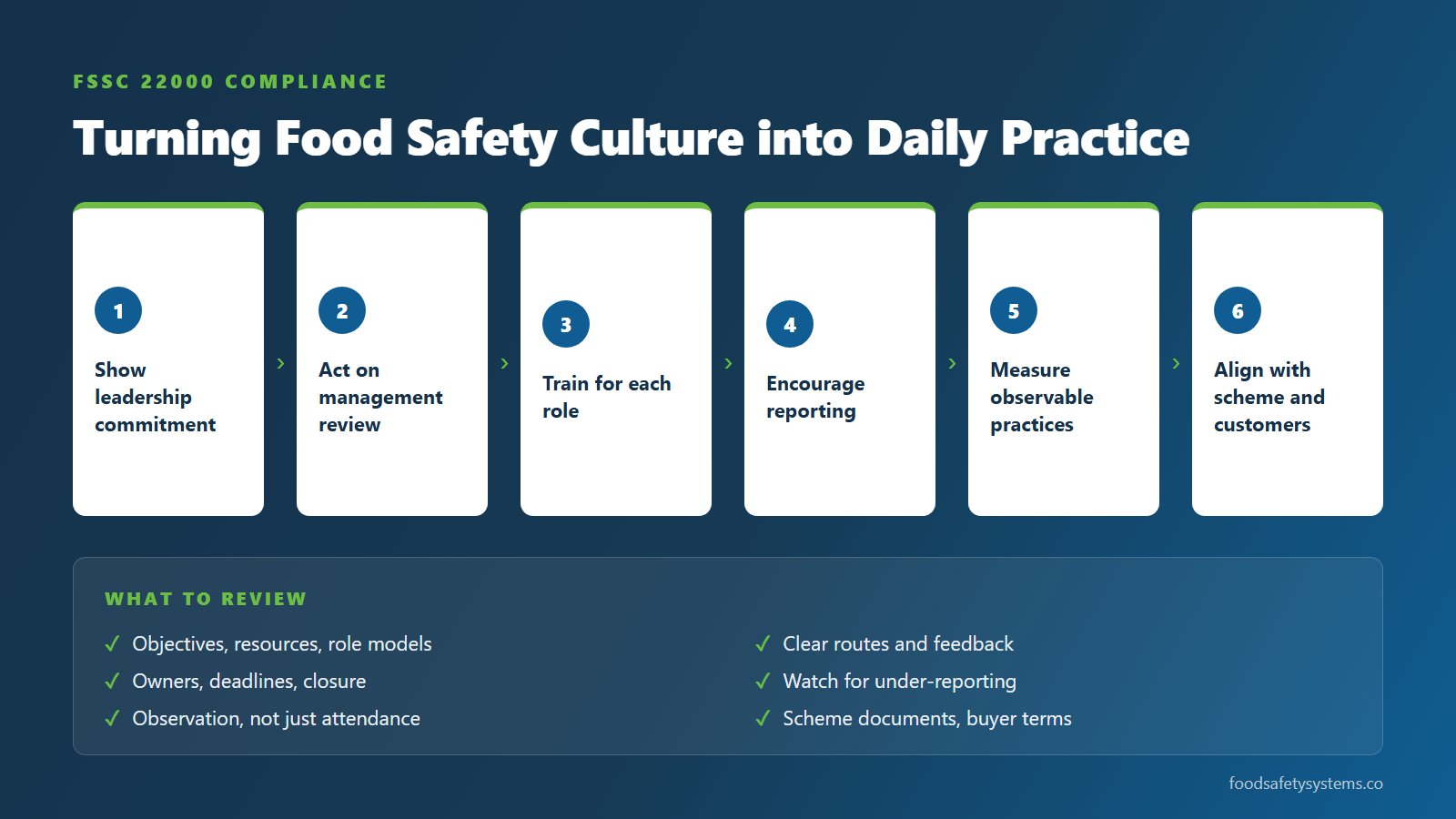
Encourage reporting and escalation
Employees should know how to report damaged packaging, pest evidence and sanitation failures. Incorrect labels, temperature deviations and equipment problems need a clear route as well. Define who receives each report, and give the employee feedback afterwards. Otherwise, a system that discourages reporting can hide problems until they become serious. See food safety communication processes.
Measure culture through observable practices
Useful indicators include training effectiveness, employee reports, repeat deviations and audit findings. Corrective-action closure, hygiene observations and management response times also help. Interpret them carefully, because a low number of reports may reflect under-reporting rather than strong performance. Therefore, combine metrics with interviews, shift observations, internal audits and trend reviews. See internal audits.
Align culture with scheme and customer requirements
Your certification scheme and your customers may both set expectations for food safety culture. Review the current scheme documents and written buyer communications rather than generic claims about what a retailer requires. Culture work should reinforce hazard analysis, preventive controls, sanitation and verification, not replace them. Costco-specific supplier requirements must be confirmed with your Costco buyer; Costco’s vendor inquiries page lists the official contact route.
Food safety culture in manufacturing checklist
- Set clear food safety leadership responsibilities and objectives.
- Provide role-specific training and verify competence.
- Create practical reporting and escalation routes, with feedback to the reporter.
- Track repeat deviations, employee observations and corrective actions.
- Use management review to assign resources and follow up.
- Align culture initiatives with applicable scheme and customer requirements.
Frequently asked questions
Does FSSC 22000 require a food safety culture plan?
Yes. Version 7 requires food safety and quality culture objectives supported by a documented plan with targets and timelines, included in management review. Confirm which scheme version applies to your next audit.
How can a manufacturer measure food safety culture?
Combine observable indicators, such as repeat deviations, reporting trends, corrective-action closure and hygiene observations, with interviews and shift observations. No single number tells the whole story.
Does a strong culture guarantee retailer approval?
No. Retailers set their own supplier requirements, and approval decisions rest with the buyer.
How Consultare Inc. Group can help
Consultare Inc. Group supports food safety culture assessments, role-based training plans, management review systems, internal audit programs, corrective-action workflows and practical improvement roadmaps. Services are tailored to the agreed scope.
- Food Safety Culture Excellence Program: a structured culture assessment and improvement plan.
- Food safety training and education: role-based training with competence checks.
- Corrective action support: root cause and effectiveness for repeat deviations.
Is your food safety culture reflected in daily operations?
Discuss leadership engagement, employee training, reporting practices and performance indicators with our team. Contact us or book a free consultation.
Prefer to organize your compliance activities yourself? Create a free SystemsBuilder account to structure training records, objectives and corrective actions.
Technical sources: FSSC 22000 scheme documents, SQFI: The SQF Code and BRCGS. This article is educational; requirements depend on your products, facility, certification scope and applicable regulations. Food Safety Systems is an independent consultancy and is not affiliated with the FSSC 22000 Foundation, FDA or Costco Wholesale. Costco-specific supplier requirements must be confirmed with the Costco buyer.